

Commentary
Jake Walles
{
  "authors": [
    "Jake Walles"
  ],
  "type": "commentary",
  "blog": "Diwan",
  "centerAffiliationAll": "dc",
  "centers": [
    "Carnegie Endowment for International Peace",
    "Malcolm H. Kerr Carnegie Middle East Center"
  ],
  "collections": [],
  "englishNewsletterAll": "menaTransitions",
  "nonEnglishNewsletterAll": "",
  "primaryCenter": "Malcolm H. Kerr Carnegie Middle East Center",
  "programAffiliation": "MEP",
  "programs": [
    "Middle East"
  ],
  "projects": [],
  "regions": [
    "Middle East",
    "Israel",
    "Palestine",
    "Levant",
    "North America",
    "United States"
  ],
  "topics": [
    "Political Reform"
  ]
}
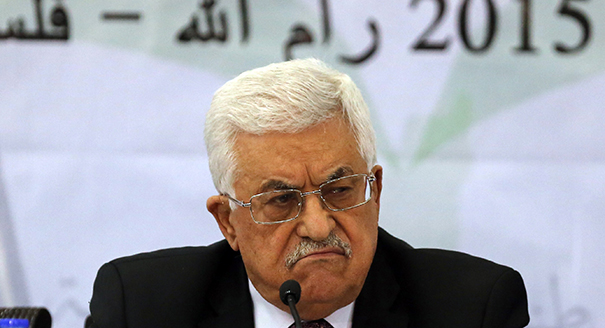
Source: Getty
In Ramallah, the Palestinian Authority has low regard for Donald Trump and is simply waiting for better times.
I recently returned from a visit to Ramallah, where I had the opportunity to meet with a wide range of Palestinians, including senior officials in the Palestinian Authority (PA). As a visitor from Washington, I had expected to be peppered with questions about the “deal of the century,” the peace plan that President Donald Trump and his team may make public after Israel’s parliamentary elections on April 9. To my surprise, my interlocutors showed almost no interest in that. They asked few questions about what might be in the plan or how it would be rolled out.
Those I met, however, had many questions about American politics. What role will the new Congress play in foreign policy? What is the impact of the investigations into Trump’s activities? How is the 2020 presidential election shaping up? My distinct conclusion from these interactions was that the Palestinian leadership had essentially given up on the Trump administration and had no expectation that the prospective peace deal would bring anything positive for them.
The Palestinian leadership in Ramallah has a low regard for Trump and believes he is being guided on the Palestinian-Israeli issue by a group of advisors who espouse views that are aligned with the Israeli right. Officials in Ramallah seemed resigned to saying “no” to whatever they were presented by Trump’s team, preferring to wait until there was a change in Washington’s approach before reengaging in a meaningful way with the U.S. administration.
The Palestinians also indicated that they were closely following the election campaign now underway in Israel. As they have before, they hoped that the election would produce a government more favorable to a negotiated two-state solution. Having been disappointed in the past, the Palestinians were realistic about Israeli politics, but they did seem prepared to make a fresh start with a different government if given the opportunity to do so.
Beyond this strategy of waiting for political change in the United States and Israel, those with whom I spoke also indicated that they remained determined to maintain stability in the West Bank and preserve those elements of the current situation that they perceived to be in their interest—the governing structure of the Palestinian Authority, the mutual recognition between the Palestine Liberation Organization and Israel, and the objective of a two-state solution. With regard to stability in the West Bank, senior PA officials confirmed that they were continuing their security coordination with Israeli agencies and still maintained some contact for this purpose with the United States through security channels.
With regard to internal Palestinian politics, the leadership in Ramallah was preoccupied while I was there with the selection of a new PA prime minister. Mohammed Shtayyeh was named by President Mahmoud Abbas to the post shortly after my visit. Shtayyeh’s appointment represents the determination of Abbas and Fatah to solidify their control over the PA and foreclose any possibility of a reconciliation with Hamas. The situation in Gaza is being watched closely, but my sense was that the leadership in the West Bank was focused on its own problems and willing to let Hamas and Israel contend with each other in the territory.
The subject of new elections to the Palestinian Legislative Council (PLC), which attracted much attention a few months back, seemed to have faded from view. Palestinian officials continued in principle to support the idea of holding PLC elections, but they noted the potential problems posed by Hamas to voting in Gaza and by Israel to voting in East Jerusalem. They seemed prepared to proceed in the face of Hamas objections, but all were adamant that PLC elections could not be held unless Israel allowed voting to take place in East Jerusalem on the same basis as during past elections. Palestinians understood that this issue would have to wait until after the Israeli elections took place and a new Israeli government was formed.
The mood in Ramallah underscores the difficulty the Trump administration will face when it moves forward with its effort to promote its peace deal. Even if the administration secures a conditional “yes” from the Israeli side and some general expressions of support from Arab states, the Palestinians seem determined to respond with a firm “no.” Trump’s team is certainly aware that the Palestinians may react in this way, but they are proceeding anyway.
This reinforces the view that the administration is less interested in initiating a negotiating process or resolving the Palestinian-Israeli conflict than in reframing the terms of the debate for the future. They appear to be seeking to replace the internationally accepted goal of a two-state solution with one of limited autonomy for the Palestinians within an enlarged Israeli state. Recent remarks by the U.S. ambassador to Israel, David Friedman, in which he mentioned autonomy in comments about the peace plan support this view.
For the Palestinian leadership, the available options are not good. They have chosen to hunker down, preserving what authority they have in the West Bank, upholding stability as best they can, and waiting for better days. While this is not an approach that inspires much hope, it may be the only plausible strategy available to them under the difficult circumstances they face today.
In such a situation, the Palestinians would be wise to reinforce their contacts in the Arab world, in Europe, and also among those in the United States who view the Trump administration’s approach as misguided and likely to do more harm than good to the prospect of a negotiated settlement between Israel and Palestinians.

Former Nonresident Senior Fellow, Middle East Program
Jake Walles was a nonresident senior fellow in the Middle East Program at the Carnegie Endowment for International Peace, where he focuses on Israeli-Palestinian issues, Tunisia, and counterterrorism.
Recent Work
Jake Walles
Jake Walles
Carnegie does not take institutional positions on public policy issues; the views represented herein are those of the author(s) and do not necessarily reflect the views of Carnegie, its staff, or its trustees.
While armed forces commander Rudolph Haykal’s caution is understandable, he is in a position to act, and must.

Michael Young
In an interview, Hamidreza Azizi discusses how Tehran has adapted in real time to the conflict with the United States and Israel.
Michael Young
The simple conclusion is that the scheme will bring neither peace nor prosperity, but will institutionalize devastation.

Nathan J. Brown
The Jamaa al-Islamiyya is the local Lebanese dimension of a broader struggle involving rival regional powers.
Issam Kayssi
In an interview, Roger Diwan discusses where the global economy may be going in the third week of the U.S.-Israeli war with Iran.
Nur Arafeh