

Commentary
Azeema Cheema, Mohanad Hage Ali
{
  "authors": [
    "Mohanad Hage Ali"
  ],
  "type": "commentary",
  "blog": "Diwan",
  "centerAffiliationAll": "dc",
  "centers": [
    "Carnegie Endowment for International Peace",
    "Malcolm H. Kerr Carnegie Middle East Center"
  ],
  "collections": [],
  "englishNewsletterAll": "menaTransitions",
  "nonEnglishNewsletterAll": "",
  "primaryCenter": "Malcolm H. Kerr Carnegie Middle East Center",
  "programAffiliation": "MEP",
  "programs": [
    "Middle East"
  ],
  "projects": [],
  "regions": [
    "Türkiye",
    "Levant",
    "Syria",
    "Middle East"
  ],
  "topics": [
    "Political Reform"
  ]
}
Source: Getty
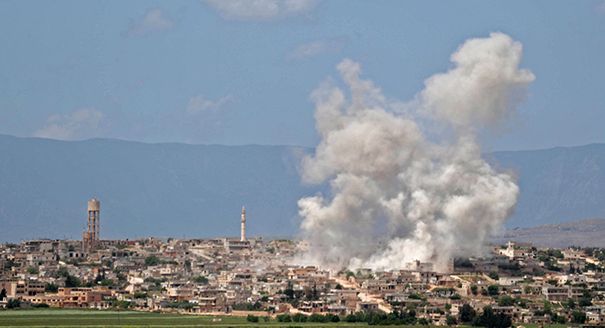
As Turkey prepares to move eastward in Syria, it is facing a growing number of difficulties.
Turkey is poised to expand its “safe zone” in northern Syria toward regions eastward controlled by the Kurdish-dominated Syrian Democratic Forces (SDF). With this goal in sight, Ankara will seek to contain Kurds affiliated with the Kurdistan Workers Party, which Ankara considers a terrorist organization, who are fighting under the banner of the SDF.
Turkey is setting high expectations. Recently, Turkish President Recep Tayyib Erdoğan claimed that this expansion would allow for the return home of 4 million Syrian refugees currently residing in Turkey. However, such a swift return is unlikely given the security challenges in the Turkish-dominated region. Failure to fulfill his promises could cost Erdogan politically, as the Turkish leader has faced more organized domestic political opposition recently.
Once it takes place, the move east would represent Turkey’s third military expansion inside Syria—following the Euphrates Shield Operation that began in August 2016 and the Olive Branch Operation that started in January 2018. Expanding the areas under Turkish military control is now officially Ankara’s policy. Turkey has pursued this through a series of understandings with Russia on the one hand, and the United States on the other. For Russia and the Syrian regime, Turkish advances have been characterized by land swaps. This process began with the Olive Branch operation, when Turkey’s takeover of Afrin was accompanied by a Syrian military advance toward the former Hijaz railway in Aleppo Governorate. These swaps have not introduced any procedure for withdrawals, so that each side has been left on its respective battlefield.
Now, it appears that such an arrangement is being replicated. A Turkish-led expansion into Manbij and Tal Rif‘at would see Russian-backed regime forces storm into opposition-controlled territories in Hama and Aleppo Governorates. The details have not been disclosed. However, the Guardian quoted two “senior diplomats” referring to such a quid pro quo, which would see a “limited campaign that gives Russian and Syrian forces a foothold in Idlib, in return for allowing Turkey to deepen its current zone of control further to the east.”
Expanding the Turkish zone is one thing, but keeping it secure is another. There are two main challenges to stability in the Turkish-dominated zone. The first is the internal divisions and violence among the various militant groups. These are often the result of their coming from different areas of origin, tribal rivalries, or competition over resources. The Euphrates Shield area, which is approximately 2,000 square kilometers, has turned into a melting pot for communities from Homs, Damascus, and Aleppo, among other places, as the vast majority of the zone’s population is made up of refugees. These refugees live in communal clusters, often under the protection of armed groups whose members fled with them. These groups frequently clash with other groups.
Bombings and firefights are now recurrent in Turkish-controlled areas, which are home to a diverse mix of Turkmen, Arab, and Kurdish communities. Under the umbrella of a so-called “Syrian National Army,” the Turkish authorities have been trying for the past year and a half to build a more coherent force and contain the large number of militias operating in the region. Their divisions can at any time escalate into a wider communal conflict. This occurred last January, when members of Ahrar al-Sharqiyyeh, a militant group whose members hail from Deir Ezzor, killed a Damascene merchant. It quickly led to fighting between the group, and Jaish al-Islam, which in Afrin has claimed to be a protector of refugees from the region of Damascus. Such disarray deprives Ankara of the tools needed to implement a coherent security strategy in the region, one that accompanies its efforts to provide services and an economic framework for the areas under its control.
A second challenge is the growing insurgency in the region, specifically in the Kurdish zones. Kurdish insurgents, often operating under the name of the Afrin Freedom Movement, have launched attacks against Turkish forces deployed in Kurdish areas. Earlier this month they attacked a Turkish military vehicle, killing a soldier and injuring five others. Such attacks have become recurrent. Adding to Turkey’s trouble is the lack of organization among pro-Turkish militias, who often respond to attacks by targeting Kurdish civilians, which further alienates the population.
In parallel to its military efforts, Turkey has been pursuing a holistic cultural and economic policy, further Turkifying the region. Turkish is now taught in schools, alongside Arabic and English, while Turkish post office branches and hospitals, often staffed by Turkish doctors, have been opened across the region. This underlines Ankara’s long-term commitment to maintaining its presence in northern Syria.
As Turkey prepares to widen its “safe zone” again, new challenges will most likely emerge, though not only because of the Kurds. The region’s security void and disarray could potentially create opportunities for other actors—from the Syrian regime to jihadi groups—who are increasingly wary of Turkish policies in Syria and Ankara’s understandings with Russia and the United States.

Deputy Director for Research, Malcolm H. Kerr Carnegie Middle East Center
Mohanad Hage Ali is the deputy director for research at the Malcolm H. Kerr Carnegie Middle East Center.
Recent Work

Azeema Cheema, Mohanad Hage Ali
Mohanad Hage Ali
Carnegie does not take institutional positions on public policy issues; the views represented herein are those of the author(s) and do not necessarily reflect the views of Carnegie, its staff, or its trustees.

As the U.S. stumbles in its war with Iran, we are likely to see an acceleration of its disengagement from the region.

Michael Young
The Zaidi government’s objective to collect weapons is constrained by regional conflict, but it can take certain measures at home.
Ali Al-Mawlawi

Huawei pushed hard to enter the Egyptian data centers market, until the Americans made a better offer.

Angie Omar

The accord represents a pivotal moment in the region to avert a security vacuum in the Gulf.
Azeema Cheema, Mohanad Hage Ali

In an interview, Jason Burke discusses his sweeping account of the “revolutionists” who so shaped the 1970s and early 1980s.
Michael Young