

Article
Dalia Ghanem
{
  "authors": [
    "Dalia Ghanem"
  ],
  "type": "commentary",
  "blog": "Diwan",
  "centerAffiliationAll": "dc",
  "centers": [
    "Carnegie Endowment for International Peace",
    "Malcolm H. Kerr Carnegie Middle East Center"
  ],
  "collections": [
    "Civil-Military Relations in Arab States",
    "Arab Spring 2.0"
  ],
  "englishNewsletterAll": "menaTransitions",
  "nonEnglishNewsletterAll": "",
  "primaryCenter": "Malcolm H. Kerr Carnegie Middle East Center",
  "programAffiliation": "MEP",
  "programs": [
    "Middle East"
  ],
  "projects": [],
  "regions": [
    "Maghreb",
    "North Africa",
    "Algeria"
  ],
  "topics": [
    "Political Reform"
  ]
}
Source: Getty
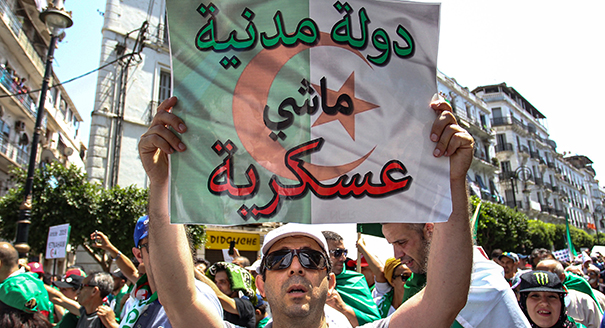
For the Algerian People’s National Army, the priority is to defend the political order and its prerogatives in it.
After seven months of protests in Algeria, the country’s military leadership appears to be taking control of the political transition that began in February 2019, when widespread demonstrations forced president Abdelaziz Bouteflika to step down. The People’s National Army (PNA) is defending the political order established in 1962, and is capitalizing on the current situation and the new power configuration to regain the role it had lost under the former president.
The PNA will most likely continue to act behind a façade of constitutionalism and pluralism while maintaining its hold on power. This it has previously done by permitting managed change in Algeria that ensures that very little changes. Its actions are helped by the fact that the constitution grants special status to the PNA. By being responsible for the “safeguarding of national independence” and for “the defense of national sovereignty, unity, and territorial integrity,” the military effectively has a blank check to intervene in politics.
The protests against Bouteflika placed the military at the center of Algerian politics again, but at a time when the army was unwilling to overstate its political ambitions. For this reason, it is conceivable that the chief of staff of the army, General Ahmad Gaïd Salah, may be pushed aside by the military. The reason is that he has been in the limelight since last February when the protests against Bouteflika began, and public resentment has turned against him. The PNA may feel that it is better at this stage to remove Salah and in that way ensure that the military does not pay a price for his unpopularity.
Also, the PNA has to respond to the demand of many Algerians for a new constitution. It is improbable that it will accept such a thing, but the military might agree to amend the existing constitution. Whichever option it supports, the PNA will ensure that it retains enough constitutional power so that the presidency and parliament will not represent a danger to its authority and the military can continue to benefit from the prerogatives it has retained until now.
Ultimately what matters most for the military is the preservation of its material interests, meaning its budget allocations, and the autonomy of military academies, doctrine, reforms, and modernization. The military’s autonomy translates, further, into asserting its exclusive right over the defense budget while retaining its political role in overseeing strategic affairs and guaranteeing its legal immunity for any past or future actions.
However, Algeria’s looming economic crisis and widespread socioeconomic discontent are the military’s Achilles heel. Algeria relies on oil rents and the authorities have had to face a drop in oil prices since 2014, forcing them to cut spending. Even if oil prices have risen since then, the government has estimated that it needs an oil price of $116 per barrel in order to balance its budget. Algeria’s fiscal challenges are significant and the most alarming trend the country has faced is the decline of foreign exchange reserves from $193.6 billion in 2014 to $72 billion in 2019. In a country that imports 70 percent of what it consumes, the current reserves only cover thirteen months of imports. If the state can no longer deliver goods and services, socioeconomic discontent will rise further.
That is what happened at the end of the 1980s. At that time the economic situation exacerbated political instability. In order to avoid such a situation today, the state and its citizens will have to renegotiate their relationship. In the past the state provided and Algerians abided. This is no longer economically feasible today, nor is it what Algerians appear to want as they seek more transparency, less corruption, and better governance of Algeria’s resources.
The PNA is uneager to take ownership of Algeria’s economic difficulties. That is why in the period ahead it is likely to place management of economic affairs in the hands of civilians, while retaining its oversight role. A technocratic government would allow civilians to run daily affairs while the military could focus on more strategic issues, including formulating national security policy and retaining veto power over decisions with which it is unhappy.
The army also needs to maintain its relevance with a population that has been asking for a civilian state, not a military one, and retain its legitimacy internally and externally. This could oblige the PNA to allow for a less controlled transition in the comings months. The military could decide to return to its barracks and permit an elected government to face demands for democracy and reform, while exerting pressure to push for specific policies if need be.
This the military has done before, during the mid-1980s. At the time the National Liberation Front government liberalized the economy in a selective and controlled way under the military’s tutelage. The PNA had reservations about certain economic reforms it deemed too liberal and which would have threatened its vested interests and those of its cronies. That is why the military agreed to support a third term for then-president Chadli Bendjedid, on condition that he appoint Kasdi Merbah as prime minister. Merbah was close to the military establishment, which at the time supported the statist policies of the late president Houari Boumedienne. In doing so, the military showed its capacity to coopt political actors to advance its own interests. The military is likely to replicate such an approach today, shaping the economic direction of the country without being held directly responsible for the discontent that may arise.
At present Algeria is being led by an interim president who has no legitimacy, parliament is weak, and political parties are discredited. Therefore, it is nearly impossible to prevent the PNA from affirming its role as national guardian. That is why in the coming months it is unlikely that any other national institution will be in a position to challenge the military’s authority. However, even if this is true the military’s instinct, in light of the seriousness of the crisis today, is to go back to the time-tested approach of remaining politically influential, but from behind the scenes.
While there may be different factions within the military, the PNA will not allow such divisions to threaten its interests and hold on power. For now the military is not prepared to accept the principle of civilian oversight of the armed forces. This will represent a continued source of tension, however, as it will fail to satisfy the large number of Algerians who want to see real change in their system.
Former Senior Resident Scholar, Malcolm H. Kerr Carnegie Middle East Center
Dalia Ghanem was a senior resident scholar at the Malcolm H. Kerr Carnegie Middle East Center in Beirut, where her research focuses on Algeria’s political, economic, social, and security developments. Her research also examines political violence, radicalization, civil-military relationships, transborder dynamics, and gender.
Recent Work
Dalia Ghanem


Frances Z. Brown, Judy Dempsey, Dalia Ghanem, …
Carnegie does not take institutional positions on public policy issues; the views represented herein are those of the author(s) and do not necessarily reflect the views of Carnegie, its staff, or its trustees.
This will be the region’s most representative tournament, amid broad changes in its footballing landscape.

Issam Kayssi
The recent African Cup of Nations tournament in Morocco touched on issues that largely transcended the sport.

Issam Kayssi, Yasmine Zarhloule

Mustaqbal Misr has expanded its portfolio with remarkable speed, but a lack of transparency remains.

Yezid Sayigh
The burden of environmental degradation is felt not only through physical labor but also emotional and social loss.
Yasmine Zarhloule, Ella Williams
The country’s youthful protest movement is seeking economic improvement, social justice, and just a little hope.
Yasmine Zarhloule