

Commentary
Michael Young
{
  "authors": [
    "Michael Young"
  ],
  "type": "commentary",
  "blog": "Diwan",
  "centerAffiliationAll": "dc",
  "centers": [
    "Carnegie Endowment for International Peace",
    "Malcolm H. Kerr Carnegie Middle East Center"
  ],
  "collections": [
    "Reaction Shot"
  ],
  "englishNewsletterAll": "menaTransitions",
  "nonEnglishNewsletterAll": "",
  "primaryCenter": "Malcolm H. Kerr Carnegie Middle East Center",
  "programAffiliation": "MEP",
  "programs": [
    "Middle East"
  ],
  "projects": [],
  "regions": [
    "Levant",
    "Palestine",
    "Middle East",
    "North America",
    "United States"
  ],
  "topics": []
}
Source: Getty
Spot analysis from Carnegie scholars on events relating to the Middle East and North Africa
What Happened?
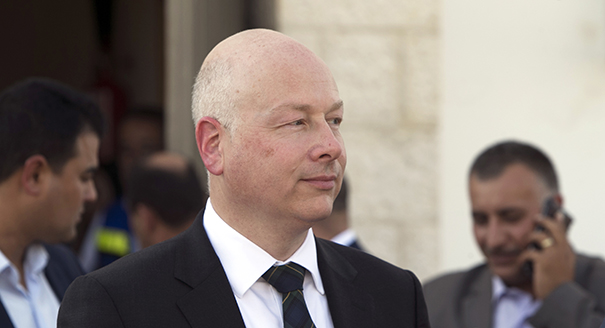
The Trump administration’s special representative for international negotiations, Jason Greenblatt, has resigned. He was one of a trio of individuals, along with President Donald Trump’s son in law Jared Kushner and U.S. Ambassador to Israel David Friedman, tasked with formulating a peace plan to resolve the conflict between Israelis and Palestinians. The plan has yet to be released, and media reports suggest that Greenblatt may stay on at his post until that happens, if it happens, after Israel’s elections on September 17.
Why Does it Matter?
It matters because it doesn’t really matter. Greenblatt’s departure is unlikely to affect the fate of the U.S. peace plan, because from what we know of such a plan it will never be accepted by Palestinians. Greenblatt’s exit simply confirms that expectations about the plan’s succeeding have hit rock bottom.
However, in many ways Greenblatt’s stepping down was also revealing. One can speculate that he left because his mission was completed. Long a supporter of Israel’s settlement policies, and of the policies of Israeli Prime Minister Benjamin Netanyahu, he and his two colleagues, Kushner and Friedman, presided over a decisive shift in Washington’s tilt toward Israel in its conflict with the Palestinians.
The United States no longer considers a two-state solution as the basis for a settlement. It has recognized Jerusalem as Israel’s capital and has closed down the Palestine Liberation Organization’s representative offices in Washington and the U.S. Consulate General in Jerusalem, which worked with Palestinians. It has also cut funding to the United Nations Relief and Works Agency, which assists Palestinian refugees, as well as to other Palestinian institutions and programs.
By adopting such measures, the Trump administration has effectively anchored its new approach in Washington’s future behavior. This makes it virtually impossible for upcoming administrations to retreat from the positions taken.
In other words speculation about the fate of the U.S. peace plan may be irrelevant. The plan may have only been a smokescreen to adopt a strongly pro-Israel, pro-Netanyahu attitude in negotiations, and permanently undermine a two-state solution that would have required Israel to give up the land it occupied in the West Bank in June 1967.
What Are the Implications for the Future?
By helping to push for a harder line on the Palestinians, Greenblatt struck a critical blow against the framework for negotiations that had prevailed for decades. However, as many Palestinians watch their principal demands—on a state, Jerusalem, and refugees—undermined by the Trump administration, the risk is that they will conclude that since negotiations brought them nothing, perhaps violence can.
There has been speculation the administration may also recognize Israeli annexation of large parts of the West Bank, after having done so the occupied Golan Heights. This would be the final nail in the coffin of any negotiated solution. Ironically, Greenblatt, by backing the Israeli position so strongly, may have contributed to pushing Israel into an irresolvable dilemma. The Palestinians won’t disappear and in the decades ahead Israel will struggle with what to do with them. None of the potential options are likely to be good for the Israelis. Perhaps Greenblatt showed the dangers of loving too much.

Editor, Diwan, Senior Editor, Malcolm H. Kerr Carnegie Middle East Center
Michael Young is the editor of Diwan and a senior editor at the Malcolm H. Kerr Carnegie Middle East Center.
Recent Work
Michael Young
Michael Young
Carnegie does not take institutional positions on public policy issues; the views represented herein are those of the author(s) and do not necessarily reflect the views of Carnegie, its staff, or its trustees.

As the U.S. stumbles in its war with Iran, we are likely to see an acceleration of its disengagement from the region.
Michael Young
The Zaidi government’s objective to collect weapons is constrained by regional conflict, but it can take certain measures at home.
Ali Al-Mawlawi

Huawei pushed hard to enter the Egyptian data centers market, until the Americans made a better offer.

Angie Omar

Middle Eastern states should welcome an accelerated U.S. disengagement from their region.
Michael Young

In an interview, former ambassador Charles Freeman assesses the Trump administration’s war against Iran.
Michael Young