

Commentary
Joseph Bahout
{
  "authors": [
    "Joseph Bahout"
  ],
  "type": "commentary",
  "blog": "Diwan",
  "centerAffiliationAll": "dc",
  "centers": [
    "Carnegie Endowment for International Peace",
    "Malcolm H. Kerr Carnegie Middle East Center"
  ],
  "collections": [
    "Reaction Shot"
  ],
  "englishNewsletterAll": "menaTransitions",
  "nonEnglishNewsletterAll": "",
  "primaryCenter": "Carnegie Endowment for International Peace",
  "programAffiliation": "MEP",
  "programs": [
    "Middle East"
  ],
  "projects": [],
  "regions": [
    "North America",
    "United States",
    "Middle East",
    "Türkiye",
    "Syria",
    "Levant"
  ],
  "topics": [
    "Political Reform"
  ]
}
Source: Getty
Spot analysis from Carnegie scholars on events relating to the Middle East and North Africa
What Happened?
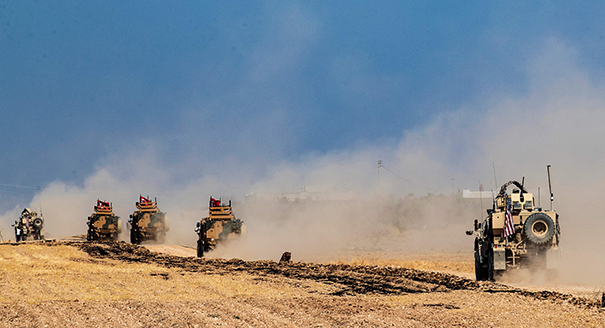
On Monday, President Donald Trump announced that he would be reducing the number of U.S. forces in the border area with Turkey, effectively making way for a Turkish incursion into northern and northeastern Syria. For now, two U.S. outposts, in Tell Abyad and Ras al-‘Ain, have been dismantled and Turkey has timidly begun entering some border areas.
This is not the first time the president has made such a sudden announcement regarding Syria. Last December, in a tweet, he also announced the imminent withdrawal of U.S. forces, taking his coalition partners and many others aback. That announcement was never implemented, but this time it might be more serious given Trump’s domestic problems and Turkish President Recep Tayyip Erdoğan’s need to act. The Turks seek to establish a safe zone in Syria in which they can resettle over a million of the Syrian refugees now in Turkey, whose presence is provoking domestic discontent.
Why Does It Matter?
A Turkish offensive in northeastern Syria would threaten the fragile equilibrium in the area, which was established after the defat of the Islamic State. It would also mean that the Kurdish Democratic Union Party (PYD) and its military arm, the People’s Protection Units (YPG), as well as the alliance they dominate, the Syrian Democratic Forces, would face the threat of being swept away after having been used by the West in the fight against the Islamic State.
Turkey’s establishment of a security zone in Syria will further dismember the country into spheres of influence. If Erdoğan transfers Syrian refugees there, this will also plant the seeds of a future Arab-Kurdish civil war. In that case we should expect the Assad regime and its backers to try to exploit the situation and push their advantage in the area. This means that the likelihood of clashes between Turkey and the Syrian regime may rise inexorably.
What Are the Implications for the Future?
We must first see if the U.S. decision is serious and what the depth of a Turkish incursion will be. The reaction of the Syrian regime, but also that of Iran and Russia, will be essential. We should expect a war of attrition, especially if the PYD-YPG collaborates with the Assad regime, which will aim to create a quagmire for Turkey. Turkish-Kurdish fighting may also facilitate a return to some areas of the Islamic State, at least in the form of smaller cells.
We could also be witnessing the unraveling of the agreements reached over Idlib, the last remaining bastion of the Syrian opposition. This may lead to a clearer Russian green light for the Syrian regime to reconquer the governorate, as a quid pro quo for Turkey’s moves in the northeast. However, Russia is also keen to preserve the Astana format and will be cautious not to antagonize Turkey or allow an Iranian-Turkish confrontation, which neither country wants anyway.
On the political front, the developments in northeastern Syria ultimately give Russia greater leverage and place it more firmly in the center of the Syrian game. At a time when a “political process” for Syria is under way, and with the Syrian presidential election nearing, this would represent a substantial gain for Moscow.
Last but not least, if Trump’s remarks about a U.S. drawdown in Syria are implemented, we should watch Israel carefully. It might well be tempted to create its own buffer zone in the south of Syria, thereby keeping Iran and its allies at a distance from the Golan Heights.
Former Nonresident Fellow, Middle East Program
Joseph Bahout was a nonresident fellow in Carnegie’s Middle East Program. His research focuses on political developments in Lebanon and Syria, regional spillover from the Syrian crisis, and identity politics across the region.
Recent Work
Joseph Bahout
Joseph Bahout
Carnegie does not take institutional positions on public policy issues; the views represented herein are those of the author(s) and do not necessarily reflect the views of Carnegie, its staff, or its trustees.
Reconciliation councils are emerging throughout the country to mediate in intracommunal disputes, many from the war years.
Natacha Danon

In an interview, Rozina Ali discusses her new book on the rise and manifestations of Islamophobia in the United States.

Michael Young
As the U.S.-led Coalition withdraws, the Kurds’ reliance on Baghdad, and on themselves, will only increase.
Wladimir van Wilgenburg

In an interview, Ian Lustick and Eli Clifton discuss their new book on why a prominent ally has so much influence in America.
Michael Young

As the U.S. stumbles in its war with Iran, we are likely to see an acceleration of its disengagement from the region.
Michael Young