

Commentary
H. A. Hellyer
{
  "authors": [
    "H. A. Hellyer"
  ],
  "type": "commentary",
  "blog": "Diwan",
  "centerAffiliationAll": "dc",
  "centers": [
    "Carnegie Endowment for International Peace",
    "Malcolm H. Kerr Carnegie Middle East Center"
  ],
  "collections": [],
  "englishNewsletterAll": "menaTransitions",
  "nonEnglishNewsletterAll": "",
  "primaryCenter": "Malcolm H. Kerr Carnegie Middle East Center",
  "programAffiliation": "MEP",
  "programs": [
    "Middle East"
  ],
  "projects": [],
  "regions": [
    "North America",
    "United States",
    "Middle East",
    "North Africa"
  ],
  "topics": []
}
Source: Getty
Measures against Arabs and Muslims mean they cannot share their insights on a region the West considers vital.
As analysts, journalists, and academics of the Arab world move between the West and the wider Arab world, they often face an interesting predicament. Within the Arab world they find it difficult to benefit from their expertise, which can often lead to a critical attitude toward authoritarian regimes, for whom too much knowledge represents a potential threat to the official positions they impose. However, when they travel to the West—at least those individuals with origins in the Arab world—they may face old-fashioned bigotry. This uneasy interplay between knowledge and prejudice has real consequences for Western countries.
I’m a British analyst of mixed race—of white English ancestry and different Arab heritages. I suspect that’s what led to my being stopped at London’s Heathrow airport last month by a particularly zealous police officer of the U.K. Border Force. He felt I had a chip on my shoulder because I pointed out how unsurprising it was that I, as a non-white looking person with a beard, had been stopped. That felt even more appropriate when I pointed out that no white-looking people were being questioned, exasperating the officer in the process. But the issue of racial profiling isn’t down to that officer or any single individual; it’s a structural issue and a system within which officers such as the one who stopped me operate.
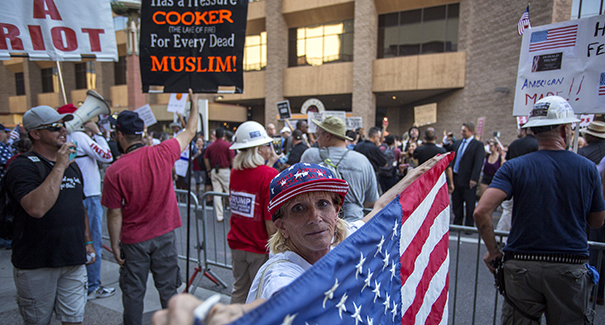
That kind of structural bigotry exists in abundance. I don’t personally get the worst of it as for reasons of education, gender, socioeconomic background, and nationality, I’m deeply privileged. But I often see such bigotry against Arabs, Muslims, or others from the Arab world, and it hinders access to those who can provide context and knowledge of a region that many Westerners regard as a threat to them. It means reductions in visas, public condemnation of these populations by Western populists, and an impulse to view countries of the Arab world without any nuance, as inevitably violent and “different.”
Some of that bigotry is plain in the mainstream press, with influential commentators such as Bret Stephens writing about the “disease of the Arab mind” in the Wall Street Journal. His was such a blatantly racist phrase. And yet, rather than being penalized, Stephens was given a regular column in the liberal “paper of record,” the New York Times. There are scores of examples when it comes to media, the academic research on which is extensive and includes carefully done work, such as “Fear Inc.” or “The Islamophobia Industry.” It’s not really a question of whether bigotry in media exists when it comes to Arabs and Muslims; it’s more about how it is sustained.
But on the analytical level, there is another aspect to this kind of exceptionalism around Arabs and Muslims. It is how we in the West engage in analysis with regard to Arabs and Muslims—whether in think tanks, academia, or policy circles. Sometimes the bias can be blatant; sometimes it can be unconscious; but it is there, and continues to be under-recognized.
There is, thankfully, a move in many analytical arenas to insist that perspectives from women, rather than just men, be included and engaged with in our discussions of issues of the day. Very often the benefit that accrues from a conscious desire to include such diversity results in a learning experience that is otherwise absent. As such, it is quite valuable in and of itself.
Yet all too often analysis, such as during panels dedicated to the region, will be dominated by experts who have not taken the time to really learn about perspectives rooted in the region, let alone include individuals who can reflect those perspectives. I wouldn’t claim that panels need to necessarily include only people who are from the Arab world when offering views on the region. But it does strike me as absurd when analysis is not rooted in the experiences of those of the region. And it can’t be so when the analysts or academics in question do not endeavor to learn the languages of the peoples they are studying or do not visit those countries for more than scant periods of time every year, or both.*
The implicit claim behind such realities is that the peoples of the region do not merit the same depth of interest that we would demand in reverse. Imagine, for example, the farce of an Egyptian who knows little English and visits the United States a week or so every year pontificating about the intricacies of American politics. But the corresponding reality on the other side is all too common, even when there are some truly excellent Western analysts of the Arab world.
Ironically, in the aftermath of the election of the right-wing populist Donald Trump in the United States, I find myself having to explain less about how peculiar it is that different Arab populations might support or oppose certain political moves. Trump shows that we’re all quite capable of making bad decisions—including those with the highest levels of education in the world.
Yet, the mainstreaming of aspects of bigotry continues, and it indelibly has an impact on our understanding of the Arab world in ways that we don’t always appreciate. Some of us in the West might actually want to bring people from the region to our countries to explain situations on the ground, but are excluded from doing so because our governments impose all sorts of visa restrictions. That goes beyond even the “Muslim ban” we are seeing in the United States, the underlying structural presumptions of which are having a great impact on Arab or Muslim applicants, even those with Western passports, who are unable to explain why they might be excluded.
In other words, those whom we need most to understand the Arab world are often perceived as a threat and strange. Their knowledge ought to be embraced, not turned into an object of suspicion. They are, after all, the ones who have the most skin in the game. In the end, the peoples of the region are the ones living its realities and paying the highest price for authoritarianism and extremism. Their perspectives ought to be amplified, not silenced, by those for whom the Arab world remains largely an abstract concern. When bigotry undermines knowledge, the consequences are negative for everyone.
*The sentence has been modified slightly at the author’s request.
Former Nonresident Scholar, Middle East Program
Dr. H.A. Hellyer was a nonresident scholar at the Carnegie Endowment for International Peace. He serves as a senior associate fellow at the Royal United Services Institute for Defence and Security Studies in London, and as a Cambridge University fellow.
Recent Work
H. A. Hellyer
H. A. Hellyer
Carnegie does not take institutional positions on public policy issues; the views represented herein are those of the author(s) and do not necessarily reflect the views of Carnegie, its staff, or its trustees.

In an interview, Rozina Ali discusses her new book on the rise and manifestations of Islamophobia in the United States.

Michael Young

In an interview, Ian Lustick and Eli Clifton discuss their new book on why a prominent ally has so much influence in America.
Michael Young

As the U.S. stumbles in its war with Iran, we are likely to see an acceleration of its disengagement from the region.
Michael Young

Middle Eastern states should welcome an accelerated U.S. disengagement from their region.
Michael Young

In an interview, former ambassador Charles Freeman assesses the Trump administration’s war against Iran.
Michael Young