

Commentary
Aram Nerguizian
{
  "authors": [
    "Aram Nerguizian"
  ],
  "type": "commentary",
  "blog": "Diwan",
  "centerAffiliationAll": "dc",
  "centers": [
    "Carnegie Endowment for International Peace",
    "Malcolm H. Kerr Carnegie Middle East Center"
  ],
  "collections": [
    "Reaction Shot",
    "Civil-Military Relations in Arab States",
    "Arab Spring 2.0",
    "Decoding Lebanon"
  ],
  "englishNewsletterAll": "menaTransitions",
  "nonEnglishNewsletterAll": "",
  "primaryCenter": "Malcolm H. Kerr Carnegie Middle East Center",
  "programAffiliation": "MEP",
  "programs": [
    "Middle East"
  ],
  "projects": [],
  "regions": [
    "Lebanon",
    "North America",
    "United States",
    "Middle East"
  ],
  "topics": []
}
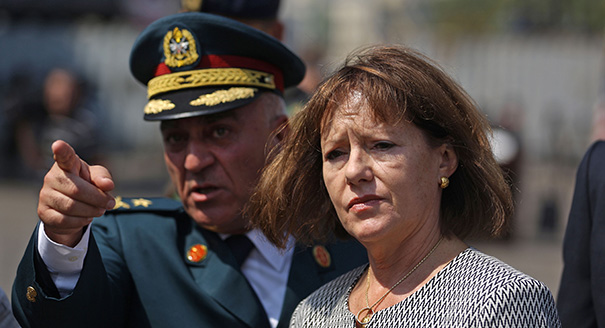
Source: Getty
Spot analysis from Carnegie scholars on events relating to the Middle East and North Africa.
What Happened?
According to Reuters, two United States government officials have reported that the Trump administration would be withholding $105 million in military assistance to Lebanon. The report came two days after the resignation of Lebanese Prime Minister Saad al-Hariri.
Reuters also noted that the State Department informed Congress that it was the White House budget office—presumably the Office of Management and Budget—and the National Security Council that had decided to withhold the assistance. No clarity was provided as to why the aid would be withheld.
Why Does It Matter?
As of November 1, 2019, it is difficult to assess the veracity of the hold in funding described by Reuters. There have been no official statements to date from the U.S. State Department or Defense Department. There is little to no practical indication of a shift in day-to-day interactions between the U.S. and Lebanese militaries.
If there has in fact been a hold on funding, discussions with U.S. government personnel suggest that there does not yet appear to be a hold on U.S. military aid deliveries and training engagements. Furthermore, if State Department funding is affected, as the article suggests, it is unclear if Defense Department funding and programs are also affected.
U.S. security assistance and security cooperation programming is a critical pillar of U.S. policy engagement in Lebanon. Successive U.S. administrations have come to view the Lebanese armed forces as the only institution that should defend Lebanon. To that end, the U.S. government provided more than $2.29 billion in military assistance—include some $800 million in Defense Department funding—to Lebanon in 2005–2019. U.S. military assistance has also been especially important given Lebanon’s chronic underspending when it comes to defense spending tied to acquisition and capital costs.
What Are the Implications for the Future?
Since the beginning of demonstrations across Lebanon on October 17, the U.S. government has gone to some lengths to not appear to interfere in an unprecedented cycle of popular unrest. However, if reports of a hold on some or all future U.S. military aid to Lebanon in the wake of Hariri’s resignation are accurate, they do little more than bolster Hezbollah’s own narrative that foreign actors—chief among them the United States—are seeking to politicize Lebanon’s wave of national protests. It is also important to note that barring official clarification, Lebanon’s Foreign Military Financing (FMF), the fund in the United States from which the U.S. government deducts money to pay for U.S. defense articles and training earmarked for Lebanon, could be on hold for other reasons, including deciding how to prioritize Lebanon’s FMF against other wider FMF objectives.
In the short term, Lebanese senior officers report that Lebanon currently maintains a positive balance in the FMF account. While there does appear to be sufficient funding to sustain planned orders in the pipeline through early 2020, any long-term suspension or hold on funds, combined with the pitfalls of Lebanese defense expenditures, would make it difficult for the armed forces to fund and sustain their current pipeline of U.S.-sourced military orders and deliveries.
The U.S. military assistance program to Lebanon has been sustained over fifteen years and three successive U.S. administrations. This has enabled the post-2005 armed forces to develop into a professional military with systems, capabilities, and standard operating procedures that are modeled on and interoperable with the U.S. military and its partners in the NATO military ecosystem. There is no indication that U.S. policy on military aid to Lebanon is changing. However, to curtail aid at a time when the Lebanese armed forces have proven critical to internal stability would be the equivalent of a foreign policy own-goal for the United States.
Former Senior Advisor, Program on Civil-Military Relations in Arab States, Malcolm H. Kerr Carnegie Middle East Center
Aram Nerguizian was senior advisor of the Program on Civil-Military Relations in Arab States at the Malcolm H. Kerr Carnegie Middle East Center, where his work focuses on the Lebanese security sector, long-term force transformation in the Levant, and efforts to develop national security institutions in post-conflict and divided societies.
Recent Work
Aram Nerguizian
Carnegie does not take institutional positions on public policy issues; the views represented herein are those of the author(s) and do not necessarily reflect the views of Carnegie, its staff, or its trustees.
As talks begin between Washington and Tehran, Beirut has an opening to advance a regional plan for the party’s disarmament.

Michael Young
What is behind Marco Rubio’s announcement that the body is now an international nongovernmental organization?
Zaha Hassan
In an interview, Elizabeth Thompson recalls how the country formulated a liberal constitution in 1920, before being denied by France and Britain.
Michael Young
Policy discussion is ignoring that the Palestinian national project is hollowed out and apartheid is a present danger.

Nathan J. Brown
As negotiations with Iran and Lebanon continue, chaos is at the heart of the Netanyahu government’s calculations.
Michael Young