

Commentary
Issam Kayssi
{
  "authors": [
    "Issam Kayssi"
  ],
  "type": "commentary",
  "blog": "Diwan",
  "centerAffiliationAll": "dc",
  "centers": [
    "Carnegie Endowment for International Peace",
    "Malcolm H. Kerr Carnegie Middle East Center"
  ],
  "collections": [
    "Arab Spring 2.0",
    "Decoding Lebanon"
  ],
  "englishNewsletterAll": "menaTransitions",
  "nonEnglishNewsletterAll": "",
  "primaryCenter": "Malcolm H. Kerr Carnegie Middle East Center",
  "programAffiliation": "MEP",
  "programs": [
    "Middle East"
  ],
  "projects": [],
  "regions": [
    "Levant",
    "Lebanon",
    "Middle East"
  ],
  "topics": [
    "Political Reform"
  ]
}
Source: Getty
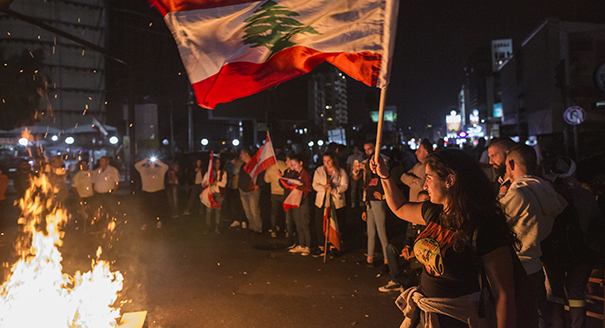
Young protestors in Lebanon say they will continue until their demands are met.
“It is the first time I feel this involved. It comes from the feeling that, this time, it is for Lebanon, for all the people,” says Michele, a 24-year-old art director at an advertising company in Beirut, who has participated in the protests from day-one on October 17.
Michele echoes the feeling of many young Lebanese from all over the country who have participated in the protest movement. The protests erupted after the Hariri government announced that it planned to levy a series of new taxes, a decision that has now been rescinded.
The tax decision came at the end of a week in which the government had proven its incompetence in extinguishing fires that had consumed hundreds of acres of Lebanon’s forests as well as some urban areas. Add to that an economic crisis in which the provision of necessities such as bread and fuel are in question and the likely impending devaluation of the Lebanese pound, and you will understand the reasons for the anger and frustration that finally pushed people to take to Lebanon’s streets.
The population’s reaction surprised the government, until it finally announced its resignation on October 29. After the resignation, there was a brief withdrawal from the streets. People seemed to be waiting to see how the political elite would act. Would it form an interim rescue government, as demanded by protesters all over the country?
Lebanon has witnessed mass demonstrations before. In 2005, demonstrations (and counter-demonstrations) took place in Beirut following the assassination of former prime minister Rafiq al-Hariri, which helped lead to the withdrawal of the Syrian army from Lebanon after a 29-year presence. In 2015, smaller demonstrations also took place in the capital, targeting the political elite, following a garbage crisis in which waste filled the streets of the country.
The difference today is that the protests are not only centered in Beirut. People from the all parts of the country have participated to reject the sectarian political class. This decentralized and spontaneous aspect of the protests has so far proven difficult to suppress.
“I have been living in Zouq all my life,” says Michele. “Three minutes away from the highway.” Zouq Mosbeh is a predominantly Christian town in the Kisirwan district of Mount Lebanon that is located a few kilometers north of Beirut. During the past two weeks of protests, protesters occupied the highway connecting northern Lebanon to the capital. “I was mainly [active] in Zouq, and I was happy to be there! It was a peaceful atmosphere and the feeling was amazing.”
Nour, a 27-year-old activist from the southern city of Tyre who had participated in the 2015 Beirut protests, says people have to be careful about what they say in southern Lebanon. In a region primarily dominated by Hezbollah and Parliament Speaker Nabih Berri’s Amal Movement, protesters in Tyre have chosen to focus on their demands in order to avoid a direct confrontation with the two parties, after early outbursts that had targeted both. “Our priority right now is the formation of an independent government of experts capable of navigating the difficult economic situation that Lebanon is in, and holding early parliamentary elections,” says Nour. If activists like Nour do not get their way, they will continue to occupy the streets.
Indeed, this is what happened on November 4, when after a few days of respite protesters again blocked roads throughout the country, angry with what they considered stalling by the political elite. By then, Lebanon’s president, Michel Aoun, had yet to schedule consultations to name a new prime minister, even though time is of the essence given the seriousness of the economic crisis. However, the president’s party was able to organize a counter-demonstration near the presidential palace on Sunday.
Maria, a 23-year-old architecture student at Notre Dame University, who has been participating in the protests in Beirut, says that the streets are the tool. “We will follow up on every decision and clearly state our disagreement, if any, through demonstrations.”
In the northern city of Tripoli, Lebanon’s second largest, the protests at Nour Square never stopped. One of the buildings facing the square is colored like a Lebanese flag with a banner that reads: “We will continue [in order] to bring down the president and parliament.” Formerly considered a stronghold of the Sunni caretaker prime minister, Sa‘d al-Hariri, Tripoli has captivated Lebanon and the world with its creative chants, light shows, and even a DJ.
‘Obeida, a 29-year-old community organizer in Tripoli says people will not stop because they have “reached the brink.” He adds that “there is a lot of pain in the city. All that people are asking for are basic rights and services.” For ‘Obeida and many like him in Tripoli, “It doesn’t matter who the faces in the new government are as much as their intentions.” Young people like ‘Obeida, Michele, Nour, and Maria seem to agree on the following: They oppose reproducing the same political class in the new government.
“In order for us to move forward, this political class must admit that it has made a mistake,” ‘Obeida says. “People will not go home without fulfilling their demands for a dignified life. Even if they held elections [in the future] and new people are elected who did not meet these demands, people will take to the streets again.”
An interim independent government may face many difficulties in navigating a political landscape entrenched with civil servants who are faithful to the old elite. What is clear, however, is that demonstrators will no longer accept slogans without tangible achievements. Previous mass demonstrations in Lebanon either failed or were ultimately monopolized by traditional sectarian politicians. In 2019, the popular movement has thus far rejected electing leaders to represent it. Its demands are clear, so no leaders are required. In Lebanon today, it seems like each person who has gone into the streets feels personally responsible for the success of the protest movement, and will not back down until its demands are met.
Research Analyst, Malcolm H. Kerr Carnegie Middle East Center
Issam Kayssi is a research analyst at the Malcolm H. Kerr Carnegie Middle East Center.
Recent Work
Issam Kayssi
Issam Kayssi
Carnegie does not take institutional positions on public policy issues; the views represented herein are those of the author(s) and do not necessarily reflect the views of Carnegie, its staff, or its trustees.
While armed forces commander Rudolph Haykal’s caution is understandable, he is in a position to act, and must.

Michael Young
The simple conclusion is that the scheme will bring neither peace nor prosperity, but will institutionalize devastation.

Nathan J. Brown
The Jamaa al-Islamiyya is the local Lebanese dimension of a broader struggle involving rival regional powers.
Issam Kayssi
In an interview, Kheder Khaddour explains that Damascus is trying to stabilize its borders, but avoiding war isn’t guaranteed.
Michael Young
The country’s strategy is no longer focused on deterrence and diplomacy, it’s about dominance and degradation.
Nathan J. Brown