

Paper
Ahmed Nagi
{
  "authors": [
    "Ahmed Nagi"
  ],
  "type": "commentary",
  "blog": "Diwan",
  "centerAffiliationAll": "dc",
  "centers": [
    "Carnegie Endowment for International Peace",
    "Malcolm H. Kerr Carnegie Middle East Center"
  ],
  "collections": [],
  "englishNewsletterAll": "menaTransitions",
  "nonEnglishNewsletterAll": "",
  "primaryCenter": "Malcolm H. Kerr Carnegie Middle East Center",
  "programAffiliation": "MEP",
  "programs": [
    "Middle East"
  ],
  "projects": [
    "X-Border Local Research Network"
  ],
  "regions": [
    "Gulf",
    "Yemen",
    "Middle East"
  ],
  "topics": [
    "Political Reform"
  ]
}
Source: Getty
Developments on the island illustrate how it has become a regional football, much as have other parts of Yemen.
During a trip to Yemen in mid-2019, I visited the Socotra archipelago, where another chapter of the Yemeni conflict is being written today. I spent several days there, interviewing locals and visiting important places. Developments in Socotra illustrate how the island has become a regional football, much as have other parts of Yemen, while the internationally-recognized government of President ‘Abd Rabbo Mansour Hadi has struggled to maintain its authority.
Socotra, in the northwest Indian Ocean near the Gulf of Aden, is the largest of Yemen’s islands and is a part of an archipelago consisting of four islands and two rocky islets. Two of the islands, ‘Abd al-Kuri and Samha, are inhabited, while a third, Darsa, is uninhabited. Socotra, which was declared a natural reserve in 2000, has an area of 3,650 square kilometers. The archipelago was a part of Hadhramawt Governorate, before becoming its own governorate in 2013.
Socotra has a population of some 90,000 people, but in the last five years the number has increased dramatically because of the arrival of people fleeing the war in mainland Yemen, with some statistics estimating the population at 150,000. Most live in Hadibo, the capital. Beside Arabic, the islanders speak their own unwritten Semitic language, Socotriyya, which is close to the Mahriyya spoken in Yemen’s eastern governorate of Mahra. Both languages descend from the same origin, and Socotra and Mahra were united during the time of the Mahra Sultanate of Qishen and Socotra, until 1967.
I flew to Socotra from Sayoun city in Hadhramawt. Upon arrival at the island’s airport, all Yemeni passengers not from Socotra were taken aside for a security check, a process conducted on a regular basis since 2018. The officers asked everyone about the purpose of their visit, and then requested that we bring in a sponsor from the island before allowing us to enter.
Traveling to Socotra is no longer easy for Yemenis. The only way to access the island is by flying Yemenia, the national carrier of Yemen, which flies there only once a week, a frequency requiring passengers to book long in advance. One can also go to the island by sea, from Hadhramawt and Mahra, but this is only allowed for the island’s inhabitants. Since the United Arab Emirates (UAE) began operating the airport in 2016 and Saudi troops deployed to the island in 2018, the security authorities have imposed a heavy fine on boat owners bringing passengers who are not from Socotra. However, there are two flights a week, sometimes more, to the island from Abu Dhabi airport. The fact that it is easier to visit Socotra from the UAE than it is from Yemen itself offers a glimpse of the current situation there.
From the arrival hall at Socotra airport one immediately senses the changes in the island. The first thing I received was a text message welcoming me to “Saudi Arabia.” I soon understood the reason why when noticing the camps of Saudi Arabian military forces nearby. The Saudis arrived on the island in April 2018 to help deescalate tensions between the UAE and the Hadi government. According to local inhabitants, the Saudis brought telecommunications equipment with them to avoid using the Emirati telecommunications network, which has been the main operator in Socotra despite having received no license from the Yemeni government.
Exiting from the airport one heads to Hadibo, along the island’s northeastern coast. The capital is where markets and public institutions are located. In the last five years, Hadibo has expanded and new houses have been built, showing how the island is being transformed as thousands of Yemenis have moved to Socotra, many to do business. Indeed, most of the traders in Hadibo’s markets hail from other Yemeni governorates. Only those in the fish market are locals, who are engaged in Socotra’s main economic enterprise.
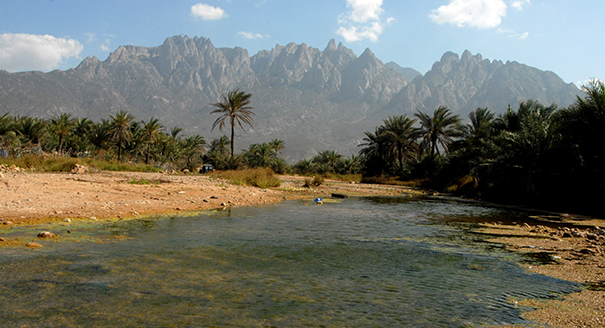
Though Socotra was a tourist destination, visitors face difficulties finding good places to stay on the island. There are only three primitive motels in Hadibo, with a limited number of rooms. Yet when there were more visitors in the past from different nationalities, they preferred to camp in coastal areas of the island. In fact, Socotra is one of the most beautiful islands in the world. In 2008, UNESCO listed it as a World Heritage Site, “because of its biodiversity with rich and distinct flora and fauna.” From the white beaches of coastal Qalansiyya to the incredible trees and plants in the mountains of Duksum, to the large caves and green lands, the island’s magnificent sites have long attracted visitors from across the globe.
However, today Socotra has attracted a different kind of interest, this one from countries in the region, above all the UAE and Saudi Arabia. The situation has led to tensions between the two countries, the origins of which can be traced back to the UAE’s expanded influence in the island after October 2015. That is when Cyclone Chapala hit the Socotra archipelago, causing extensive damage. At the time, the battle was at its peak in the Yemeni mainland between ‘Ansar Allah, usually referred to as the Houthi movement, and its then ally ‘Ali ‘Abdullah Saleh on the one side and the Saudi-led coalition aligned with the Hadi government on the other. Given the weakness of the Hadi government’s institutions, it was the Gulf countries who offered assistance to the islanders after the cyclone.
In many regards, this assistance proved to be a Trojan Horse. Thanks to aid provided by the Emirati Red Crescent and the Khalifa Bin Zayid Al Nahyan Foundation, the UAE’s presence in Socotra effectively began to grow in the aftermath of Chapala. The islanders as well as Hadi’s government were thankful for the humanitarian support and consequently eased the work of Emirati organizations functioning in the island. In February 2016, the then-Yemeni prime minster, Khalid Bahah, signed several agreements with Emirati aid organizations to implement developmental projects in Socotra.
Since that time, the UAE has expanded its involvement in Socotra through several means. It began by buying the loyalty of the local authorities by paying extra salaries to public servants as well as giving new cars to key officials. It has also paid salaries to tribal leaders, including the heads of smaller tribal groups. In addition, the UAE has unified Yemeni security institutions present in Socotra under one authority, centralizing security matters in the island.
In terms of soft power, the UAE has built or renovated dozens of schools across the island, as well as building or expanding mosques, including family mosques. Given that the island community is religious, this has enhanced the Emiratis’ credibility. The UAE has provided school buses and has distributed scholarships to study in Emirati universities. It has also sponsored social activities such as group marriages. Its most significant project is the establishment of the Sheikh Khalifa Hospital to provide medical treatment for islanders, while those requiring surgery are sent to the UAE.
The Emirati presence in Socotra pushed the Saudis to also think about expanding their influence in the strategic island. The Saudi Development and Reconstruction Program for Yemen began implementing humanitarian projects to guarantee the loyalty of islanders and maintain a foothold there. Competition between the Saudis and Emiratis is immediately visible, leading to polarization in the island. A consequence of this is that each country has financed projects even in remote parts of Socotra where the population is small. It’s as if no part of the island is unimportant in their rivalry, even if the Emiratis have an advantage in having arrived sooner.
The Emirati presence provoked uneasiness among Yemeni government officials, especially as tensions increased between Hadi’s forces and UAE-backed southern separatists in Aden in January 2018. It was notable that in April 2018, more than two years after Cyclone Chapala, the UAE sent a military force of around 300 men to Socotra. They took over the airport, the seaport, and vital facilities. Moreover, the UAE-backed security forces prevented Yemeni officials from entering the airport to receive a Saudi delegation visiting the island to resolve the dispute between the UAE and Hadi’s government.
It is possible that the Emiratis decided to affirm their presence more forcefully in Socotra because of developments in Mahra Governorate, where Saudi Arabia had deployed its forces in November 2017. The UAE interpreted this as a Saudi attempt to bolster Hadi’s government, so that its response was to assert greater control over Socotra. It is noteworthy that then-Yemeni prime minister Ahmed ‘Ubaid bin Daghr was pushed by the Saudis to travel to Socotra in April 2018 in order to condemn the UAE’s behavior there. This represented a new milestone in relations between the UAE and Hadi’s government, as well as between the UAE and Saudi Arabia.
Omani anxiety has also grown with neighboring Mahra under Saudi influence and Socotra dominated by the UAE. These developments have pushed Muscat to intensify its links with Socotra’s tribal leaders, who have historical ties with Oman. The Omani approach is focused on strengthening the Yemeni government and the local population of Socotra against the UAE.
Despite attempts to deescalate tensions, the UAE’s support for southern Yemeni separatists against the Hadi government has had a negative impact on the security situation in Socotra. Today the contending interests of the UAE, Saudi Arabia, and the Hadi government have become increasingly threatening to the islanders, causing rifts in Socotra’s social fabric. The inhabitants find themselves caught in the middle, dreaming of the days when the only storms they had to worry about were those caused by nature.




Senior Analyst at the International Crisis Group
Ahmed Nagi is a senior Analyst at the International Crisis Group.
Recent Work
Ahmed Nagi
Carnegie does not take institutional positions on public policy issues; the views represented herein are those of the author(s) and do not necessarily reflect the views of Carnegie, its staff, or its trustees.

Huawei pushed hard to enter the Egyptian data centers market, until the Americans made a better offer.

Angie Omar

Middle Eastern states should welcome an accelerated U.S. disengagement from their region.

Michael Young

The accord represents a pivotal moment in the region to avert a security vacuum in the Gulf.


Azeema Cheema, Mohanad Hage Ali

In an interview, Jason Burke discusses his sweeping account of the “revolutionists” who so shaped the 1970s and early 1980s.
Michael Young

There is a disturbing structural parallel between the old global energy economy and the new green transition.
Angie Omar