

Article
Dalia Ghanem
{
  "authors": [
    "Dalia Ghanem"
  ],
  "type": "commentary",
  "blog": "Diwan",
  "centerAffiliationAll": "dc",
  "centers": [
    "Carnegie Endowment for International Peace",
    "Malcolm H. Kerr Carnegie Middle East Center"
  ],
  "collections": [
    "Arab Spring 2.0",
    "Coronavirus"
  ],
  "englishNewsletterAll": "menaTransitions",
  "nonEnglishNewsletterAll": "",
  "primaryCenter": "Malcolm H. Kerr Carnegie Middle East Center",
  "programAffiliation": "MEP",
  "programs": [
    "Middle East"
  ],
  "projects": [],
  "regions": [
    "Maghreb",
    "North Africa",
    "Algeria"
  ],
  "topics": [
    "Political Reform"
  ]
}
Source: Getty
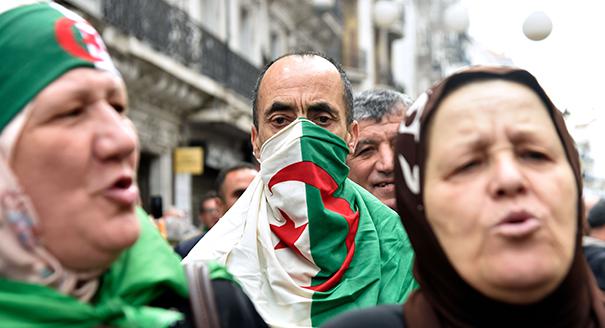
The authorities in Algeria are exploiting the coronavirus lockdown to stifle the country’s protest movement.
While the world has been taking measures to fight the spread of the novel coronavirus, several governments have exploited the lockdowns imposed by the pandemic to curtail freedoms and rights. Algeria’s government is one such example of this.
Shaken by an unprecedented peaceful protest movement that has been going on for over a year, the Algerian authorities are capitalizing on the coronavirus outbreak to strike back at civil society and opposition figures in a desperate effort to stifle dissent and end the protests. The arrest and summons of protestors to go to police stations underline that human rights in Algeria are under threat.
After his election last December, President Abdel-Majid Tebboun promised reforms to “consolidate democracy,” the rule of law, and respect for human rights. He also committed to initiating a dialogue with the protest movement and releasing political detainees. In January of this year, the public channel ENTV announced that 76 people from across the country had been released, among them the 86-year-old veteran of the war of independence, Lakhdar Boureg‘a. However, no less than 173 individuals are still believed to be in jail.
Today, despite the suspension of weekly demonstrations because the popular movement agreed to a truce during the country’s confinement, arbitrary arrests targeting opposition figures, students, civil society activists, and journalists continue. Dozens of people have been detained under various charges such as “illegal gathering,” “harming state security,” “harming the integrity of national territory,” or “distribution of documents harming the national interest.” The cases abound of activists and students, including Sohaïb Debaghi, Meziane Koufi, and Anaïs Matari, who have been summoned by the police and gendarmerie during the confinement period.
The regime is also using the judicial system to imprison activists or placing them in lengthy pretrial detention on false charges. This is what has happened, for instance, with Samir Belarbi, Suleiman Hamitouche, and Khaled Drareni. Drareni, who writes for Reporters Without Borders and is a cofounder of the Algerian news website Casbah Tribune, had been arrested several times and was charged on March 27 with “attacking the integrity of the national territory.” He was put in prison, though the judge did not specify a prison term, saying this would be determined after his incarceration.
Similarly, Karim Tabbou, the leader of the Democratic and Social Union, which the authorities don’t recognize, has been arrested and released several times. He was eventually sentenced to a one-year jail term in a hasty trial on March 24, for “incitement to violence.” The Order of Lawyers declared that Tabbou’s trial violated a Justice Ministry decree imposing a temporary halt on court hearings from March 17 until March 31 to fight the spread of the coronavirus.
The arbitrary arrest and detention of activists is putting pressure on an already overcrowded and decrepit prison system, which facilitates more contaminations. For instance, the main prison of Al-Harrash, where both Tabbou and Drareni have been transferred, along with many others, was built in 1855 and is notoriously overpopulated. It suffers from insufficient bed space as well as ventilation and hygiene problems, not to mention inadequate food for the inmates. As a result of this, doctors and lawyers are calling for the immediate release of political prisoners as well as those charged with minor offenses.
Nonetheless, the authorities have remained deaf to such calls. In fact they have sanctioned state employees who have shown leniency toward protestors. Such is the case of the public prosecutor linked to the Sidi M’hamed tribunal in Algiers, Mohammed Sid Ahmed Belhadi. In February, Belhadi was transferred to Oued, over 600 kilometers southeast of the capital, because he had requested the acquittal of sixteen peaceful protesters. The National Union of Algerian Magistrates condemned his transfer as being “a threat to the constitutional and professional security of magistrates.”
More recently, on March 29, the deputy prosecutor of the court of Tiaret, southwest of Algiers, was placed in detention for allegedly “handing over confidential documents” to a journalist. The deputy prosecutor is a member of a syndicate that has been fighting for the independence of the judiciary. These punitive measures violate the basic principles of judicial independence.
The authorities took a further step under the guise of fighting the coronavirus. They have intensified their war on social media. To this end, they have used trolls, shut down Facebook accounts, and posted personal information of political opponents and journalists online, all to shame, attack, or discredit them.
On March 17, Tebboun warned that the “publication of false and misleading information to propagate confusion and keep the citizen in a state of anxiety and terror” would be severely punished. He also ordered the minister of communications to take all measures to prohibit the publication of figures and information on the coronavirus that were not released by the Ministry of Health, Population, and Hospital Reform. As such, the right to access and share information regarding the spread of the virus became unlawful, opening up anyone who did so to arrest.
While the fight against the coronavirus outbreak may require some limitations on personal freedoms, the Algerian authorities are using the health threat to curb dissent, while also returning to its old habits of opaqueness, concealment, and distortion of information. This will only exacerbate the Algerians’ crisis of confidence in their state, as they are likely to suffer a lasting erosion of their basic freedoms.
Former Senior Resident Scholar, Malcolm H. Kerr Carnegie Middle East Center
Dalia Ghanem was a senior resident scholar at the Malcolm H. Kerr Carnegie Middle East Center in Beirut, where her research focuses on Algeria’s political, economic, social, and security developments. Her research also examines political violence, radicalization, civil-military relationships, transborder dynamics, and gender.
Recent Work
Dalia Ghanem


Frances Z. Brown, Judy Dempsey, Dalia Ghanem, …
Carnegie does not take institutional positions on public policy issues; the views represented herein are those of the author(s) and do not necessarily reflect the views of Carnegie, its staff, or its trustees.

This will be the region’s most representative tournament, amid broad changes in its footballing landscape.

Issam Kayssi
The recent African Cup of Nations tournament in Morocco touched on issues that largely transcended the sport.

Issam Kayssi, Yasmine Zarhloule
Mustaqbal Misr has expanded its portfolio with remarkable speed, but a lack of transparency remains.

Yezid Sayigh
The burden of environmental degradation is felt not only through physical labor but also emotional and social loss.
Yasmine Zarhloule, Ella Williams
The country’s youthful protest movement is seeking economic improvement, social justice, and just a little hope.
Yasmine Zarhloule