

Commentary
The Zaidi government’s objective to collect weapons is constrained by regional conflict, but it can take certain measures at home.
Ali Al-Mawlawi
{
  "authors": [
    "Armenak Tokmajyan",
    "Walid al-Nofal"
  ],
  "type": "commentary",
  "blog": "Diwan",
  "centerAffiliationAll": "dc",
  "centers": [
    "Carnegie Endowment for International Peace",
    "Malcolm H. Kerr Carnegie Middle East Center"
  ],
  "collections": [],
  "englishNewsletterAll": "menaTransitions",
  "nonEnglishNewsletterAll": "",
  "primaryCenter": "Malcolm H. Kerr Carnegie Middle East Center",
  "programAffiliation": "MEP",
  "programs": [
    "Middle East"
  ],
  "projects": [
    "X-Border Local Research Network"
  ],
  "regions": [
    "Levant",
    "Syria",
    "Middle East",
    "Jordan"
  ],
  "topics": [
    "Political Reform"
  ]
}
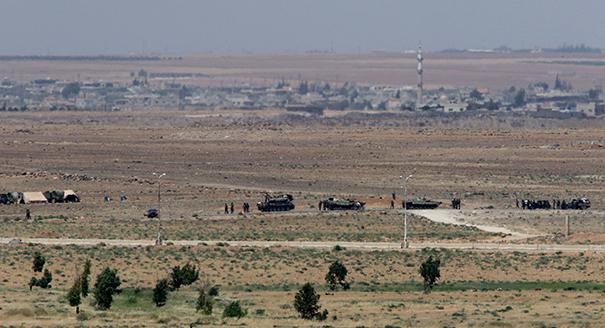
Source: Getty
Syria’s conflict has transformed the conditions of tribal clan notables who have sought refuge in Jordan.
The social fabric on both sides of the Syrian-Jordanian border has remained similar, notwithstanding the fact that a century has passed since the Sykes-Picot agreement that divided the region between Britain and France. Communities on either side of the separation line remain similar, with extended families and clans (sub-tribes or ‘ashireh) dominating the social landscape. They remain linked by family and kinship ties, as well as shared customs and traditions.
But this so-called “line in the sand”—the boundary dividing British and French areas of control drawn during World War I—has also left its mark. Relations between tribal clans and their respective states differ markedly between Jordan and Syria, both in terms of their roles in the state-building process and the space that clan notables have been given to exercise traditional authority within their societies.
With the increasing levels of violence in Syria after 2011, many Syrians, especially from the border governorate of Dar‘a, sought refuge in Jordan. Statistics from the United Nations High Commissioner for Refugees show that the largest concentration of refugees is located in Amman Governorate, Jordan’s economic heartland. The second-largest is present in the northwestern border areas of the kingdom, which resemble nearby parts of Syria in their climate, geography, and even architecture. Not only is the environment similar, but many Jordanian and Syrian families have family ties and relationships from before the conflict. This helped Syrians integrate into Jordanian society after they had fled Syria.
After settling in Jordan, many refugees found that the state’s relationship with clans were different than what they had encountered in Syria. Throughout the decades of Ba‘th Party rule, the Syrian state sought to weaken tribal clan authority. Half a century of such policies prior to the uprising, along with changing ways of life, gradually reduced the role of clan notables. Still, the state used what remained of these notables’ influence for its own ends. For example, it took advantage of their authority to contain and resolve major disputes between large families and keep the peace in rural peripheries of the country.
Jordan’s tribal clans, in turn, face few of the restraints and pressures experienced by their Syrian counterparts. Instead, they remain a major power center with considerable authority and influence in the kingdom. Tribal tradition plays a crucial role in Jordanian society despite growing opposition to it. Even today, the king derives some of his legitimacy from his status as the leader of the kingdom’s tribal leaders, a historical legacy dating back to Jordan’s foundation. Despite rare bumps in ties between the state and tribal clans, especially for economic reasons, these relationships have remained essential for the stability of Hashemite rule.
The new reality in Jordan makes some Syrian notables claim that there is more respect for the clan in Jordan than in Syria. Indeed, in Jordan tribal traditions and customs similar to those in Syria are more widely practiced. This continues to strengthen the clans’ traditional authority, which gives them positions of leadership with judicial, customary, and even political roles as intermediaries between their communities and the state—far more than in Syria.
The situation in Syria has brought about deep changes in the relationship between state and society, including with clan notables. Early on in 2011, notables in Dar‘a broke with their traditional roles and were at the forefront of anti-regime protests when Brigadier General ‘Atif Najib, the head of the Political Security Directorate in Dar‘a, humiliated notables who had gone to seek the release of children arrested and tortured for writing anti-regime slogans. This is widely seen as the incident that sparked the uprising.
Tribal customs remained, and perhaps were strengthened, amid the absence of state institutions in Syria. As a result, some known personalities lost their social status as notables, while others turned the crisis into an opportunity. They gained authority and prominence within their extended families and clans and became new intermediaries with the state. These transformations are ongoing and the political role of clan notables in Syrian society today has yet to become clear. For now, many seem to have lost the roles they played before the uprising, becoming rivals and targets of the state.
The lives of Syrian clan notables in Jordan differ greatly from their lives before the uprising and from the situation of Syrians who are living in Dar‘a today. Many certainly face the hardships of being refugees and do not enjoy the same privileges as their Jordanian counterparts. Yet they live in a sociopolitical environment in which they are able to exercise their traditional authority more widely over their communities and without the fear of being targeted by the state. In that sense, despite living in exile, they are in a more favorable social and political setting than where they had been.
*Walid al-Nofal is a journalist in Dar‘a, Syria.


Nonresident Scholar Malcolm H. Kerr Carnegie Middle East Center
Armenak Tokmajyan is a nonresident scholar at the Malcolm H. Kerr Carnegie Middle East Center in Beirut. His research focuses on borders and conflict, Syrian refugees, and state-society relations in Syria.
Walid al-Nofal
Carnegie does not take institutional positions on public policy issues; the views represented herein are those of the author(s) and do not necessarily reflect the views of Carnegie, its staff, or its trustees.
The Zaidi government’s objective to collect weapons is constrained by regional conflict, but it can take certain measures at home.
Ali Al-Mawlawi

Huawei pushed hard to enter the Egyptian data centers market, until the Americans made a better offer.

Angie Omar

The accord represents a pivotal moment in the region to avert a security vacuum in the Gulf.


Azeema Cheema, Mohanad Hage Ali

In an interview, Jason Burke discusses his sweeping account of the “revolutionists” who so shaped the 1970s and early 1980s.

Michael Young
In an interview, Sohaib Jawhar analyzes the profound changes in the ties between the neighboring countries.
Michael Young