

Paper
Yezid Sayigh
{
  "authors": [
    "Yezid Sayigh"
  ],
  "type": "commentary",
  "blog": "Diwan",
  "centerAffiliationAll": "dc",
  "centers": [
    "Carnegie Endowment for International Peace",
    "Malcolm H. Kerr Carnegie Middle East Center"
  ],
  "collections": [
    "Civil-Military Relations in Arab States"
  ],
  "englishNewsletterAll": "menaTransitions",
  "nonEnglishNewsletterAll": "",
  "primaryCenter": "Malcolm H. Kerr Carnegie Middle East Center",
  "programAffiliation": "MEP",
  "programs": [
    "Middle East"
  ],
  "projects": [],
  "regions": [
    "Egypt",
    "North Africa",
    "Libya"
  ],
  "topics": [
    "Security",
    "Political Reform"
  ]
}
Source: Getty
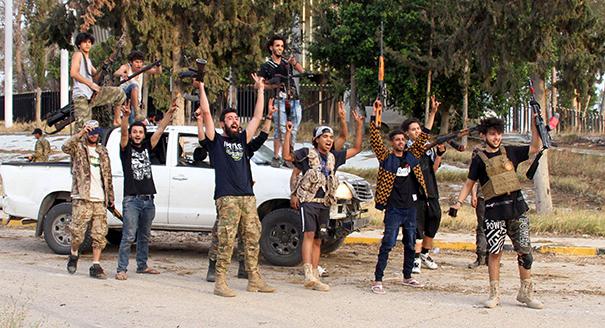
The Egyptian military may intervene in neighboring Libya, but it likely wants to avoid a major confrontation.
Carnegie senior fellow Yezid Sayigh has written extensively on the Egyptian military, particularly in the context of the Program on Civil-Military Relations in Arab States, which he leads. In a recent Carnegie report, he provided a detailed anatomy of Egypt’s military economy. In light of this, Sayigh was asked by a journalist to comment on the warning by Egyptian President Abdel-Fattah al-Sisi on June 20 that Egyptian forces would intervene in Libya if Turkish-backed forces of the Government of National Accord crossed the Sirte-Jufra frontline. His answers are reproduced below.
Question: How likely is Egypt to intervene militarily in Libya or enter into direct confrontation with Turkish forces there?
Yezid Sayigh: The possibility that Egypt will intervene directly is increasing, although I think the Sisi administration strongly prefers not to, and will only do so as a last resort. If it does intervene, this does not have to be a full intervention in order to be effective in dissuading forces loyal to the Tripoli-based Government of National Accord and its Turkish backers from advancing to or past the Sirte-Jufra line. Nor does the Egyptian military need to advance to that line itself or confront Turkish-backed forces directly.
I expect that Egypt’s first step would be to cross the border in force, in other words through a sizeable deployment, and then pause. In that way it would signal its seriousness and persuade the other side to stop its advance. But if worse comes to worst, Egypt has the ability to move a significant number of forces into Libya since it is right next door to the country. In this regard, its capacities are greater than Turkey’s. But even then Egyptian forces are likely to remain in the eastern border region of Libya.
Question: Do you think Egypt might seek goals in Libya that go beyond concerns about security on their shared border?
YS: No. Egypt’s primary interest in Libya is to protect its own security on that border. It distrusts the Government of National Accord and sees Turkey’s involvement as a serious threat. However, its support for the Libyan National Army led by Field Marshal Khalifa Haftar only really derives from the hope that he can deliver a secure and stable common border. Egypt has economic interests in Libya, which provides a market for Egyptian labor and contractors. However, these are not major and Cairo would not risk a potentially costly military deployment over them.
Question: Would Egypt come out as a political winner or loser from an intervention?
YS: The state would probably gain domestically, since it controls public media and can manipulate how its actions and their outcomes are seen. Moreover, Egyptians have a heightened threat perception of Libya and would view the government’s behavior as legitimate. There will probably also be a certain amount of international sympathy and even open support for Egypt from Russia and some European countries. The United States and main European countries would probably express their understanding for such a move, but not voice unconditional support. That is because they will worry about the potential for further military escalation in Libya, conflict in the Mediterranean, and enhanced Russian influence. So we are likely to see diplomatic efforts to make sure that the Egyptian intervention is defensive, limited, and gradual.
Question: Could Egyptian military intervention tip the scales back in favor of Haftar’s forces after their major recent setbacks?
YS: Egypt already supports Haftar’s forces. Direct intervention would help them considerably by securing their rear, freeing up troops to redeploy to central Libya, and strengthening morale. It would also dampen rising discontent with Haftar in the east as well as within the Libyan National Army, unless the Egyptians also decide to nurture a successor to him. In all cases it is very likely that Egypt will seek to rein Haftar in and prevent him from making a second attempt to seize western Libya and Tripoli, a move it opposed last year. I believe that Egypt will make it clear to Haftar that any future support, including intervention, is aimed at preventing his collapse but no more, and that he must accept a new political process to resolve the conflict. Egyptian intervention will not represent a blank check for Haftar.
Question: Could declared United Arab Emirates (UAE) and Saudi Arabian backing for an Egyptian military intervention help win the war against Turkish-backed forces in Libya?
YS: There will not be a total war involving Egyptian forces in Libya. The UAE could resume and expand both arms supplies and the combat role of their air force in support of the Libyan National Army, in coordination with the Egyptian military. But I don’t expect the UAE to tip the balance any more than they already have in the past. I suspect that Saudi support will mostly be declaratory.
Most important, however, is that Egypt will not engage in a major war in Libya just to fulfill the strategic agenda of the UAE or Saudi Arabia. We saw that with the Sisi administration’s refusal to join the joint Emirati-Saudi war effort in Yemen, despite the strength of their political relationship and the massive financial and economic investment the two Gulf monarchies had made in Egypt. The outcome of Egyptian intervention will be strategic stalemate, which hopefully could lead to a more serious diplomatic effort by the international community to produce a lasting political settlement of the Libyan conflict.

Senior Fellow, Malcolm H. Kerr Carnegie Middle East Center
Yezid Sayigh is a senior fellow at the Malcolm H. Kerr Carnegie Middle East Center in Beirut, where he leads the program on Civil-Military Relations in Arab States (CMRAS). His work focuses on the comparative political and economic roles of Arab armed forces, the impact of war on states and societies, the politics of postconflict reconstruction and security sector transformation in Arab transitions, and authoritarian resurgence.
Recent Work
Yezid Sayigh
Yezid Sayigh
Carnegie does not take institutional positions on public policy issues; the views represented herein are those of the author(s) and do not necessarily reflect the views of Carnegie, its staff, or its trustees.

There is a disturbing structural parallel between the old global energy economy and the new green transition.

Angie Omar

This will be the region’s most representative tournament, amid broad changes in its footballing landscape.

Issam Kayssi
Cairo’s efforts send a message to the United States and the region that it still has a place at the diplomatic table.
Angie Omar
The recent African Cup of Nations tournament in Morocco touched on issues that largely transcended the sport.

Issam Kayssi, Yasmine Zarhloule
Mustaqbal Misr has expanded its portfolio with remarkable speed, but a lack of transparency remains.
Yezid Sayigh