

Commentary
Maha Yahya
{
  "authors": [
    "Maha Yahya"
  ],
  "type": "commentary",
  "blog": "Diwan",
  "centerAffiliationAll": "dc",
  "centers": [
    "Carnegie Endowment for International Peace",
    "Malcolm H. Kerr Carnegie Middle East Center"
  ],
  "collections": [
    "Decoding Lebanon"
  ],
  "englishNewsletterAll": "menaTransitions",
  "nonEnglishNewsletterAll": "",
  "primaryCenter": "Malcolm H. Kerr Carnegie Middle East Center",
  "programAffiliation": "MEP",
  "programs": [
    "Middle East"
  ],
  "projects": [],
  "regions": [
    "Levant",
    "Lebanon",
    "Middle East"
  ],
  "topics": [
    "Political Reform",
    "Economy"
  ]
}
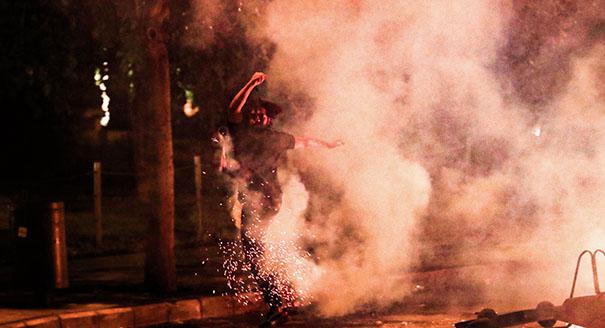
Source: Getty
Today, four of the five pillars that had sustained Lebanon are collapsing, creating fears for the future.
Lebanese politicians are pushing their country over the precipice. Eight months into a complex crisis that is threatening Lebanon’s foundations, they have yet to take steps to stem the collapse. On the contrary, they have pursued a malign business-as-usual approach as they hedge their bets on a system that is no more.
Today, four of the five key pillars that have long sustained Lebanon are crumbling. First, the power-sharing arrangement that has characterized the country since its foundation is no longer working and is characterized by persistent and debilitating blockages. This arrangement rests on an equitable distribution of government posts among the country’s different sects. It was also based on a double negative of a “no to the East” and “a no to the West,” whereby Christians would not seek Western involvement in Lebanon’s affairs, and Muslims would not seek Arab intervention.
The power-sharing system is in no danger of immediate collapse. However, the last time it was contested, Lebanon entered into a fifteen-year civil war between 1975 and 1990. The Taif Accord, the settlement ending that conflict, foresaw Lebanon’s transition to a civil state in which sectarian representation in parliament would end. In exchange, all sects would be represented in a new Senate, whose authority would be limited to deciding on major national issues. Yet those parts of the accord were never implemented. Today, sectarian governance has become far more entrenched in state institutions, making change extremely difficult.
Second, Lebanon’s role as a merchant republic, based primarily on banking and services, is at an end. In 2018, financial services contributed 8.5 percent of GDP and the tourism sector (mainly hotels and restaurants) 3.1 percent. Today, losses in the banking sector are estimated at $83 billion. In a country that imports almost everything it consumes, informal capital controls and the cancellation of lines of credit to businesses show a banking system that no longer functions.
Similarly, around 800 tourism-related establishments closed permanently between October 2019 and January 2020. Tourism and related services employed 25 percent of Lebanon’s labor force, but some 25,000 individuals lost their jobs in the sector during that same period. It’s likely that this figure has increased because of Covid-19 containment measures. The scale of the crisis is threatening the basic integrity of Lebanon’s economy. Experts now estimate the economy will contract by 25 percent in real terms over the next two years.
This economic collapse and the ensuing destruction of wealth is wiping out the country’s third pillar, namely the middle class, historically one of the most affluent, resourceful, and professional in the region. Lebanese society is being rapidly impoverished, while the youngest and brightest seek opportunities elsewhere. One in three Lebanese have reportedly lost their jobs, and many others are likely to be pushed into the informal sector. The Lebanese pound has lost some 80 percent of its value on the black market.
To cite but one example of the effects of this, the average annual salary of an assistant professor at the American University of Beirut is LL94 million. This used to be equivalent to $63,000 a year, or around $5,000 per month. At today’s exchange rate of $1 = LL8.000, the monthly salary has dropped to $11,000 a year, or $900 a month.
The middle class is swelling the ranks of the poor, with the World Bank estimating that around 50 percent of Lebanese now live below the poverty line, while thousands are going hungry. Clothes, food, and fuel are becoming unaffordable as year-on-year purchasing power has been halved, with inflation reaching 90 percent in June 2020. The price of basic goods increased by around 55 percent in May alone. All this represents an epic collapse with a generational impact.
A fourth pillar of the Lebanese system, namely freedoms, is also being eroded. Since independence, Lebanon has been renowned for freedom of speech and a flourishing press. By the end of the 1940s the country was publishing 39 dailies and 137 periodicals in three languages. In its heyday Lebanon acted as a safe haven for dissidents and refugees, boasting a cultural and intellectual life unparalleled in the region, a role it continued to play until recently, albeit much less effectively.
The decline in fundamental freedoms and the repression of free speech is apparent in the alarming increase and systematic targeting of activists, dissidents, and refugees over the past few years, with the help of more aggressive security services and a pliant judiciary. While Lebanon’s constitution upholds freedom of speech within the bounds of the law, its penal code criminalizes defamation against political and religious officials. Since October 17 at least 60 individuals have been arrested or summoned for interrogation because of things they posted on social media. More recently, there were reports that the country’s top prosecutor ordered a security agency to investigate social media posts offensive to the president. In response, a coalition of fourteen organizations has been formed to defend freedoms.
Finally, the Lebanese system’s fifth pillar, the army and the internal security forces, is also feeling the impact of the economic crisis. Like all Lebanese, military and security personnel have seen their incomes and pensions disappear. The salary of the army’s commander has declined in dollar terms to around $750 a month, while that of a colonel has gone down to $300 and a soldier to $150. The personnel may be faring better than those who have lost their jobs, but they no longer enjoy many of the benefits they previously did. In an environment of heightened tensions, economic pressure on the military and security sector will only grow. More worrisome, this is happening as crime rates have risen in recent months.
In response to this dire situation, national-level decisionmaking has been slow, with politicians displaying callous disregard for the country. They continue to seek short-term gains and are looking for ways to hang on to power, plunging Lebanon deeper into crisis. By dragging their feet they are imposing further losses on depositors, who cannot withdraw their U.S. dollars from banks except in pounds, and at an official rate far lower than the black market rate.
Agreement on an economic rescue plan is critical for unlocking desperately needed financial assistance. Yet, the government and parliament are still bickering over the size of Lebanon’s financial losses as the government negotiates with the International Monetary Fund. Rather than introduce reforms, the politicians have continued to behave much as they did in the past. This was evident in recent civil service appointments that privileged political clientelism over merit. Without reforms, external support will not materialize.
Meanwhile, political parties are returning to their sectarian reflexes, fracturing the Lebanese polity even more. Trends visible on the ground point to increasing fragmentation, with villages, towns, and neighborhoods initiating self-protection mechanisms. Against the background of Covid-19, increasing crime rates, and collapsing state institutions, parties have revived their protection rackets and are providing food and medicine to constituents in need. This is happening even as many Lebanese seek a nonsectarian state that upholds their rights as citizens, not merely as members of a sect.
Lebanon’s problems can only be addressed if its political leaders place the country’s, and their own, long-term interests above short-term gains. That means an agreement to shoulder some of the losses stemming from the crisis and bringing in a government capable of envisioning and implementing an immediate stabilization program and a medium- to long-term recovery program. So far, however, these do not seem to be priorities for Lebanon’s political leadership.

Director, Malcolm H. Kerr Carnegie Middle East Center
Maha Yahya is director of the Malcolm H. Kerr Carnegie Middle East Center, where her research focuses on citizenship, pluralism, and social justice in the aftermath of the Arab uprisings.
Recent Work
Maha Yahya
Maha Yahya
Carnegie does not take institutional positions on public policy issues; the views represented herein are those of the author(s) and do not necessarily reflect the views of Carnegie, its staff, or its trustees.
Reconciliation councils are emerging throughout the country to mediate in intracommunal disputes, many from the war years.
Natacha Danon
As the U.S.-led Coalition withdraws, the Kurds’ reliance on Baghdad, and on themselves, will only increase.
Wladimir van Wilgenburg

As the U.S. stumbles in its war with Iran, we are likely to see an acceleration of its disengagement from the region.

Michael Young
The Zaidi government’s objective to collect weapons is constrained by regional conflict, but it can take certain measures at home.
Ali Al-Mawlawi

The accord represents a pivotal moment in the region to avert a security vacuum in the Gulf.


Azeema Cheema, Mohanad Hage Ali