

Commentary
As the U.S. stumbles in its war with Iran, we are likely to see an acceleration of its disengagement from the region.
Michael Young
{
  "authors": [
    "Ghida Tayara"
  ],
  "type": "commentary",
  "blog": "Diwan",
  "centerAffiliationAll": "dc",
  "centers": [
    "Carnegie Endowment for International Peace",
    "Malcolm H. Kerr Carnegie Middle East Center"
  ],
  "collections": [],
  "englishNewsletterAll": "menaTransitions",
  "nonEnglishNewsletterAll": "",
  "primaryCenter": "Malcolm H. Kerr Carnegie Middle East Center",
  "programAffiliation": "MEP",
  "programs": [
    "Middle East"
  ],
  "projects": [],
  "regions": [
    "Levant",
    "Lebanon",
    "Middle East"
  ],
  "topics": [
    "Political Reform",
    "Economy"
  ]
}
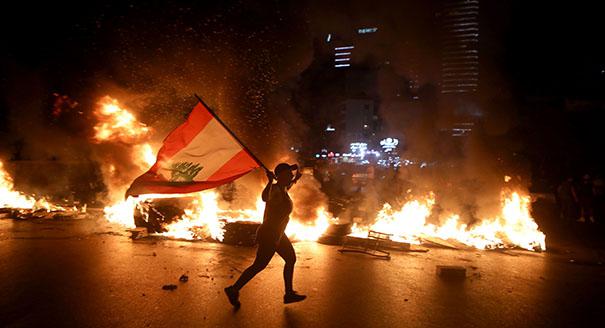
Source: Getty
In an interview, Alain Bifani discusses the country’s financial collapse and his exit from the Finance Ministry.
Alain Bifani is Lebanon’s former director general of the Finance Ministry, who resigned last June in protest at the way Lebanon’s leadership has been handling the country’s financial crisis. Bifani holds an engineering degree in optics and telecommunication from the Ecole Superieure d’Optique in France and a higher degree (equivalent to an MBA) in management and finance from the Ecole des Hautes Etudes Commerciales. Previously, he worked at Arthur Andersen in Paris, mostly auditing banks and industries in Europe and consulting for housing sector needs in postwar countries. He then occupied senior positions at ABN AMRO Bank Lebanon and Dubai and at Thomson Financial Bankwatch, where he was director for sovereign ratings for the Middle East, Central Asia, and North Africa. Bifani was the key driver behind the Diab government’s economic and financial reform plan that sought to put Lebanon on the right path after the country defaulted on its foreign debt. Diwan interviewed him in late August to get his perspective on the financial situation in the country and ask what was behind his resignation.
Ghida Tayara
Senior Digital and Web Coordinator
Carnegie does not take institutional positions on public policy issues; the views represented herein are those of the author(s) and do not necessarily reflect the views of Carnegie, its staff, or its trustees.

As the U.S. stumbles in its war with Iran, we are likely to see an acceleration of its disengagement from the region.

Michael Young
The Zaidi government’s objective to collect weapons is constrained by regional conflict, but it can take certain measures at home.
Ali Al-Mawlawi

Huawei pushed hard to enter the Egyptian data centers market, until the Americans made a better offer.

Angie Omar

The accord represents a pivotal moment in the region to avert a security vacuum in the Gulf.


Azeema Cheema, Mohanad Hage Ali

In an interview, Jason Burke discusses his sweeping account of the “revolutionists” who so shaped the 1970s and early 1980s.
Michael Young