

Commentary
Marc Pierini
{
  "authors": [
    "Marc Pierini"
  ],
  "type": "commentary",
  "blog": "Diwan",
  "centerAffiliationAll": "dc",
  "centers": [
    "Carnegie Endowment for International Peace",
    "Carnegie Europe",
    "Malcolm H. Kerr Carnegie Middle East Center"
  ],
  "collections": [],
  "englishNewsletterAll": "menaTransitions",
  "nonEnglishNewsletterAll": "",
  "primaryCenter": "Malcolm H. Kerr Carnegie Middle East Center",
  "programAffiliation": "MEP",
  "programs": [
    "Middle East"
  ],
  "projects": [],
  "regions": [
    "Levant",
    "Middle East",
    "Türkiye",
    "Caucasus",
    "Azerbaijan",
    "Armenia"
  ],
  "topics": [
    "Political Reform"
  ]
}
Source: Getty
The European Union’s soft line with Turkey at a recent meeting may ultimately represent a strategic risk.
During the past few months Turkey has launched several bold foreign policy initiatives, often with a strong military component. After much debate, the European Council, on October 1, decided to take a soft line toward Ankara by offering it incentives and sidelining the idea of imposing sanctions. Does such an approach create strategic risks for the European Union and NATO?
The European Union is, by construction, a benevolent entity promoting the peaceful resolution of conflicts with and among its neighbors. Among European leaders, German Chancellor Angela Merkel has been particularly conciliatory with Turkey, as illustrated by the personal role she played in negotiating the refugee deal in 2015–2016 and the European Council’s conclusions on October 1.
However, this last episode is troubling. European leaders came together to discuss relations with Turkey following months of unilateral moves by Ankara against EU interests in Syria, Libya, the Eastern Mediterranean, and the land border with Greece.
Yet, after prolonged talk of sanctions the European Council offered a respite to Turkey. Not a word on the dismal state of the rule of law—at a time when the situation in Belarus and the apparent poisoning of Russian opposition figure Alexei Navalny worry European leaders—and when suppression of Turkish civil society and political opponents continues unabated. And there was only a hint about sanctions, even as European leaders adopted the “silver tray approach” seen during the 2015 refugee crisis, offering multiple benefits to Ankara, such as a renovation of the customs union with the EU, progress on visas, and the prospect of more money for Syrian refugees, apparently believing that they could assuage President Recep Tayyip Erdoğan.
True, Merkel is facing a distinct situation. The opinion of 3.5 million Germans of Turkish origin matters, trade and investment with Turkey are important, and Germany fears that a new wave of refugees could head to Germany if the EU adopts a harder line toward Ankara. However, what was missing on October 1 was a lucid diagnosis of Turkey’s trajectory and its consequences for Europe and NATO.
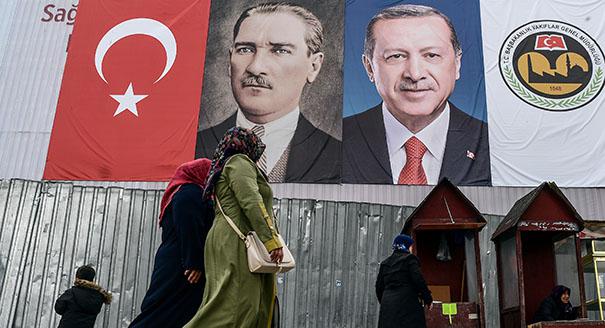
Ankara’s militarized diplomacy is deeply rooted in domestic politics. At a time when the economy is at a cliff’s edge and the popularity of the Islamist-nationalist coalition is waning, Erdoğan needs to portray himself as the savior of a nation attacked on all sides so that he can cruise through the 2023 elections and centennial celebrations. Ankara seeks to coalesce Turkey’s nationalist fervor around the president by resuscitating old (and real) disputes—maritime boundaries with Greece and Cyprus and the conflict in Nagorno-Karabakh—and venturing into foreign territories, such as northern Syria, Libya, and northern Iraq, and deploying reinforced military assets in support of its disruptive diplomacy.
For Turkey, this is probably a time of multiple opportunities. The EU is perceived as a paper tiger incapable of agreeing quickly on foreign policy issues. The pro-Turkish Merkel will leave power in just a year. The United States is engulfed in a massive pandemic and paralyzed by a divisive presidential campaign. NATO’s strength is weakened by Turkey’s deployment of Russian S-400 missiles alongside assets critical for the alliance’s operations. The bilateral relationship with Moscow is increasingly complex, but offers Ankara opportunities to emerge as a rival to Moscow on the international stage, whether in Syria, Libya, or now in the Armenia-Azerbaijan conflict.
In parallel, Turkey’s military capacity to inflict damage to conventional forces has recently been boosted by the use of armed drones in northern Syria, Iraq, western Libya, and now Nagorno-Karabakh. Moreover, this is only a beginning, as new air and naval assets will come into service in 2021 and beyond.
Turkey’s leadership sees a concurrence of domestic political imperatives, a window of opportunity, and a sense of renewed military power. By sowing confusion among all its partners, it is hoping to position itself as a crucial player that nobody can ignore and few can fight. In such a context, the European Council conclusions weren’t much of an achievement. Why?
Revamping the customs union would require a level playing field for EU operators in Turkey, but there is no independent judiciary there anymore. Visa facilitation would need a different Turkish anti-terror law, which is nowhere in sight. And the offer to convene a Eastern Mediterranean conference is a terrible idea, as the EU would agree, in one go, to recognize the Turkish Republic of Northern Cyprus, sit across from Syrian President Bashar al-Assad’s representatives, and sponsor a platform for Turkey’s vindictive narratives.
In hindsight, the European Council only managed to kick the Turkish can down the road, hoping for a more conciliatory attitude from Ankara, rather than considering containment. Was a strategic risk overlooked or minimized?
It certainly was both, because seen from a wider perspective, Turkey’s expansionist activities and disruptive foreign policy initiatives are clearly at odds with the European Union’s and NATO’s interests. They are the exact opposite of the EU’s own political culture and are akin to the political traditions of Russia. The acquisition of S-400s created major risks for NATO’s missile defense architecture, even as the system will be activated and tested in a few days on the Black Sea coast. The dispatching of Syrian jihadis, military personnel, and equipment to Libya creates risks for Europe’s energy supply lines and may fuel terrorism in the Sahel. And encouraging and supplying the Azeri side in the South Caucasus war will cause a lasting conflict and a humanitarian disaster. Jihadis have also been sent there.
That the European Council is allowing an autocratic Turkey to pursue adversarial steps on Europe’s southeastern confines is not a strategy. It is a mere expedient that will come back to haunt EU leaders.

Senior Fellow, Carnegie Europe
Marc Pierini is a senior fellow at Carnegie Europe, where his research focuses on developments in the Middle East and Turkey from a European perspective.
Recent Work
Marc Pierini
Marc Pierini
Carnegie does not take institutional positions on public policy issues; the views represented herein are those of the author(s) and do not necessarily reflect the views of Carnegie, its staff, or its trustees.

As the U.S. stumbles in its war with Iran, we are likely to see an acceleration of its disengagement from the region.

Michael Young
The Zaidi government’s objective to collect weapons is constrained by regional conflict, but it can take certain measures at home.
Ali Al-Mawlawi

Huawei pushed hard to enter the Egyptian data centers market, until the Americans made a better offer.

Angie Omar

The accord represents a pivotal moment in the region to avert a security vacuum in the Gulf.


Azeema Cheema, Mohanad Hage Ali

In an interview, Jason Burke discusses his sweeping account of the “revolutionists” who so shaped the 1970s and early 1980s.
Michael Young