

Commentary
H. A. Hellyer
{
  "authors": [
    "H. A. Hellyer"
  ],
  "type": "commentary",
  "blog": "Diwan",
  "centerAffiliationAll": "dc",
  "centers": [
    "Carnegie Endowment for International Peace",
    "Malcolm H. Kerr Carnegie Middle East Center"
  ],
  "collections": [],
  "englishNewsletterAll": "menaTransitions",
  "nonEnglishNewsletterAll": "",
  "primaryCenter": "Malcolm H. Kerr Carnegie Middle East Center",
  "programAffiliation": "MEP",
  "programs": [
    "Middle East"
  ],
  "projects": [],
  "regions": [
    "North America",
    "United States",
    "Middle East",
    "Israel",
    "Palestine",
    "Levant"
  ],
  "topics": [
    "Political Reform"
  ]
}
Source: Getty
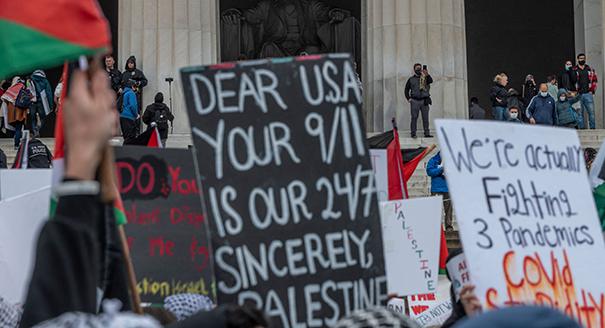
The recent Gaza conflict showed that attitudes toward Israel in the United States are shifting.
The violence in the Israeli-Palestinian conflict is bleakly asymmetrical. At least 213 Palestinian civilians, including 61 children, were killed after Israel began bombarding Gaza on May 10, following rocket attacks by Hamas against Israeli territory. Israeli deaths numbered ten. The lack of parity has been evident for decades.
What has also been typical for decades is the reaction from the political elite and mainstream media in the United States, which have generally been strongly pro-Israel. Whether it is think-tanks, political parties, or media outlets, it has been rare indeed to hear criticism of Israel among Americans. Until now.
When the confrontation in Gaza intensified, it became clear that the narrative in the U.S. mainstream was changing. American politicians spoke in favor of the Palestinians far more loudly than before—both figures in the progressive left of the Democratic Party and others. Senators Todd Young and Chris Murphy issued a bipartisan call for a ceasefire, with dozens of signatories. During the fighting, Democrats in Congress sought to introduce a resolution to force the Biden administration to delay a $735 million sale of precision-guided bombs to Israel, a highly unusual step. Senator Bernie Sanders did much the same on May 20, introducing a resolution of disapproval on the sale. Neither measure succeeded, but they opened up space for a conversation that hadn’t existed before.
Media personalities and journalists, such as Ali Velshi, John Oliver, Mehdi Hasan, and many others also came out in full support for Palestinian rights. Many of them used words such as “apartheid,” “war crimes,” and “ethnic cleansing,” all of which are applicable, but have rarely been heard so loudly in the mainstream. The situation of Palestinian citizens of Israel, who face harsh discrimination, also became part of the mainstream discussion, maybe for the first time.
More broadly, in think tanks and human rights organizations the shift has been in the making for a while now. On May 19, the Carnegie Endowment for International Peace released a landmark report insisting on the need for the United States to base its policies with regard to the West Bank, Jerusalem, and Gaza on a “rights-based approach.” A week or so later Human Rights Watch, following on from the Israeli human rights group B’Tselem, condemned Israeli officials for being guilty of the crimes of apartheid and persecution.
The “Palestinian Lives Matter” phrase sums up this change, not only in terms of its actual meaning but also its relationship to the movement from which it borrowed the name. Black Lives Matter reasserted the centrality of civil liberties among U.S. progressives. The Democratic Party has already shifted to the left, especially among the young. President Joe Biden’s electoral platform, despite his own history as a centrist, reflected a great deal from the left of the party, including from Sanders and Elizabeth Warren. Both senators came out in open support of the Palestinians, as have other public figures and celebrities, including actors John Cusack, Natalie Portman, and Mark Ruffalo. It involves too many verbal and moral acrobatics to be a “progressive except for Palestine,” which is why even before the latest escalation, progressives such as Marc Lamont Hill and Mitchell Plitnick were pushing for the progressive camp to extend the logic of its politics to how it engaged on the Palestine question.
On May 19, a former U.S. ambassador to Israel, Martin Indyk, stated in an interview with Mehdi Hasan that the trend supporting Israel has been “slipping” for years, pro-Palestinian sentiment is picking up steam, and such differences are “fracturing the Democratic Party.” Against that backdrop, it’s going to be difficult for “progressives except for Palestine” to hold onto their progressive credentials in the progressive and Democratic camps. That’s one of the unintended dividends of the Black Lives Matter movement. One cannot push for accountability, oppose discrimination, and reject unwarranted state violence at home, while making apologies for it abroad.
Yet it is also important that throughout the latest escalation, U.S. policy remained solidly pro-Israel. The Biden administration intervened several times at the United Nations to foil Security Council attempts to reach a ceasefire, and repeatedly upheld what it called Israel’s right to self-defense, without insisting that this be exercised only in accordance with international law. This, predictably, resulted in the disproportionate Israeli use of force, and the large number of civilian deaths. Moreover, the Palestinians’ right to defend against Israeli strikes, like specific condemnation of the killings of Palestinian civilians, was not even suggested by the administration, leading to bizarre statements when it was pressed on the issue.
The “both sides” school of foreign policy commentary also took center stage in much of the mainstream discussion, despite this hardly being a situation of parity. Israel is occupying Palestinian territory, while Palestinians are not occupying Israeli territory. Twenty times as many Palestinians were killed as Israelis. There is no real equivalence here.
For the time being, U.S. policy isn’t changing, but the discussion certainly is. Earlier this week, more than 500 Biden staffers issued an open letter to the president, insisting on a more balanced approach to the Palestinian-Israeli conflict. The question is not if policies will shift, but when. Moreover, the increased prominence of the far-right in Israeli politics will only exacerbate splits between Israel and the American left—including within the Democratic Party. This might be a long time overdue, but Palestinian lives do, in fact, matter.

Former Nonresident Scholar, Middle East Program
Dr. H.A. Hellyer was a nonresident scholar at the Carnegie Endowment for International Peace. He serves as a senior associate fellow at the Royal United Services Institute for Defence and Security Studies in London, and as a Cambridge University fellow.
Recent Work
H. A. Hellyer
H. A. Hellyer
Carnegie does not take institutional positions on public policy issues; the views represented herein are those of the author(s) and do not necessarily reflect the views of Carnegie, its staff, or its trustees.
Spot analysis from Carnegie scholars on events relating to the Middle East and North Africa.

Michael Young
The party’s objectives involve tying together the Lebanese and Iranian fronts, while surviving militarily and politically at home.
Mohamad Fawaz
While armed forces commander Rudolph Haykal’s caution is understandable, he is in a position to act, and must.
Michael Young
In an interview, Hamidreza Azizi discusses how Tehran has adapted in real time to the conflict with the United States and Israel.
Michael Young
The simple conclusion is that the scheme will bring neither peace nor prosperity, but will institutionalize devastation.

Nathan J. Brown