

Commentary
Michael Young
{
  "authors": [
    "Michael Young"
  ],
  "type": "commentary",
  "blog": "Diwan",
  "centerAffiliationAll": "dc",
  "centers": [
    "Carnegie Endowment for International Peace",
    "Malcolm H. Kerr Carnegie Middle East Center"
  ],
  "collections": [
    "Reaction Shot",
    "Decoding Lebanon"
  ],
  "englishNewsletterAll": "menaTransitions",
  "nonEnglishNewsletterAll": "",
  "primaryCenter": "Malcolm H. Kerr Carnegie Middle East Center",
  "programAffiliation": "MEP",
  "programs": [
    "Middle East"
  ],
  "projects": [],
  "regions": [
    "Levant",
    "Lebanon",
    "Middle East"
  ],
  "topics": [
    "Political Reform"
  ]
}
Source: Getty
Spot analysis from Carnegie scholars on events relating to the Middle East and North Africa.
What Happened?
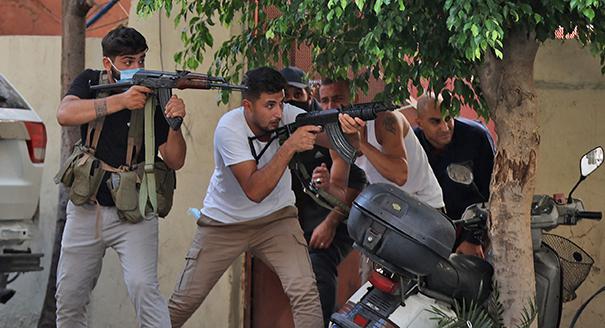
On October 14, fighting broke out in Beirut between armed members of Hezbollah and the allied Amal Movement in Beirut on the one side and as yet unidentified gunmen on the other, as unarmed protestors were heading toward the Palace of Justice to oppose the ongoing investigation into the Beirut port blast of August 4, 2020. The fighting killed seven people and injured 32. Hezbollah and Amal, along with other political forces, had accused the investigating magistrate, Tareq Bitar, of politicizing his investigation. Bitar has sought to question a number of former ministers and parliamentarians. Among them are two members of Amal, Ali Hassan al-Khalil and Ghazi Zeaiter. Bitar issued an arrest warrant for Khalil when he failed to attend his interrogation, provoking Amal’s and Hezbollah’s anger.
As the Hezbollah and Amal members reached the Tayyouneh roundabout that would take them into a predominantly Christian area where the Palace of Justice is located, snipers fired upon them. According to witnesses and people who posted videos on social media, before the gunfire began Shia youths had entered a Christian neighborhood near the roundabout and attacked the inhabitants while shouting “Shia! Shia!” It remains unclear whether the sniper fire was a reaction to the entry of the youths into the quarter or a premediated effort to warn Hezbollah and Amal that they would no longer go into Christian neighborhoods without paying a price for this. Very likely, it was a mixture of both.
Why Is It Important?
By the end of the day, few doubted that the sniper fire was the work of the Lebanese Forces, the Christians’ principal wartime militia that is today a political party. Hezbollah and Amal accused the Lebanese Forces of being responsible, even naming names, which the latter denied. However, since the previous day, members of the Lebanese Forces had been preparing for the protests by Hezbollah and Amal, viewing them as an act of intimidation against Christian areas. A majority of the victims of the port explosion were Christian, so in Lebanon’s sectarian context, Hezbollah, which many Christians believe was responsible for the explosion (though nothing indicates this as yet), and Amal are seen as preventing accountability for a tragedy that mainly affected Christian areas.
The Lebanese Forces also appear to have seen an opportunity to portray themselves as the defenders of Christian areas. On several occasions, young Shia men affiliated with the community’s political parties have entered Christian-majority neighborhoods in an aggressive way. They did so in January 2018, when Amal supporters attacked the Free Patriotic Movement (FPM) headquarters in an eastern suburb of Beirut, after the FPM leader, Gebran Bassil, called Nabih Berri, Amal’s leader, a “thug.” They did so again in November 2019, when youths entered Monot Street and began throwing rocks at cars and homes, as part of an effort to intimidate protestors who at the time were demonstrating against Lebanon’s political leadership.
Even if the young Shia in these incidents were pushing hard against the red lines of sectarian sensitivities, the decision of the Lebanese Forces to escalate in this manner, if it is confirmed that they were behind the sniper attacks, is both dangerous and shameful. The Lebanese Forces leader, Samir Geagea, may have decided to organize the attacks because he felt that Hezbollah’s options were limited. If the party attacks Christian areas in retaliation, it would undermine its key Christian allies, President Michel Aoun and Bassil, his son in law. Hezbollah has no interest in provoking a Christian-Shia conflict, all the more so as it would isolate the party in Lebanon’s sectarian environment. Hezbollah is on poor terms with a majority of Sunni Muslims and Druze, so also unifying the Christians against the party would make its status in the country even more precarious.
Such calculations hardly preclude other forms of retaliation by Hezbollah. However, the party may also want to avoid dynamics leading to a civil war, as this could jeopardize its role in Iran’s regional system. With a majority of Lebanese opposed to Hezbollah’s agenda, and Israel nearby waiting for an opportunity to cripple the party, it would be suicidal for Hezbollah to become engulfed in a protracted civil conflict that would grind down its military capacities, as happened to Palestinian organizations during the Lebanese civil war. Nor does Hezbollah, for all its vaunted military might, have the means to control all of Lebanon, a viper’s nest if there ever was one.
As for Geagea, his move has done several things. It has put Aoun and Bassil, his main Christian political rivals, in a tight spot. By defending Hezbollah and Amal, they risk alienating many Christians, who want the investigation of the port explosion to continue and regard the incursion of Shia youths into their neighborhoods as unacceptable. But if they condemn the Shia parties, they may undermine their ties with Hezbollah, which Bassil considers essential if he is to have any chance of succeeding Aoun as president next year. Not surprisingly, Bassil issued a statement yesterday in which he tried to have it both ways—condemning those who fired on the protestors, while also implicitly criticizing Hezbollah’s and Amal’s efforts to impose their will on the rest of society.
Geagea has also forced Aoun and Bassil to think carefully about their electoral strategy in parliamentary elections next spring. In the last three elections, they have been allied with Hezbollah. However, if Hezbollah and Amal manage to derail Bitar’s investigation, the Christian backlash could be very strong and have a negative impact in terms of Christian support for Aoun’s and Bassil’s electoral lists. The problem, however, is that the sudden escalation in violence could possibly provoke new developments in Lebanon that lead to a cancellation of elections, and take the country into a much darker period than the one that exists today.
What Are the Implications for the Future?
Whether the Lebanese want it or not, their country is now locked in a logic of civil war. That does not mean war will happen, in fact it may not, but the groundwork is certainly taking form. Armed groups are defining their sectarian territories, the state appears too weak to prevent hostile actions, and the economic situation is catastrophic, which means there is a large pool of young men who can be recruited into militias. At this stage what is missing is foreign funding, a key dimension of movement toward war. But that could change quickly.
A major problem is that Hezbollah is now acting as the supreme authority in Lebanon, when it has no legitimacy to do so. In a profoundly sectarian context, in which diverse communities regard the efforts by one religious group to impose its hegemony as an existential threat, this can be perilous. The Sunnis made that mistake in 1975–1976, as did the Maronites in 1982–1984. Moreover, Hezbollah is the proxy of an outside power with scant consideration for Lebanon’s complicated and volatile sectarian system. Unless the party addresses its sectarian isolation, lowers tensions with the other communities, and allows the state to revive itself economically, the country’s already unstable peace will disintegrate even more.

Editor, Diwan, Senior Editor, Malcolm H. Kerr Carnegie Middle East Center
Michael Young is the editor of Diwan and a senior editor at the Malcolm H. Kerr Carnegie Middle East Center.
Recent Work
Michael Young
Michael Young
Carnegie does not take institutional positions on public policy issues; the views represented herein are those of the author(s) and do not necessarily reflect the views of Carnegie, its staff, or its trustees.
Reconciliation councils are emerging throughout the country to mediate in intracommunal disputes, many from the war years.
Natacha Danon
As the U.S.-led Coalition withdraws, the Kurds’ reliance on Baghdad, and on themselves, will only increase.
Wladimir van Wilgenburg

As the U.S. stumbles in its war with Iran, we are likely to see an acceleration of its disengagement from the region.
Michael Young
The Zaidi government’s objective to collect weapons is constrained by regional conflict, but it can take certain measures at home.
Ali Al-Mawlawi
The accord represents a pivotal moment in the region to avert a security vacuum in the Gulf.


Azeema Cheema, Mohanad Hage Ali