

Commentary
Michael Young
{
  "authors": [
    "Michael Young"
  ],
  "type": "commentary",
  "blog": "Diwan",
  "centerAffiliationAll": "dc",
  "centers": [
    "Carnegie Endowment for International Peace",
    "Malcolm H. Kerr Carnegie Middle East Center"
  ],
  "collections": [],
  "englishNewsletterAll": "menaTransitions",
  "nonEnglishNewsletterAll": "",
  "primaryCenter": "Malcolm H. Kerr Carnegie Middle East Center",
  "programAffiliation": "MEP",
  "programs": [
    "Middle East"
  ],
  "projects": [],
  "regions": [
    "Levant",
    "Lebanon",
    "Middle East",
    "Iran"
  ],
  "topics": [
    "Political Reform"
  ]
}
Source: Getty
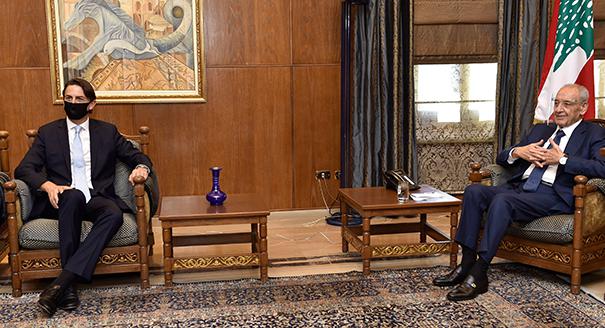
Iran, through Hezbollah, has invited itself into Lebanon’s negotiations with Israel over offshore gas fields.
After Hezbollah flew drones over an Israeli gas rig last week, it was apparent that Lebanon’s negotiations with Israel over offshore gas fields had become a regional matter involving Iran. Throughout the Middle East, the Iranians have a major say on several fronts—in Yemen, Syria, the Palestinian territories, Iraq, and Lebanon—and they’ve just opened up another box over which to negotiate.
At a moment when Europe is reducing its dependency on Russian oil and gas, Iran has upped the ante by affirming that the security of potential Israeli gas supplies to Europe may be under threat if Iran’s interests are not taken seriously—whether in reviving the Joint Comprehensive Plan of Action (JCPOA), the nuclear deal with Iran, in Lebanon, or elsewhere. Iran is also better able to leverage its demands in the nuclear negotiations if Europe and the United States seek to urgently bring Iranian oil to market in order to make up for their curtailment of Russian supplies.
Whatever the calculations, it is apparent that Lebanon’s gas is now very much an extension of Iran’s gas. For a time, President Michel Aoun, with his son in law Gebran Bassil, competed with Parliament Speaker Nabih Berri for control of the gas file, but all this has been shown to be minor clutter. The real game is taking place at the regional level, and even at the level of the global economy, where Iran has increased its sway over potential gas supplies to the West. That’s worth a lot to officials in Tehran, and can bring dividends in talks over the Middle East’s future.
To understand what is happening, one has to look at the broader region. Despite claims of Arab hostility toward Iran, most of the major Arab states—Saudi Arabia, Egypt, Jordan, and the United Arab Emirates—appear to be engaged in a dialogue with Tehran, mostly through Iraqi mediation. While the outcome of such exchanges remains unclear, the fact that they are happening makes perfect sense. To Arab states, the revival of the JCPOA will represent a signal achievement for Iran, one that will unlock billions of dollars for the country once sanctions are lifted. The agreement would also acknowledge Iran’s regional importance, which is what president Barack Obama sought when he initially negotiated the JCPOA.
In that case, opening channels to Iran is a necessity. But the contrary is also true. If negotiations over the JCPOA fail, Tehran is likely to press forward on developing a nuclear weapons capability, which will polarize the Middle East even more. Therefore, the Arab states, realists all, understand they will need to speak to the Iranians, who have the means to be a spoiler in many parts of the region. The war in Yemen has shown the Saudis and the Emiratis that a frontal confrontation with Iran and its regional allies can have unforeseen consequences, which end up strengthening the Iranians rather than weakening them.
Where does this place Lebanon’s gas dispute with Israel? The optimism expressed by Aoun and his foreign minister, Abdullah Abou Habib, about the likelihood of an impending deal seems ludicrous in light of news from the mediation efforts of Amos Hochstein, the Biden administration’s senior advisor for energy security. During the envoy’s last visit to Lebanon, Lebanese officials reportedly proposed that line 23, the line they have officially presented to the United Nations as the boundary of their maritime territory abutting Israel’s, be modified to include the entirety of the Qana gas field, so as not to share the field with Israel. According to newspaper reports, Israel responded with two conditions for ceding Qana: that once Lebanon begins exploiting its gas, it compensate Israel financially; and that Israel receive a greater share of Bloc 8, next to Qana, to offset what it surrendered.
Both Israeli conditions, particularly the first, may be unacceptable to Hezbollah. Worse, the Lebanese are on shaky legal ground because, while they have set line 23 as their official demand, Aoun has said publicly that Lebanon is entitled to a larger maritime zone, corresponding to an area encompassed by what is known as line 29. Yet Lebanon has not registered line 29 at the UN. So it finds itself in a gray zone, where it is asking for an area larger than that contained by line 23, but without having established a legal basis for this. Meanwhile, Hezbollah, having invited itself into the negotiations, is setting Iranian red lines on how things should proceed.
The Lebanese authorities, through their incompetence, now find themselves caught between Hezbollah and the Americans. According to a Lebanese newspaper that tends to be critical of Hezbollah, Hochstein allegedly warned the Lebanese after the drones incident that such steps might bring punitive measures, including sanctions on Lebanon’s investments in oil and gas. Whatever the veracity of such claims, Lebanese officialdom condemned the drone mission, amid indications that this had been demanded by U.S. officials.
One has to wonder, then, how Aoun and Abou Habib can be optimistic. If anything, their words appear to cover for the fact that Lebanon’s incoherent negotiating strategy has been a complete fiasco. But maybe that just doesn’t matter, as the negotiations today are not in Lebanon’s hands anyway. Ultimately, they’re in Iran’s hands, as talks continue over the JCPOA and as Tehran continues to seek advantageous arrangements with its Arab counterparts.

Editor, Diwan, Senior Editor, Malcolm H. Kerr Carnegie Middle East Center
Michael Young is the editor of Diwan and a senior editor at the Malcolm H. Kerr Carnegie Middle East Center.
Recent Work
Michael Young
Michael Young
Carnegie does not take institutional positions on public policy issues; the views represented herein are those of the author(s) and do not necessarily reflect the views of Carnegie, its staff, or its trustees.
As the U.S.-led Coalition withdraws, the Kurds’ reliance on Baghdad, and on themselves, will only increase.
Wladimir van Wilgenburg

As the U.S. stumbles in its war with Iran, we are likely to see an acceleration of its disengagement from the region.
Michael Young
The Zaidi government’s objective to collect weapons is constrained by regional conflict, but it can take certain measures at home.
Ali Al-Mawlawi

Huawei pushed hard to enter the Egyptian data centers market, until the Americans made a better offer.

Angie Omar

Middle Eastern states should welcome an accelerated U.S. disengagement from their region.
Michael Young