

Commentary
As the U.S.-led Coalition withdraws, the Kurds’ reliance on Baghdad, and on themselves, will only increase.
Wladimir van Wilgenburg
{
  "authors": [
    "Marc Pierini",
    "Francesco Siccardi"
  ],
  "type": "commentary",
  "blog": "Diwan",
  "centerAffiliationAll": "dc",
  "centers": [
    "Carnegie Endowment for International Peace",
    "Carnegie Europe",
    "Malcolm H. Kerr Carnegie Middle East Center"
  ],
  "collections": [],
  "englishNewsletterAll": "menaTransitions",
  "nonEnglishNewsletterAll": "",
  "primaryCenter": "Malcolm H. Kerr Carnegie Middle East Center",
  "programAffiliation": "MEP",
  "programs": [
    "Middle East"
  ],
  "projects": [],
  "regions": [
    "Levant",
    "Middle East",
    "Türkiye",
    "Syria",
    "Western Europe",
    "Europe"
  ],
  "topics": [
    "Political Reform"
  ]
}
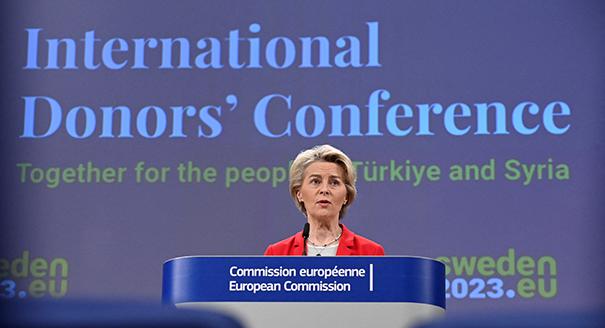
Source: Getty
Donors have pledged money to Turkey and Syria after the recent earthquake, but now the hard part begins.
In an era of media-focused diplomacy, the post-earthquake donors’ conference convened on March 20 in Brussels by European Commission President Ursula von der Leyen and Sweden’s Prime Minister Ulf Kristersson was a show where all sides played politics—European Union (EU) institutions, EU member states, the United Nations, Turkey’s leadership, and even Syria’s absent authorities. Pledges adding up to nearly €7 billion (around $7.5 billion) were quite remarkable, but this was the “easy” part. Now the pledges need to be carefully implemented.
Seen from newsrooms, the conference was spectacular in several ways. Turkey’s government was invited, while Syria’s couldn’t be since the EU does not recognize the legitimacy of the Assad government. This led to a protest from Damascus. Ankara managed to have President Recep Tayyip Erdoğan speak by video link, a smart move given the underlying electoral context in Turkey. Kristersson was present, perhaps hoping for side chats with Turkish participants on Sweden’s accession to NATO, which is still being blocked by Ankara—to no avail. Turkey and Greece requested a private room for a bilateral session of earthquake diplomacy, which led to an exchange of diplomatic gestures linked to the UN Security Council and the International Maritime Organization.
Von der Leyen, the sole leader from the EU’s executive branch, was able to show that, notwithstanding the aggression against Ukraine and a massive challenge to Europe’s energy security, a daunting catastrophe could be handled with dignity and speed. She declared, “Together with our partners, we have raised €7 billion in total to support the people in Türkiye and Syria, following the devastating earthquakes. … We have shown to the world that we are supporting those in need. And we always stand by our partners.”
Regarding pledges, what is striking is the vast discrepancy between the amount collected for Syria (€911 million in grants) and Turkey (€1.7 billion in grants and €4.29 billion in loans). Some of it can be explained: Turkey suffered more seismic damage; northeastern Syria is ruled by several political actors, which makes it more complicated to disburse funds there; and most international organizations are reluctant to extend loans to Damascus’ bankrupt and corrupt regime. The grants secured for Syria will be managed through the UN system and by internationally recognized nongovernmental organizations.
The EU will mobilize a range of financial instruments—humanitarian assistance from the European Civil Protection and Humanitarian Aid Operations for both Syria and Turkey; and the EU Solidarity Fund, the Instrument for Pre-Accession Assistance, and the European Investment Bank for Turkey. But it is a long way from the shiny Charlemagne Building in Brussels to the piles of rubble in Turkey and Syria. The issues to be addressed in rehabilitating damaged infrastructure and rebuilding destroyed homes are truly daunting.
The multiplicity of donors, each with its own procedures dedicated to “humanitarian aid,” “early recovery,” “rehabilitation,” or “reconstruction,” creates a challenging task for the officials in charge of implementing the pledges. Furthermore, the fact that participants in the conference articulated no clear vision for post-earthquake projects may lead to opaque implementation. The risk is inherent in any post-catastrophe support, as governments of the impacted countries are keen to show immediate action. This is particularly evident for Turkey, where presidential and legislative elections will take place in May. The Syrian regime, engaged in a process of political reconciliation with the Gulf states, probably expects additional funding from the region as part of this incipient rapprochement.
One obvious, if uneasy, task for the international community of donors is to make sure that anti-seismic norms and construction material standards are checked and enforced. The tens of thousands of victims and the millions of impacted citizens in both countries deserve such efforts. Another underlying issue is the risks to human health and the environment. Lack of potable water and sanitation is an obvious worry, as is the enormous amount of rubble (including asbestos and chemicals) that is being hastily disposed of without precautions.
In Turkey, the UN estimates that 15 million people have been directly impacted by the earthquakes. Of these, 3 million people are homeless, while another 2 million have moved to other parts of the country to secure jobs, healthcare, and schooling. Such voluntary relocations deprive large Turkish cities such as Gaziantep, Karahmanmaraş, or Şanliurfa of some of their best workforce, creating a risk for the region’s commercial and industrial fabric. Syrian refugees present in the region may be able to fill some of the empty jobs, thus limiting Ankara’s ambitions to send them back to their homeland.
In Syria, according to UN agencies, close to 9 million people have been affected, primarily in Aleppo and Idlib Governorates. The task of assisting victims of the earthquake comes on top of the effects of the decade-long civil war in Syria’s northwest, where health infrastructure is already destroyed and there is the presence of a large number of internally displaced people. Implementing the new package of post-earthquake assistance measures will fall largely on the UN organizations already present in the area. Vigilance will be necessary in order to avoid any form of demographic engineering in the regions bordering Turkey.
Overall, international solidarity was strong only six weeks after the earthquake took place. Now, implementing the €7 billion in pledges will require steadfastness from the agencies involved. They will face both the epic magnitude of the disaster as well as a vast array of political constraints.

Senior Fellow, Carnegie Europe
Marc Pierini is a senior fellow at Carnegie Europe, where his research focuses on developments in the Middle East and Turkey from a European perspective.
Deputy Director, Carnegie Europe
Francesco Siccardi is deputy director at Carnegie Europe.
Carnegie does not take institutional positions on public policy issues; the views represented herein are those of the author(s) and do not necessarily reflect the views of Carnegie, its staff, or its trustees.
As the U.S.-led Coalition withdraws, the Kurds’ reliance on Baghdad, and on themselves, will only increase.
Wladimir van Wilgenburg

As the U.S. stumbles in its war with Iran, we are likely to see an acceleration of its disengagement from the region.

Michael Young

The Zaidi government’s objective to collect weapons is constrained by regional conflict, but it can take certain measures at home.
Ali Al-Mawlawi

The accord represents a pivotal moment in the region to avert a security vacuum in the Gulf.


Azeema Cheema, Mohanad Hage Ali
In an interview, Jason Burke discusses his sweeping account of the “revolutionists” who so shaped the 1970s and early 1980s.
Michael Young