

Commentary
Nathan J. Brown
{
  "authors": [
    "Nathan J. Brown"
  ],
  "type": "commentary",
  "blog": "Diwan",
  "centerAffiliationAll": "dc",
  "centers": [
    "Carnegie Endowment for International Peace",
    "Malcolm H. Kerr Carnegie Middle East Center"
  ],
  "collections": [],
  "englishNewsletterAll": "menaTransitions",
  "nonEnglishNewsletterAll": "",
  "primaryCenter": "Malcolm H. Kerr Carnegie Middle East Center",
  "programAffiliation": "MEP",
  "programs": [
    "Middle East"
  ],
  "projects": [],
  "regions": [
    "Middle East",
    "Israel",
    "Palestine",
    "Levant"
  ],
  "topics": [
    "Political Reform"
  ]
}
Source: Getty
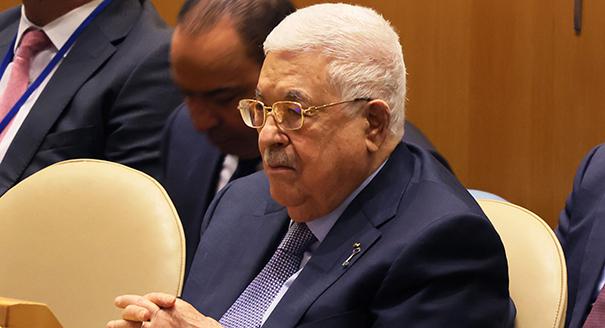
As the succession of Mahmoud Abbas looms, in what ways are his countrymen speculating about the aftermath of his departure?
Mahmoud Abbas, the Palestinian president for two decades, is an old man, prompting speculation about succession. Neither his age nor the speculation is particularly new, but they are both becoming more pronounced. However, there is a subtler shift in discussions about the Palestinian leadership that goes beyond adding years to Abbas’ age: The interrogative adverb, “how,” is now being used by international observers in questions about succession. But among Palestinians, especially those outside official circles, the question is “what.” And the mood among some of those asking these questions is increasingly grim.
The journalistic and diplomatic gossip—and gossip it is—has generally asked, “Who will follow Abbas?” A half-dozen names are bandied about—Fatah leaders, current ministers, security chiefs—with the list changing only slightly over the years, and they point to a small group of aging men. When asked, Palestinian intellectuals and Ramallah will contribute their thoughts on whose star is rising and whose is fading, but the heart of their discussions are moving to other questions.
Indeed, this speculation seems to assume that Palestinians have personalities more than politics or procedures. They are rich in both, if not always happy in either. But with the procedural aspects in mind, in September 2022 Vladimir Pran and I wrote an account of “the how of the who” and sketched the rules and procedures by which various leadership bodies would handle Palestinian succession. Our point was not that the rules were all that mattered, but that they were unlikely to be irrelevant.
More abstractly, the problem for Palestinians is not that the rules will be violated but that they rely on structures, some of which, like the Palestinian National Authority’s parliament, are broken; others operate, but do not offer any accountability or popular voice, such as the Supreme Constitutional Court, which is now headed by Abbas’ former legal advisor. We have not been alone in our interest, as other analysts have joined us in exploring procedural aspects or suggesting the necessity of discussing which fixes can be improvised or imposed.
So specialists have begun to shift the attention to procedure. But what about politics? And it is here that I have found the greatest disconnect between diplomats and pundits on the one hand and the Palestinians whose future is being discussed on the other (though that gap is closing). In discussions with Palestinians during periodic visits over the long period of succession speculation, I have generally been struck by how little the discussions about “who” resonated while those about “how” seemed unsurprisingly legalistic. In that sense, I sometimes sensed that outside of restricted circles, speculation and rumors would be circulated because I was in the room, but I guessed they would stop as soon as I left. There were other more pressing concerns and, in raising the issue of procedures for succession, I seemed to be asking “chicken or pasta?” to airline passengers alarmed that their airplane was rapidly losing altitude.
On a recent visit to the West Bank, I no longer had that sensation. Yes, questions about “who” resonated little—most of the names on the short list do not have a high public profile, and even fewer are held in high public regard because of a sense that Palestinian officials form part of a small, self-perpetuating clique. The corruption of Palestinian leaders has been a staple of conversations for years, but on this trip I was struck by how authoritarianism, harassment of dissidents, restrictions on speech and organization, and their unaccountability came up just as frequently. If the current Palestinian leaders pass from the scene, few will mourn them.
But there is one aspect of succession that does prompt discussion. Palestinians are more likely to speculate about what will come next, not who will succeed or how succession will be handled. Abbas has virtually no public support and the structures of the Palestinian National Authority (PNA)—or the State of Palestine, as the PNA refers to itself—seem not to be the kernel of state, even to those who run them except in a ritualistic way that persuades (or interests) almost no one. The PNA has no raison d’etre, no strategy. It only has an embedded leadership and structures for administration, policing, and service provision for some cities and towns.
But those structures do have some presence and control of them is largely in Mahmoud Abbas’ hands. His departure would be a leap into the unknown. Which structures will survive him? How will they work, if indeed they do? And how might daily life change? Unless there is a very well managed succession consecrated by credible elections, whoever does succeed Abbas will likely raise suspicions from the beginning as being either a foreign imposition or the product of a corrupt backroom deal—or both.
Nobody expects elections any time soon. Most people want them, and I think if they were scheduled and seemed credible, they might generate considerable interest and involvement, even from most young people, who complain about having no voice. But there is no organized or public pressure, and the various political factions either do not want elections or want them on their own specific and irreconcilable terms. The sense that people are voiceless is widespread and is particularly pronounced among youths.
But what comes next can be worse in many ways. The more moderate voices in the current Israeli government talk of annexing territory, but not people. A generation ago, Palestinian critics of the Oslo process (and even its supporters) feared that if the process failed, a series of “Bantustans” would be created in the Occupied Territories. The children and grandchildren of those critics are now watching the entrenchment of that reality.
A Palestinian population controlled by local Palestinian strongmen in disconnected cities, managing rather than replacing the terms of Israeli occupation and keeping some basic level of public services alive, seems a prospect that is not only a real possibility but also a possible Israeli strategy. And more extreme Israeli voices—sometimes in key positions—are calling not simply for bottling up Palestinians as noncitizens in their homeland, but for expelling those who do not like it. Others speak darkly of “Amalek”—the people mentioned in the Bible as an eternal enemy of the Jewish people whose memory should be eliminated.
So speculation about “what” will follow Abbas is rarely cheery. And the prevailing reaction seems to be a mixture of despair and radicalism—the latter particularly pronounced among the young. This radicalism is not in the ideological realm but in the distrust of institutions and authority, and in the willingness to countenance any form of resistance. The upsurge of violence against Israel in Palestinian areas seems therefore more about self-expression than either collective or strategic action.
The anger and despair behind that upsurge are in rich supply but whether that will metamorphose into anything sustainable remains unclear. So far it has not. The first two intifadas were preceded by the strengthening of informal networks, and even formal ones, at the grassroots level. They were led by groups that were somewhat organized at the very local level. There is no evidence thus far of such organizations, formal or informal, arising today. However, there is also little restraining individual action. What appears from afar to be a wave of impulsive but isolated actions looks the same way up close. And over the short term, that may be what comes next.

Nonresident Senior Fellow, Middle East Program
Nathan J. Brown, a professor of political science and international affairs at George Washington University, is a distinguished scholar and author of nine books on Arab politics and governance, as well as editor of five books.
Recent Work
Nathan J. Brown
Nathan J. Brown
Carnegie does not take institutional positions on public policy issues; the views represented herein are those of the author(s) and do not necessarily reflect the views of Carnegie, its staff, or its trustees.
The party’s objectives involve tying together the Lebanese and Iranian fronts, while surviving militarily and politically at home.
Mohamad Fawaz
While armed forces commander Rudolph Haykal’s caution is understandable, he is in a position to act, and must.

Michael Young
In an interview, Hamidreza Azizi discusses how Tehran has adapted in real time to the conflict with the United States and Israel.
Michael Young
The simple conclusion is that the scheme will bring neither peace nor prosperity, but will institutionalize devastation.
Nathan J. Brown
The Jamaa al-Islamiyya is the local Lebanese dimension of a broader struggle involving rival regional powers.

Issam Kayssi