

Commentary
Michael Young
{
  "authors": [
    "Michael Young"
  ],
  "type": "commentary",
  "blog": "Diwan",
  "centerAffiliationAll": "dc",
  "centers": [
    "Carnegie Endowment for International Peace",
    "Malcolm H. Kerr Carnegie Middle East Center"
  ],
  "collections": [],
  "englishNewsletterAll": "menaTransitions",
  "nonEnglishNewsletterAll": "",
  "primaryCenter": "Malcolm H. Kerr Carnegie Middle East Center",
  "programAffiliation": "MEP",
  "programs": [
    "Middle East"
  ],
  "projects": [],
  "regions": [
    "Iran",
    "Levant",
    "Israel",
    "Lebanon",
    "Palestine",
    "Middle East"
  ],
  "topics": [
    "Political Reform"
  ]
}
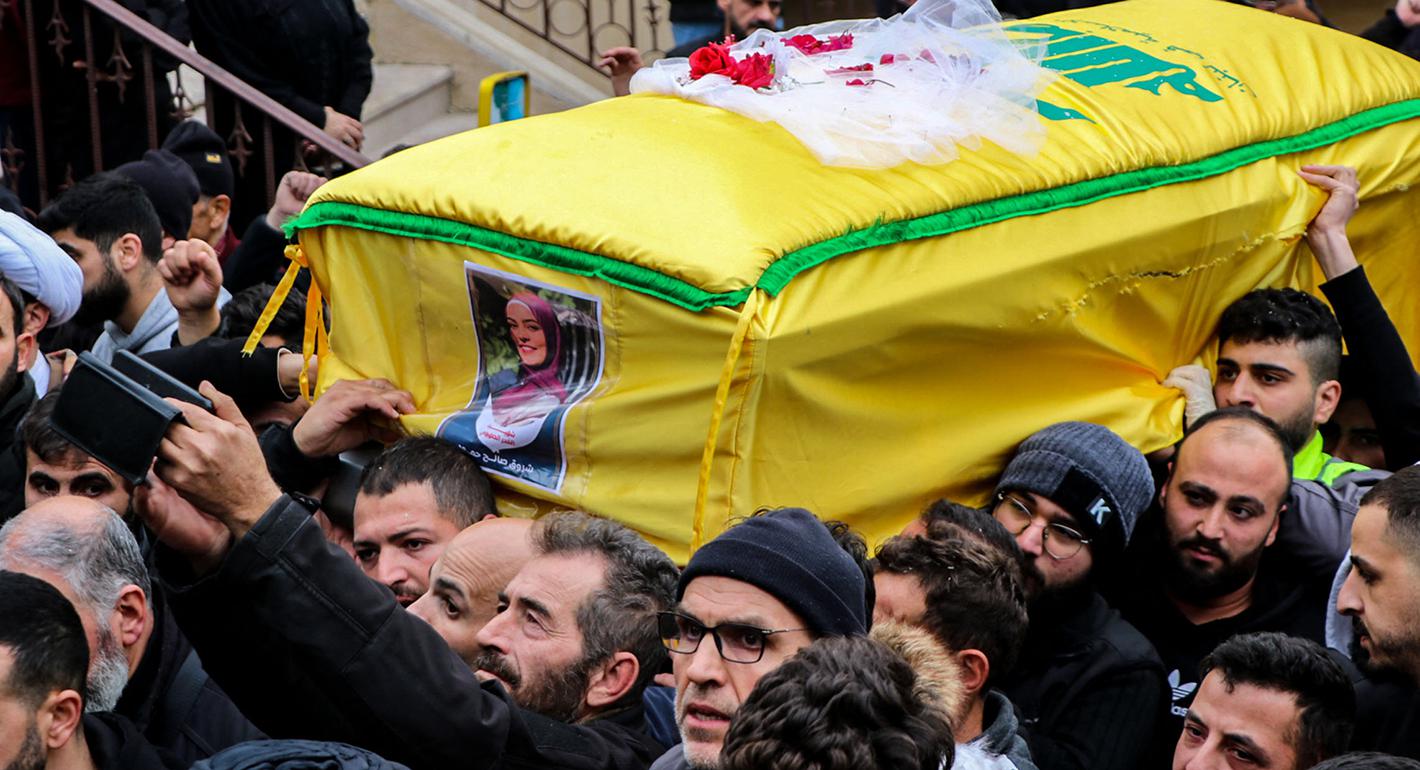
Source: Getty
While Iran has been able to mobilize its region-wide networks and reaffirm its regional importance, the story is more complicated in Lebanon.
While few doubt that Iran and Hezbollah knew of Hamas’s intention to attack Israeli towns around Gaza, it remains unclear whether they knew of the timing, or even welcomed it. Indeed, Reuters, citing three sources, reported that Iran’s supreme leader, Ayatollah Ali Khamenei, told Hamas’s Ismail Haniyeh in early November, “You gave us no warning of your October 7 attack on Israel and we will not enter the war on your behalf.” Hamas later denied the report, calling it “a lie.”
Not everyone buys the version of Iranian surprise, particularly as Iran always had an interest in distancing itself from the Hamas operation, preferring that a phalanx of pro-Tehran Arab militias bear the brunt of Israeli and Western retaliation instead. However, developments in Lebanon may lend some credence to an interpretation that what happened on October 7 was not as clear-cut as an Iranian push-button operation. While Iran’s so-called Axis of Resistance has been able to react on multiple levels to the war in Gaza and the Biden administration’s support for Israel, thereby showing that Tehran is a central player in the Middle East that cannot be circumvented, the storyline is more complicated for Hezbollah.
From the outset of the Gaza war, Hezbollah’s reaction was marked by constraints. Until today, the party has been able to accomplish a careful balancing act of maintaining a certain level of deterrence with Israel while avoiding an all-out, ruinous war that could undermine Hezbollah’s position in Lebanon. Yet this approach always posed great risks, as there was never any certainty that Israel would play along and restrict itself to the party’s levels of violence.
More significantly, a Lebanon conflict almost certainly implied that new arrangements would be sought along the Lebanese-Israeli border at the end, which meant that Hezbollah would have to wrestle with dynamics that might alter the convenient status quo from which the party had benefited prior to October 7. In other words, if the Hamas attacks were planned and coordinated by Iran, they thrust Hezbollah into a highly volatile situation, one reflected in the vocabulary of deescalation from the party’s secretary general, Hassan Nasrallah, in the weeks after the attacks, which showed a strong desire to avoid the worst.
According to the Israeli defense minister, Yoav Gallant, Israel will not end its bombing along the border with Lebanon if there is a pause in the fighting in Gaza. For months, Gallant has been the bad cop on the Lebanon front, threatening to send the country back into prehistory. At the same time, the Israelis have more or less stuck to the unwritten rules of the game along the border, even if they have occasionally widened the margin of their attacks, as when they assassinated the Hamas official Saleh Arouri in Beirut’s southern suburbs.
Revealingly, in an interview on January 18, Gadi Eisenkot, a minister in the Israeli war cabinet, stated that the war cabinet had stopped an attack against Lebanon, which would have been a “very incorrect decision … a very serious strategic error.” Therefore, there is no consensus among Israeli leaders on expanding the war with Lebanon, strongly suggesting that Gallant’s apocalyptic warnings are designed more to shape the outcome of negotiations than a sign of an impending ground war.
But nor can a ground war be completely ruled out. Once Gaza ends, Israel will need to return the inhabitants of the Galilee to the border area. The problem is that many are not sure they want to return, given Hezbollah’s presence nearby. As one local official in the north put it, “We demand a military-political solution responsible for the residents. We have zero tolerance for temporary solutions.” That means that some kind of agreement has to be reached for the broader border region, since there are also tens of thousands of Lebanese citizens who have been displaced by the fighting and who will also need to come back. Until Israel secures concessions allowing it to send northern residents home, it has no incentive to make life bearable in southern Lebanon for Lebanese wanting to return to their villages.
This reality poses problems for Hezbollah. While the party can destroy Israeli towns at will in response to Israeli bombing, the fact that southern villages have been emptied of their inhabitants has given Israel, and other countries, such as the United States, more leverage to reach a resolution in the border area. This may compel Hezbollah to compromise, at least if it seeks to avert a major war in Lebanon—which it does. Can the party be happy with this situation?
Hezbollah has refused to discuss the specifics of any border arrangements until now, saying that all such discussions should await the end of the Gaza war. But the party will have taken note of an apparent concession from the U.S. envoy Amos Hochstein to encourage a Hezbollah withdrawal from the border. Rather than demanding that the party withdraw to behind the Litani River, some 30 kilometers from the border (a condition outlined in Security Council Resolution 1701 and also an Israeli demand) Hochstein reportedly proposed that Hezbollah pull back some 7 kilometers. While Hezbollah is said to have rejected this, its response could well have been an opening position, since when Hochstein proposed it, he was not examining mutual concessions. However, once negotiations begin in earnest, it is possible, even likely, that Hezbollah would consider a package deal from which it could derive something in exchange. Already, the party can see that the U.S. envoy had moved away from Resolution 1701, itself a significant gain.
The main focus of Western governments looking for a solution in Lebanon is to give a leading role to the Lebanese army in any postwar accord. Talk of plans to create an extra regiment in UNIFIL, the United Nations interim force in Lebanon, to man border towers, as reported by the pro-Hezbollah daily Al-Akhbar, is apparently incorrect. As one person very familiar with Western thinking on the south put it, “This is more about getting the [Lebanese armed forces] to extend the state’s sovereignty to an area where you have a line of contact that is unsustainable. The current pattern between Israel and Hezbollah can only end in one of two ways. Either it’s going to be some kind of a negotiated withdrawal north of the Litani River, or at least to a 7-kilometer buffer north of the Blue Line, and the insertion of the [Lebanese armed forces] … [or it’s going to be a full-scale war].
That person added, “There is a willingness, if not a desire, to see [a negotiated solution] happen. At least insofar as the belligerents are concerned, there is a preference for this as a conflict-mitigation tool, but there are a lot of obstacles.”
For Hezbollah, the determinism in this observation—the fact that the conflict on the southern border must end either in a negotiated solution (almost certainly implying new border arrangements) or war—is something the party has tried to avoid. From the outset, Hezbollah appears to have regarded the conflict ideally as an interregnum between two status quos, which is why it has been so reluctant to discuss anything final before the war in Gaza ends.
However, the foul mood in Israel is not one Hezbollah can readily ignore. The October 7 attacks, in being so successful from Hamas’s perspective, created an existential fear in Israel that was always going to have profound repercussions on the Lebanese front, particularly in the sense of encouraging Israeli leaders to eliminate the Hezbollah menace to the north. To avoid this, the party may find itself having to accept new understandings to ward off a wider conflict.
The border war will have also pushed Hezbollah to clarify the constructive ambiguity that had surrounded the party’s, and Iran’s, “unification of the arenas” strategy. Certainly, the Iranians have managed to show their regional reach, their ability to simultaneously put pressure on the Israelis and Americans from Lebanon, Yemen, and Iraq, even as their ally Hamas has survived despite months of withering Israeli bombardment. But at the same time, Hezbollah’s restraint and its depiction of Lebanon as merely a “support front” for Hamas in Gaza have also highlighted the limitations of the “unification of the arenas” strategy. This has accentuated Hezbollah’s assessment that an expanded war in Lebanon might so devastate the country, that it would turn most Lebanese against Hezbollah’s “resistance” role. Such a conclusion may encourage the Israelis to see advantages in entering into a major war, while it also shows that the “unification of the arenas” concept can be a very imperfect one once domestic vulnerabilities are factored into it.
By creating dynamics that might undermine the status quo, by imposing unwanted clarity on the “unification of the arenas” strategy, the Hamas operation may have been unwelcome for Hezbollah, at least in its timing. The situation in Lebanon can go in many directions, but with Gaza destroyed and Hamas’s and the Islamic Jihad’s latitude to coerce Israel militarily neutralized for the time being, even if Hezbollah manages to sidestep a major Israeli offensive in the south, it’s difficult to conclude that October 7 has brought the party much benefit.

Editor, Diwan, Senior Editor, Malcolm H. Kerr Carnegie Middle East Center
Michael Young is the editor of Diwan and a senior editor at the Malcolm H. Kerr Carnegie Middle East Center.
Recent Work
Michael Young
Michael Young
Carnegie does not take institutional positions on public policy issues; the views represented herein are those of the author(s) and do not necessarily reflect the views of Carnegie, its staff, or its trustees.

Middle Eastern states should welcome an accelerated U.S. disengagement from their region.
Michael Young

In an interview, former ambassador Charles Freeman assesses the Trump administration’s war against Iran.
Michael Young

The accord represents a pivotal moment in the region to avert a security vacuum in the Gulf.


Azeema Cheema, Mohanad Hage Ali

In an interview, Jason Burke discusses his sweeping account of the “revolutionists” who so shaped the 1970s and early 1980s.
Michael Young
Lying at the heart of Lebanon’s dysfunction is an inability to secure accountability and institutional legitimacy.

Maha Yahya