

Commentary
Michael Young
{
  "authors": [
    "Michael Young"
  ],
  "type": "commentary",
  "blog": "Diwan",
  "centerAffiliationAll": "",
  "centers": [
    "Malcolm H. Kerr Carnegie Middle East Center",
    "Carnegie Endowment for International Peace"
  ],
  "collections": [
    "Decoding Lebanon"
  ],
  "englishNewsletterAll": "",
  "nonEnglishNewsletterAll": "",
  "primaryCenter": "Malcolm H. Kerr Carnegie Middle East Center",
  "programAffiliation": "",
  "regions": [
    "Lebanon",
    "Israel",
    "United States"
  ]
}
Source: Getty
Israeli-Lebanese talks have stalled, and the reason is that the United States and Israel want to impose normalization.
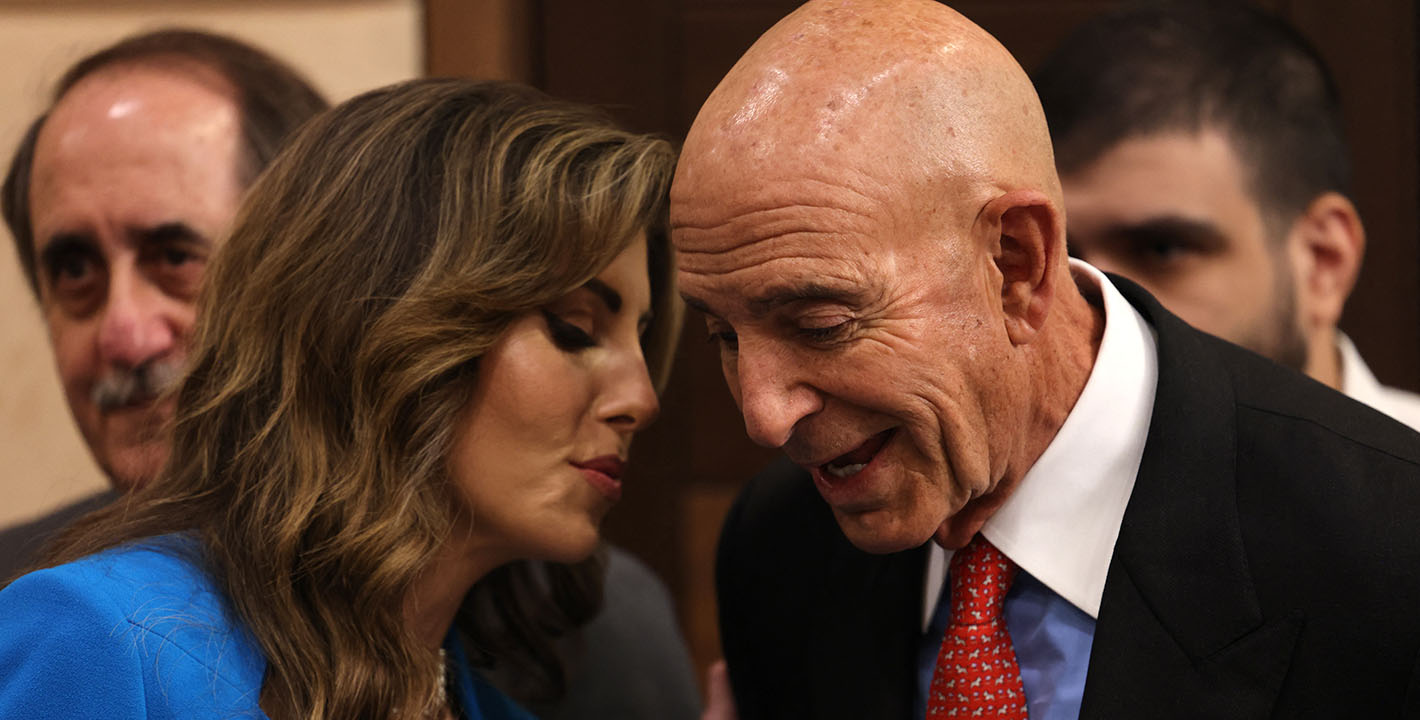
In recent days, there have been reports that the so-called Mechanism, the five-party committee discussing implementation of the ceasefire agreement reached between Lebanon and Israel in 2024, is in deep freeze. This may be due partly to the fact that the U.S. envoy to Lebanon, Morgan Ortagus, recently revealed her relationship with Lebanese banker Antoun Sehnaoui, raising questions about possible conflicts of interest. Ortagus was the major mover in the Mechanism, so until her situation is clarified, things may not advance.
Yet that is not the sole, or even the major, reason for what is a manufactured deadlock. In principle, the Mechanism is supposed to discuss several issues related to implementation of the ceasefire deal. These include an Israeli withdrawal from southern Lebanon in a period “which should not exceed 60 days,” implementation of Resolution 1701 (and implicitly Resolution 1559), which affirm that only the Lebanese state should holds weapons, and indirect negotiations between Lebanon and Israel “with the objective of resolving remaining disputed points along the Blue Line, consistent with [Security Council] Resolution 1701.”
From the Lebanese perspective, the priorities are three: an Israeli withdrawal, border demarcation, which would likely include security arrangements with Israel, and the release of Lebanese prisoners held by the Israelis. However, Israel and the United States have other plans. Their primary aim is to push Lebanon into a normalization arrangement with Israel, and one of their instruments for doing so is the establishment of an economic zone in the border area, an idea that was not part of the November 2024 ceasefire agreement. Rather, the plan was proposed by another U.S. envoy, Tom Barrack, in September. His rationale was that such a zone would create an incentive to normalize relations and bring prosperity to all, replacing Hezbollah’s patronage networks and making its weapons anachronistic.
The Lebanese state is adamantly opposed to such schemes. It understands this would not only divide the country, it could also provoke regional retribution. Beirut is still committed to the Arab Peace Initiative of 2002, which offers Israel peace if it withdraws from all Arab territories occupied in 1967 and accepts a Palestinian state in the West Bank, Gaza, and East Jerusalem. However, neither the United States nor Israel has any interest in what Lebanon wants. Their shared aim is to bludgeon the Lebanese into a hazardous peace.
Making matters worse, the economic zone plan hides something deeply pernicious. According to unconfirmed reports in Beirut, such a zone would be managed by a civil council, which would have Israeli representatives. This would give Israel a say in whatever happens in the Lebanese border area covered by the zone—in other words, it would be allowed to take, or more likely impose, decisions affecting sovereign Lebanese territory.
Faced with bad options, what can the Lebanese do? They should start by looking around them. Given the disengagement of the United States, the present Middle East is being shaped by competition among the region’s leading states—Israel, Türkiye, Saudi Arabia, and Iran, despite its setbacks in the past two years—as they strive to fill the vacuum. The regional political order has morphed into a game largely devoid of ideology or commitments, defined mainly by cold calculations of power, where every country is a potential opponent or ally depending on the circumstances, but where all countries have a stake in preventing the rise of a regional hegemon (other than themselves). In this environment, the parties seek to consolidate spheres of influence in which they can act freely and deny access to their foes.
Only recently, we saw major examples of this new game of nations in three countries—Yemen, Syria, and Iran. In Yemen at the start of the year, Saudi Arabia showed its apprehensions about the partnership between the United Arab Emirates and Israel by engaging in military action in the country. It reversed the early December takeover of Hadhramawt and Mahra Governorates by the UAE-backed Southern Transitional Council (STC), which seeks independence for southern Yemen. This takeover was likely associated in the Saudi mind with Israel’s recognition of Somaliland on December 26. Riyadh saw two of its rivals consolidating their foothold around the Bab al-Mandab Strait, the Saudi passageway to the Gulf of Aden and the Arabian Sea. By taking over the two Yemeni governorates, the STC also cut off Saudi land access to the sea.
While Israel’s involvement in Yemen had been mainly focused on Ansar Allah, or the Houthis, and its alliance with Iran, the reversal of fortune for its Emirati partner cannot have gone down well. The Israelis seek a presence in Somaliland because Bab al-Mandab is also a passage to their Red Sea port of Eilat, and access to the territory will give them the military and intelligence capabilities to monitor the Houthis and Iranian movements in the area, even if Israel does not establish permanent bases. The Iranians and Houthis have also developed ties in the African Horn, including with Al-Shabab in Somalia. Therefore, we are seeing an expansion of Middle Eastern rivalries to the region’s periphery in eastern Africa, which is why, in this broader contest, Emirati setbacks in Yemen have meaning for Israel.
In Syria, Turkish and Saudi agreement on the need to consolidate a unified Syrian state received a major boost when the country’s army forced the Kurdish-led Syrian Democratic Forces to retreat behind the Euphrates River. This was a victory over an Israeli yearning to see Syria fragmented. Israel’s insistence on protecting Syria’s Druze has been an example of this aim, but it was Israel’s foreign minister, Gideon Sa’ar, who best expressed Israeli thinking on the matter. Just under a year ago, he publicly supported a federal system in Syria, one in which ethnosectarian minorities would live in autonomous regions to protect themselves. Not surprisingly, critics construed this as a revival of an Israeli fantasy to break up Arab countries to better safeguard Israel. Several months before that, Sa’ar had, similarly, voiced support for the Kurdish minority in northeastern Syria, describing them as “a great nation, one of the great nations without political independence. They are our natural allies.”
Türkiye has for some time been highly critical of Israel because of its brutality in Gaza. In August of last year, Turkish Foreign Minister Hakan Fidan announced that his country had completely cut off trade ties with Israel and closed its airspace to Israeli aircraft. This reconfirmed and reinforced a decision taken in May 2024 to sever direct bilateral trade ties. However, the Turks are not alone. Since Israel’s bombing of a Hamas office in Qatar last September, Riyadh has also regarded Israel as a foremost regional adversary, seeing in that attack an effort to impose its domination, particularly over the Gulf states, after having provoked a war with Iran in June and dragging the United States into it.
The recent uprising in Iran was also interpreted by the region’s leading states in a similar light. The fact that the Saudis discouraged the United States from attacking Iran, as President Donald Trump had vowed, was built on two premises: that chaos in the country would have a negative impact on regional, therefore Saudi, stability. But most probably also, that Iran’s breakdown could shift the regional balance sharply in Israel’s favor. That’s not to say the Saudis would regret the Iranian regime’s downfall, but today Iran is a potential counterweight to Israel, and the Saudis do not want Israel to gain from an Iranian collapse.
There may be something else. There have been persistent reports of Israeli ties with Baluchi separatists in the Iranian province of Sistan-Baluchistan, which could create problems for both Iran and Pakistan. There have been claims that Israel armed groups in the province prior to the recent uprising, an accusation the Iranian authorities have also made. While this remains unconfirmed, from a Saudi perspective the escalation of a Baluchi insurgency in Iran could also endanger Pakistan, Saudi Arabia’s partner in the Strategic Mutual Defense Agreement of September 2025, which is aimed at reinforcing defense cooperation between Riyadh and Islamabad and laying a foundation for mutual defense in case of war.
What lessons can Lebanese officials draw from the Yemeni, Syrian, and Iranian examples? Siding with Israel will mean turning Lebanon into a regional football, which the country cannot afford. Any U.S. or Israeli effort to shoehorn Lebanon into an Israeli sphere of influence will be perceived by Israel’s adversaries as a challenge, not least because Lebanon is a strategic extension of Syria, whose stability is vital for Ankara and Riyadh. The Lebanese have to play on this to secure a margin of maneuver with regard to Israel, as both the Saudis and Turks have a strong voice in Washington. This is easier said than done, however, and will probably have to be accompanied by measures that satisfy the Americans, such as making tangible gains in disarming Hezbollah and strengthening the army’s presence south of Sidon.
The Lebanese must also ensure that France and the United Nations remain active participants in the Mechanism, and not be pushed aside by the United States and Israel. There are limits to what both can do, but by refusing a U.S. and Israeli monopoly over the Mechanism, Lebanon could avoid the trap of coerced peace. This would also reaffirm Beirut’s commitment to a UN framework for diplomacy on Lebanon, as well as Lebanese willingness to implement Security Council resolutions, above all Resolutions 1559 and 1701.
Lebanon’s weaknesses impose more proactive regional diplomacy as well, to find supporters in its efforts to push back against the U.S. and Israeli agenda. Aside from Türkiye and Saudi Arabia, states such as Egypt, Qatar, and Jordan, which all have considerable leverage in Washington, could back the Lebanese in sidestepping normalization. If Israel uses this as a pretext to resume a more intensive bombing campaign, such countries would also be valued allies in asking the Trump administration to restrain the Israelis.
Hezbollah is not making things easier for the Lebanese state, as it has refused to disarm in the impending second phase of the army’s plan to secure a state monopoly over weapons, which covers the area between the Litani and Awwali Rivers. Consequently, Lebanon may have to engage in a more sustained dialogue with Iran over the party’s weapons. The usual response to this is that Tehran has no intention of agreeing to Hezbollah’s disarmament, as it doesn’t want to lose a valuable regional card for nothing in exchange. That may be true, but a new Israeli offensive may not only seize that card from Iran’s hands, it may also make it all but impossible for Lebanon to escape a more concerted U.S. and Israeli push to force it into Israel’s arms. Iran, as a major regional power, has to accept that it has a similar interest as Türkiye and Saudi Arabia in not allowing this to happen.
The United States’ and Israel’s disdain for international law and sovereignty should be a warning to officials in Beirut. Neither has any interest in real peace with Lebanon; their ambition is subjugation, the imposition of a surrender under the guise of peace. If Lebanon wants to reassert the sovereignty of its state institutions, this cannot stop at collecting Hezbollah’s arms; Hezbollah’s archenemy presents no less of a danger.

Editor, Diwan, Senior Editor, Malcolm H. Kerr Carnegie Middle East Center
Michael Young is the editor of Diwan and a senior editor at the Malcolm H. Kerr Carnegie Middle East Center.
Recent Work
Michael Young
Michael Young
Carnegie does not take institutional positions on public policy issues; the views represented herein are those of the author(s) and do not necessarily reflect the views of Carnegie, its staff, or its trustees.

In an interview, Rozina Ali discusses her new book on the rise and manifestations of Islamophobia in the United States.
Michael Young

In an interview, Ian Lustick and Eli Clifton discuss their new book on why a prominent ally has so much influence in America.
Michael Young

As the U.S. stumbles in its war with Iran, we are likely to see an acceleration of its disengagement from the region.
Michael Young

It is improbable that Israel’s forthcoming elections will alter much in terms of how the country thinks about security.

Nathan J. Brown

Middle Eastern states should welcome an accelerated U.S. disengagement from their region.
Michael Young