

Report
Mr. Husain Haqqani, Ashley J. Tellis
{
  "authors": [
    "Husain Haqqani"
  ],
  "type": "legacyinthemedia",
  "centerAffiliationAll": "dc",
  "centers": [
    "Carnegie Endowment for International Peace"
  ],
  "collections": [],
  "englishNewsletterAll": "ctw",
  "nonEnglishNewsletterAll": "",
  "primaryCenter": "Carnegie Endowment for International Peace",
  "programAffiliation": "SAP",
  "programs": [
    "South Asia"
  ],
  "projects": [],
  "regions": [
    "South Asia",
    "India",
    "Pakistan"
  ],
  "topics": []
}
Source: Getty
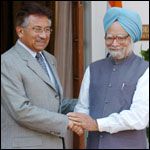
Haqqani argues that it is clearly in India’s interest to help Pakistan gain sufficient confidence as a nation to overcome the need for conflict or regional rivalry for nation building. Simultaneously, it is important for Pakistani civil society to acknowledge that normal relations with India are the key to normalization of politics and policy in Pakistan as well.
Source: The Indian Express

Manmohan Singh accorded priority to normalization of relations between the two nuclear armed South Asian neighbors, hoping that their dispute over Jammu and Kashmir would be resolved as a result of normalization. Singh envisaged ‘‘a situation where the two parts of Jammu and Kashmir can, with the active encouragement of the Governments of India and Pakistan, work out cooperative, consultative mechanisms.’’
The Pakistani response, articulated by a glib but not brilliant foreign office spokeswoman, was predictable. She said that it would be ‘‘unrealistic’’ to expect Pakistan to move forward without progress on the Kashmir issue. ‘‘The ground reality from Pakistan’s point of view’’, she explained, ‘‘is that status quo meaning LOC was not acceptable to Pakistanis or Kashmiris so a viable solution has to be found.’’
Foreign Minister Khurshid Kasuri welcomed the ‘‘positive tone’’ of Prime Minister Singh’s statement. But he, too, emphasized the need to resolve outstanding issues, including Kashmir, as a precondition to normalization of relations.
This exchange, with India calling for normalization and Pakistan insisting on ‘‘resolving’’ Kashmir first, miniaturizes the dilemma of India-Pakistan negotiations. The international community, and sensible people within both countries, wants the India-Pakistan dialogue to continue. But once dialogue gets under way, it sooner or later ends with both sides sticking to stated positions, with little scope for a substantive breakthrough.
Negotiations usually involve reconciling maximum demands — what one side says it desires — with its minimal expectation, what it will settle for. Most observers agree that India’s maximum demand is that Pakistan gives up its claim on all of Jammu and Kashmir, and its minimal expectation would probably be that Pakistan accepts the status quo without further violence and a de facto partition of Kashmir along the Line of Control. An Indian negotiating team would try to secure more than the minimum and would probably settle for less than the maximum.
In recent public pronouncements, Indian officials have made more or less official their preference for settling the Kashmir issue on the basis of legitimizing the status quo, a de facto “take it or leave it” offer albeit with minor sweeteners. But in Pakistan’s case, there has never been much discussion of a ‘bottom line’ national position on the Kashmir conflict.
It is true that an overwhelming majority of Pakistanis feel strongly that they were cheated at the time of partition, when a contiguous Muslim majority state was not allowed to become part of Pakistan. But now, given the price Pakistan has paid in military setbacks and internal crises for trying to secure Kashmir, realism must dictate Pakistan’s foreign policy priorities.
Normalization of relations with India, an emerging global power that is also the strategic partner of the world’s sole superpower, is far more important for Pakistan today than it was in the early years of its life as an independent state. Pakistan no longer has the strategic options of playing one cold war rival against the other to help compensate for its military and economic disparity with India. Pakistan has tried, and failed, to change the territorial status quo in Jammu and Kashmir through both conventional and sub-conventional warfare. Efforts to secure international support against India by emphasizing India’s violations of human rights in Jammu and Kashmir have also yielded little result.
The problem for Pakistan’s ruling elite is that after 58 years of describing Kashmir as Pakistan’s primary national ‘cause’ it is not easy, especially for an unelected military regime, to effectively manage a major shift in national priorities. A feeling of insecurity against a much larger and hostile neighbour was the original source of Pakistani apprehensions about its nationhood. But over the years, structures of conflict have evolved, with the Pakistani establishment the major beneficiary of maintaining hostility.
It is clearly in India’s interest to help Pakistan gain sufficient confidence as a nation to overcome the need for conflict or regional rivalry for nation building. Prime Minister Manmohan Singh’s vision of a comprehensive treaty of peace, friendship and security is a step in helping bolster the confidence of Pakistanis in normal ties between India and Pakistan. It is important for Pakistani civil society to acknowledge that normal relations with India are the key to normalization of politics and policy in Pakistan as well.
Former Visiting Scholar
Recent Work
Mr. Husain Haqqani, Ashley J. Tellis
Mr. Husain Haqqani
Carnegie does not take institutional positions on public policy issues; the views represented herein are those of the author(s) and do not necessarily reflect the views of Carnegie, its staff, or its trustees.
In an interview, Abhinav Pandya discusses the multiple facets of India’s ties with the Middle East.

Armenak Tokmajyan
The interaction of national armed forces and private business sectors offers a useful lens for viewing the politics of numerous countries of the so-called Global South. A rising trend of military political activism—often accompanied by military commercial activity—underlines the importance of drivers and outcomes in these relationships.

Yezid Sayigh, Hamza Meddeb

The Gulf Cooperation Council has shifted its energy export focus to Asia, particularly India and China. This is part of a broader shift as GCC members look to expand their geopolitical alliances away from the West.

Alexandre Kateb
Scholars from Carnegie’s global network comment on how the ongoing conflict between Israelis and Palestinians is affecting their areas of interest, and what the implications of this may be.



Maha Yahya, Rosa Balfour, Judy Dempsey, …
Turkey’s success in finding a role in Afghanistan could bring its leadership valuable benefits.

Marc Pierini