

Commentary
Amr Hamzawy
{
  "authors": [
    "Amr Hamzawy"
  ],
  "type": "legacyinthemedia",
  "centerAffiliationAll": "dc",
  "centers": [
    "Carnegie Endowment for International Peace",
    "Malcolm H. Kerr Carnegie Middle East Center"
  ],
  "collections": [],
  "englishNewsletterAll": "menaTransitions",
  "nonEnglishNewsletterAll": "",
  "primaryCenter": "Carnegie Endowment for International Peace",
  "programAffiliation": "MEP",
  "programs": [
    "Middle East"
  ],
  "projects": [],
  "regions": [
    "North America",
    "United States",
    "Palestine",
    "Levant"
  ],
  "topics": [
    "Political Reform",
    "Security",
    "Foreign Policy"
  ]
}
Source: Getty
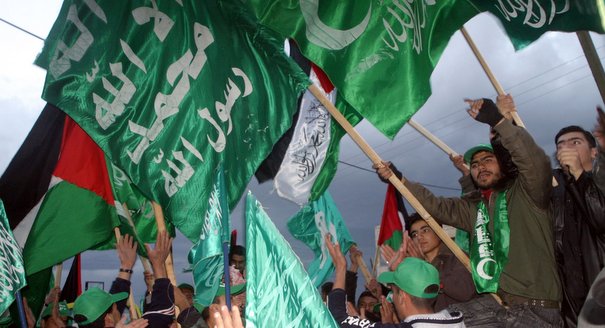
The Obama administration should establish direct talks with Hamas on substantive issues in a public, multilateral forum— otherwise it risks squandering a good deal of its prestige in the Arab world by not making a prominent departure from Bush administration policy.
Source: The National

Hamas is trying to convey to the US its willingness to accept a two-state solution to the Israeli-Palestinian conflict, and that it is willing to play a productive rather than obstructionist role in the peace process. But is the US listening?
It depends on what the US is listening for. If the US is waiting for Hamas to accept its three demands to renounce violence, honour past agreements and recognise Israel’s right to exist, it will probably be disappointed. To expect your opponent to give up all of its leverage before negotiations actually begin is hardly realistic. Rather, the US should interpret Hamas’s statements with two points in mind.
First, Hamas has two different voices for two different audiences. One voice avows armed resistance against Israel and is directed at its Palestinian and Arab base of support. The other voice expresses an interest in a diplomatic solution to the conflict and is directed at the international community.
Second, Hamas’s diplomatic voice has, over the years, consistently stated its willingness to coexist with Israel. In 2003, Hamas stated that it would renounce violence if “the Israelis are willing to fully withdraw from the 1967 Occupied Territories and present a timetable for doing so”. In 2006, Hamas stated: “We have accepted the principle of accepting a Palestinian state within the 1967 borders.” And in 2007, Hamas acknowledged that it is a “reality” that Israel exists and “a matter of fact” that it will continue to exist.
Focusing only on Hamas’s resistance voice would blind anyone to important signals it is trying to send: in practical terms, Hamas has given up pursuing a Palestinian state extending from the Jordan River to the Mediterranean Sea, and the group has acknowledged the two-state solution as fundamental to the peace process.
This is not exactly the stuff of intransigence. Hamas may be a violent organisation, and the most powerful potential spoiler in the Israeli-Palestinian conflict, but its use of violence is tactical rather than ideological and would most likely end in exchange for progress on the ground toward a Palestinian state.
The US should put Hamas’s diplomatic voice to the test. But should the US approach be more indirect or direct, multilateral or bilateral, procedural or substantive, clandestine or public? Domestically, it may be too early for President Obama to pursue direct, bilateral talks in a public forum. Internationally, however, it may be too late for the more a gradual approach of indirect or clandestine talks: President Obama will squander a good deal of his prestige in the Arab world if he doesn’t make a prominent departure from Bush administration policy – and soon.
Mindful of these constraints, we believe the US should establish direct talks on substantive issues in a public, multilateral forum. This forum, for its part, could build on the two forums currently fostering talks with Hamas, one made up of European countries and another of Arab states. Progress on the US-Syrian relationship could open up another channel of communication to Hamas as well.
The talks should focus on how Hamas can play a productive role in the peace process. Above all, this would mean tackling how Hamas can gradually transform into a political group integrated into a unity government; how it can apologise for its June 2007 takeover of the Gaza Strip; and how its forces can be integrated into the broader Palestinian security forces in order to consolidate both Israeli and Palestinian security. A patient and productive exchange could induce positive change in Hamas’s behaviour, identity and relationship with Israel and the West.
Once again, Hamas has explicitly reiterated its support for a two-state solution and implicitly recognised the state of Israel. As the indispensable mediator of the peace process, the US must realise that excluding Hamas cannot possibly advance the peace process beyond the status quo.
This article originally appeared in the National on August 24, 2009.

Director, Middle East Program
Amr Hamzawy is a senior fellow and the director of the Carnegie Middle East Program. His research and writings focus on Egypt’s and other middle powers’ involvement in regional security in the Middle East, particularly through collective diplomacy and multilateral conflict resolution
Recent Work
Amr Hamzawy
Amr Hamzawy
Carnegie does not take institutional positions on public policy issues; the views represented herein are those of the author(s) and do not necessarily reflect the views of Carnegie, its staff, or its trustees.
As the U.S.-led Coalition withdraws, the Kurds’ reliance on Baghdad, and on themselves, will only increase.
Wladimir van Wilgenburg

In an interview, Ian Lustick and Eli Clifton discuss their new book on why a prominent ally has so much influence in America.

Michael Young

As the U.S. stumbles in its war with Iran, we are likely to see an acceleration of its disengagement from the region.
Michael Young
The Zaidi government’s objective to collect weapons is constrained by regional conflict, but it can take certain measures at home.
Ali Al-Mawlawi

Huawei pushed hard to enter the Egyptian data centers market, until the Americans made a better offer.

Angie Omar