

Q&A
Christopher Boucek
{
  "authors": [
    "Christopher Boucek"
  ],
  "type": "legacyinthemedia",
  "centerAffiliationAll": "dc",
  "centers": [
    "Carnegie Endowment for International Peace",
    "Malcolm H. Kerr Carnegie Middle East Center"
  ],
  "collections": [],
  "englishNewsletterAll": "menaTransitions",
  "nonEnglishNewsletterAll": "",
  "primaryCenter": "Carnegie Endowment for International Peace",
  "programAffiliation": "MEP",
  "programs": [
    "Middle East"
  ],
  "projects": [],
  "regions": [
    "Middle East",
    "Yemen",
    "Gulf"
  ],
  "topics": [
    "Security",
    "Military"
  ]
}
Source: Getty
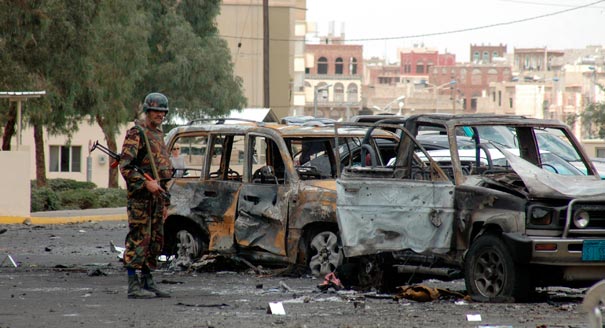
If U.S. counterterrorism assistance to Yemen only takes the form of military and security cooperation, the result is likely to be an increase in the popular grievances that fuel militant groups like al-Qaeda in the Arabian Peninsula.
Source: CTC Sentinel

AQAP has evolved into an increasingly lethal and agile organization, with a proven track record of mounting operations within Yemen, regionally, and internationally. AQAP has been clear in stating its planned objectives, and it has repeatedly delivered on its threats. These concerns have been heightened by the presence of Yemeni-American cleric Anwar al-`Awlaqi in Yemen and his alleged role in inciting English-speaking foreigners to engage in violence and militancy. There are also increasing worries about the involvement of Western, and especially American, nationals in alleged domestic terrorist plots related to or connected with Yemen, AQAP, and Anwar al-`Awlaqi. Moreover, Yemen itself is being transformed from a rest and training arena into an actual theater of jihad.
This article originally appeared in the CTC Sentinel

Former Associate, Middle East Program
Boucek was an associate in the Carnegie Middle East Program where his research focused on security challenges in the Arabian Peninsula and Northern Africa.
Recent Work
Christopher Boucek

Christopher Boucek, Karim Sadjadpour
Carnegie does not take institutional positions on public policy issues; the views represented herein are those of the author(s) and do not necessarily reflect the views of Carnegie, its staff, or its trustees.

The armed forces champion a form of capitalism that is generating revenue, but its reliance on rent faces diminishing returns, leaving the country with massive sunk costs and deferred returns, deepening dependency on external borrowing.

Yezid Sayigh

Morocco and Algeria, each in its own way, are having to navigate the global economic fallout of the U.S.-Israeli military campaign against Iran.

Yasmine Zarhloule

There is a disturbing structural parallel between the old global energy economy and the new green transition.

Angie Omar

In an interview, Marc Lynch discusses his new book decrying the post-1990 U.S.-dominated order in the Middle East.

Michael Young

Because perpetual conflict enhances control, offers economic benefits, and allows leaders to ignore popular preferences.
Angie Omar