• Research
  • Diwan
  • About
  • Experts
Carnegie Middle East logoCarnegie lettermark logo
LebanonIran
{
  "authors": [
    "Amr Hamzawy"
  ],
  "type": "legacyinthemedia",
  "centerAffiliationAll": "",
  "centers": [
    "Carnegie Endowment for International Peace",
    "Malcolm H. Kerr Carnegie Middle East Center"
  ],
  "collections": [
    "Arab Awakening"
  ],
  "englishNewsletterAll": "",
  "nonEnglishNewsletterAll": "",
  "primaryCenter": "Carnegie Endowment for International Peace",
  "programAffiliation": "",
  "programs": [],
  "projects": [],
  "regions": [
    "North Africa",
    "Tunisia",
    "Maghreb"
  ],
  "topics": [
    "Political Reform"
  ]
}
Source: Getty

In The Media

Tunisia: Revolution Shows Hollowness of Arab System in Face of People Power

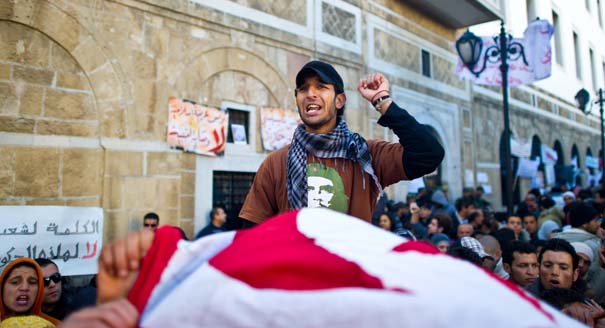
The recent revolution in Tunisia demonstrates the strong potential for citizens to rise up against authoritarianism and should serve as encouragement for Arab leaders to implement democratic change in their own nations.

Link Copied
By Amr Hamzawy
Published on Jan 19, 2011

Source: Los Angeles Times

Tunisia: Revolution Shows Hollowness of Arab Syste
The citizens’ revolution in Tunisia that forced dictator Zine el Abidine ben Ali to flee the country provides many lessons for the Arab world. Regimes should keep the lessons in mind to avoid repeating Tunisia’s experience in their own countries, while citizens can draw inspiration in hopes of effecting democratic change.
 
First, Tunisian citizens have reminded Arabs of the main lesson of democratic transformations: Never underestimate the potential of peoples stifled under the yoke of authoritarianism. No matter how long the rule lasts or how tight its grip, citizens will instigate change through sudden revolutions and uprisings with the power to overcome corruption and bullets.
 
Second, Arabs have learned that authoritarian regimes lack public legitimacy, even if they create economic growth. Under Ben Ali, Tunisia had the highest growth rate among Arab countries outside the Gulf region; average annual individual income rose to $4,000, education became more widespread, and illiteracy rates were cut significantly.
 
Once this growth stagnated, however, many Tunisians became dissatisfied and had no place to turn to air their grievances. Their concerns about bread-and-butter issues quickly evolved into a broader demand for political liberties and democracy.
 
Third, authoritarian leaders are incapable of comprehending people’s suffering. Ben Ali and his ministers ignored rising unemployment rates of 40% among the educated youth and the increasing gap between rich and poor. When street protests turned into a larger uprising, Ben Ali’s regime responded with bullets and clubs. It was only in the final days of his 23-year rule that Ben Ali promised citizens economic and social development, government accountability and democratic change. He convinced no one.
 
Fourth, attempts to overthrow authoritarian rule can occur spontaneously and gain momentum quickly. Demonstrators in Tunisia went beyond raising slogans of democracy, human rights and good governance by forcing the regime to acknowledge their basic social and economic rights. While the cost of overcoming Ben Ali’s regime was high — some 70 Tunisians were killed before he left the country — the demonstrators’ speed and persistence, as well as their growing ability to use social media, were successful in facilitating change.
 
Finally, authoritarian rulers in the Arab world who form friendships with the West — as Tunisia did — should recall the Islamic revolution of Iran in 1979 that overthrew Shah Mohammad Reza Pahlavi. Despite the West’s support for the authoritarian ruler, dictators can be removed from office and Western capitals are among the first to give up on them.
 
If Arab leaders of recalcitrant regimes heed these lessons, they should seek to implement democratic change in measured steps. Within a few weeks, they can impose a democratic form of government, despite the absence of viable opposition. That would benefit not only those in power, but their citizens as well.

About the Author

Amr Hamzawy

Director, Middle East Program

Amr Hamzawy is a senior fellow and the director of the Carnegie Middle East Program. His research and writings focus on governance in the Middle East and North Africa, social vulnerability, and the different roles of governments and civil societies in the region.

    Recent Work

  • Commentary
    Iran Is Pushing Its Neighbors Toward the United States

      Amr Hamzawy

  • Paper
    U.S. Peace Mediation in the Middle East: Lessons for the Gaza Peace Plan
      • Sarah Yerkes

      Amr Hamzawy, Sarah Yerkes, Kathryn Selfe

Amr Hamzawy
Director, Middle East Program
Amr Hamzawy
Political ReformNorth AfricaTunisiaMaghreb

Carnegie does not take institutional positions on public policy issues; the views represented herein are those of the author(s) and do not necessarily reflect the views of Carnegie, its staff, or its trustees.

More Work from Malcolm H. Kerr Carnegie Middle East Center

  • Commentary
    Diwan
    When Football Is More Than Football

    The recent African Cup of Nations tournament in Morocco touched on issues that largely transcended the sport.

      Issam Kayssi, Yasmine Zarhloule

  • Article
    Rethinking Power-Sharing Agreements in Libya

    The UN Support Mission in the country should reassess its approach so that consensus between the warring parties becomes the eventual goal, rather than a procedural matter that dogs the negotiating process at every turn.

      Soraya Rahem

  • Commentary
    Diwan
    Has Sisi Found a Competent Military Entrepreneur?

    Mustaqbal Misr has expanded its portfolio with remarkable speed, but a lack of transparency remains.

      Yezid Sayigh

  • Commentary
    Diwan
    Women, Water, and Adaptation in Ait Khabbash

    The burden of environmental degradation is felt not only through physical labor but also emotional and social loss.

      Yasmine Zarhloule, Ella Williams

  • Article
    Between Marginalization and Climate Change: The Resilience of Morocco’s Ait Khabbash

    For the traditionally nomadic Amazigh pastoralists in the Draa-Tafilalet region, environmental change has exacerbated long-standing inequities, forcing the community to adapt, which has laid bare the blind spots of state-centered climate policy frameworks.

      Yasmine Zarhloule, Ella Williams

Get more news and analysis from
Malcolm H. Kerr Carnegie Middle East Center
Carnegie Middle East logo, white
  • Research
  • Diwan
  • About
  • Experts
  • Projects
  • Events
  • Contact
  • Careers
  • Privacy
  • For Media
Get more news and analysis from
Malcolm H. Kerr Carnegie Middle East Center
© 2026 Carnegie Endowment for International Peace. All rights reserved.