• Research
  • Diwan
  • About
  • Experts
Carnegie Middle East logoCarnegie lettermark logo
LebanonIran
{
  "authors": [
    "Marina Ottaway"
  ],
  "type": "legacyinthemedia",
  "centerAffiliationAll": "dc",
  "centers": [
    "Carnegie Endowment for International Peace",
    "Malcolm H. Kerr Carnegie Middle East Center"
  ],
  "collections": [
    "Arab Awakening"
  ],
  "englishNewsletterAll": "menaTransitions",
  "nonEnglishNewsletterAll": "",
  "primaryCenter": "Carnegie Endowment for International Peace",
  "programAffiliation": "MEP",
  "programs": [
    "Middle East"
  ],
  "projects": [],
  "regions": [
    "Middle East",
    "North Africa",
    "Egypt",
    "Gulf",
    "Levant",
    "Maghreb"
  ],
  "topics": [
    "Political Reform",
    "Foreign Policy"
  ]
}
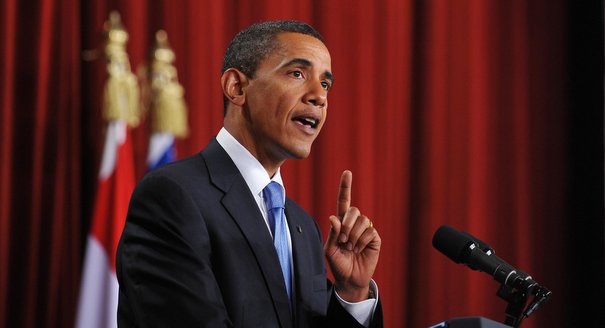
Source: Getty

In The Media

Did Obama Lay Out a Cohesive Middle East Policy?

President Obama’s speech in response to the Arab Spring did not establish a clear foreign policy for the region, but rather outlined a vision of a democratic and prosperous Middle East.

Link Copied
By Marina Ottaway
Published on May 19, 2011

Source: Politico

Did Obama Lay Out a Cohesive Middle East Policy?President Obama’s speech will disappoint audiences in the Middle East. It does not outline a policy, but a vision — that of a democratic and prosperous Middle East — which of course is not new. In the region, this will be seen as another rhetorical statement rather than as a policy.

The amount of economic assistance he offered to countries that have started a transition, Egypt in particular, will undoubtedly disappoint. It will also probably be ridiculed as totally insufficient: up to $ 1 billion in debt relief to Egypt, helpful in the long run but not in the short run. And $2 billion in investment guarantees through the Overseas Private Investment Corporation is unlikely to encourage U.S. companies to invest in an unstable country.
 
Nor did he set out a new policy for the Israeli-Palestinian problem. He repeated well-known U.S. positions, which Arabs will criticize as being pro-Israel, even as Israeli Prime Minister Benjamin Netanyahu reacted strongly to Obama’s statements that the borders of a Palestinian state should be those of 1967, with negotiated modification.
 
The speech was not a winner.

About the Author

Marina Ottaway

Former Senior Associate, Middle East Program

Before joining the Endowment, Ottaway carried out research in Africa and in the Middle East for many years and taught at the University of Addis Ababa, the University of Zambia, the American University in Cairo, and the University of the Witwatersrand in South Africa.

    Recent Work

  • Article
    Reactions to the Syrian National Initiative

      Marina Ottaway, Omar Hossino

  • Article
    Slow Return to Normal Politics in Egypt

      Marina Ottaway

Marina Ottaway
Former Senior Associate, Middle East Program
Marina Ottaway
Political ReformForeign PolicyMiddle EastNorth AfricaEgyptGulfLevantMaghreb

Carnegie does not take institutional positions on public policy issues; the views represented herein are those of the author(s) and do not necessarily reflect the views of Carnegie, its staff, or its trustees.
More Work from Malcolm H. Kerr Carnegie Middle East Center

  • Commentary
    Diwan
    The Mecca Agreement Unpacked

    The accord represents a pivotal moment in the region to avert a security vacuum in the Gulf.

      Azeema Cheema, Mohanad Hage Ali

  • Commentary
    Diwan
    Years of Fire

    In an interview, Jason Burke discusses his sweeping account of the “revolutionists” who so shaped the 1970s and early 1980s.

      Michael Young

  • Commentary
    Diwan
    In the Trump Gaza Plan, Diplomatic Failure is Success

    By failing to address Palestinian representation, the current process is bound to lead to just another temporary arrangement.

      Nathan J. Brown

  • Paper
    Egypt’s Military Landlord Economy and its Limitations

    The armed forces champion a form of capitalism that is generating revenue, but its reliance on rent faces diminishing returns, leaving the country with massive sunk costs and deferred returns, deepening dependency on external borrowing.

      Yezid Sayigh

  • Article
    From Hormuz to the Maghreb: The Geopolitical Reach of a Gulf Crisis

    Morocco and Algeria, each in its own way, are having to navigate the global economic fallout of the U.S.-Israeli military campaign against Iran.

      Yasmine Zarhloule

Get more news and analysis from
Malcolm H. Kerr Carnegie Middle East Center
Carnegie Middle East logo, white
  • Research
  • Diwan
  • About
  • Experts
  • Projects
  • Events
  • Contact
  • Careers
  • Privacy
  • For Media
Get more news and analysis from
Malcolm H. Kerr Carnegie Middle East Center
© 2026 Carnegie Endowment for International Peace. All rights reserved.