• Research
  • Diwan
  • About
  • Experts
Carnegie Middle East logoCarnegie lettermark logo
LebanonIran
{
  "authors": [],
  "type": "other",
  "centerAffiliationAll": "",
  "centers": [
    "Carnegie Endowment for International Peace"
  ],
  "collections": [],
  "englishNewsletterAll": "",
  "nonEnglishNewsletterAll": "",
  "primaryCenter": "Carnegie Endowment for International Peace",
  "programAffiliation": "",
  "programs": [],
  "projects": [],
  "regions": [
    "North Africa",
    "Egypt"
  ],
  "topics": []
}
Source: Getty

Other

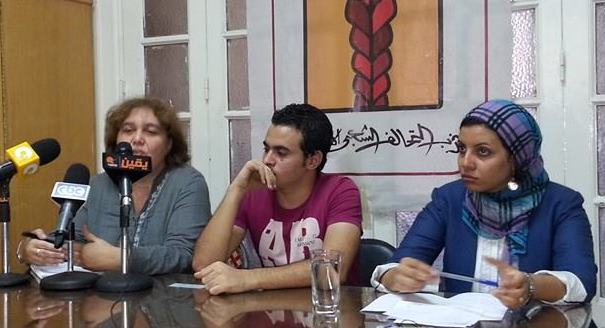
Socialist Popular Alliance Party

A backgrounder on the Socialist Popular Alliance Party.

Link Copied
Published on Oct 19, 2011

This resource was published on 10/19/2011 and is not updated to reflect changing circumstances.

Socialist Popular Alliance Party is a new leftist political party founded after the January 2011 uprising. It is the first of the new leftist parties to be legally recognized, gaining official party recognition in October 2011. It was originally a member of the Coalition of Socialist Forces, then joined the Egypt Bloc, but pulled out of that alliance in October 2011. The party participated in 2011 parliamentary elections as a member of the “Completing the Revolution” Alliance before later joining the Revolutionary Democratic Coalition.

Major Party Figures

Abu al-Ezz al-Hariri: founding member
Abd al-Ghaffar Shukr: prominent member
Ibrahim al-Esawi: prominent member
Mohamed al-Agaty: prominent member
Mustafa Kamel al-Sayyid: prominent member

Background

The Socialist Popular Alliance Party was founded in March 2011 following the January 2011 uprising. A number of the party’s members were formerly members of the al-Tagammu Party, but split from al-Tagammu because of disagreements over the November 2010 parliamentary elections and the January 2010 uprising. Previous al-Tagammu members include Abd al-Ghaffar Shukr and Ibrahim al-Esawi, both prominent Egyptian leftist thinkers.

On May 10, 2011, the Socialist Popular Alliance Party formed the Coalition of Socialist Forces with the Social Party of Egypt, the Democratic Labor Party, the Egypt Communist Party, and the Revolutionary Socialists. On September 28, it became the first new leftist political organization to submit a request to be recognized as an official political party and it was legally recognized on October 13, 2011.

Platform

Political Issues

  • Supporting the establishment of a civil, democratic state in Egypt with no discrimination between the people
  • Establishing a parliamentary republic with a unicameral legislature and a government that is accountable to the parliament
  • Calling for an immediate end to the emergency law
  • Granting greater power to local government, particularly in the management of financial resources, and granting elected municipal people’s councils greater powers of oversight, planning, and local legislation
  • Encouraging the spread of democracy to all institutions of society
  • Calling for full judicial independence, including public prosecutors and the Attorney General
  • Implementing the principle of decentralization of the police by putting the police under the authority of elected municipal people’s councils and reducing the Ministry of Interior’s role to setting the general rules and regulations of the police force

Socioeconomic Issues

  • Calling on the government to formulate a comprehensive development plan which includes investment in vital sectors and to develop the technologies that are required locally
  • Establishing popular and government oversight of the market  in order to elinimate monopolies and liquidating all monopolies through all legal means available
  • Including all state resources in the public budget and establishing the principles of transparency and parliamentary oversight in all budgetary matter, including subjecting the military budget to parliamentary oversight
  • Implementing complete tax reform with the goal of achieving social justice, including the abolition of indirect taxation
  • Managing natural resources such as oil, gas, and mineral wealth so that all the revenues of these resources belong to the people
  • Retaining state ownership of major banks and insurance companies
  • Adopting a comprehensive social insurance system
  • Reducing  unemployment through a national project for youth employment in the agricultural and industrial sectors
  • Advocating for a new housing law that would create a more equal relationship between landlord and tenant and developing a housing policy based on support for public housing, youth, and the poor
  • Providing universal free education from primary school to university and standardizing the educational system
  • Respecting and protecting women’s reproductive rights

Foreign Policy Issues

  • Reexamining trade agreements and partnerships in order to ensure that they serve the interests of the Egyptian people
  • Supporting the cancellation of all concessions granted to foreign countries in Egypt’s waterways, land, and air if these are used to harm any of the peoples of the world
  • Supporting democratization in other Arab countries and greater integration between the Arab regimes
  • Calling for the severance of diplomatic relations with Israel and resolution of the Arab-Israeli conflict through the establishment of a unified secular democratic state of all religions on Palestinian land
  • Advocating greater cooperation with African countries especially the Nile Basin countries
North AfricaEgypt

Carnegie does not take institutional positions on public policy issues; the views represented herein are those of the author(s) and do not necessarily reflect the views of Carnegie, its staff, or its trustees.

More Work from Malcolm H. Kerr Carnegie Middle East Center

  • Commentary
    Diwan
    When Football Is More Than Football

    The recent African Cup of Nations tournament in Morocco touched on issues that largely transcended the sport.

      Issam Kayssi, Yasmine Zarhloule
  • Article
    Rethinking Power-Sharing Agreements in Libya

    The UN Support Mission in the country should reassess its approach so that consensus between the warring parties becomes the eventual goal, rather than a procedural matter that dogs the negotiating process at every turn.
      Soraya Rahem

  • Commentary
    Diwan
    Has Sisi Found a Competent Military Entrepreneur?

    Mustaqbal Misr has expanded its portfolio with remarkable speed, but a lack of transparency remains.

      Yezid Sayigh

  • Commentary
    Diwan
    Women, Water, and Adaptation in Ait Khabbash

    The burden of environmental degradation is felt not only through physical labor but also emotional and social loss.

      Yasmine Zarhloule, Ella Williams

  • Article
    Between Marginalization and Climate Change: The Resilience of Morocco’s Ait Khabbash

    For the traditionally nomadic Amazigh pastoralists in the Draa-Tafilalet region, environmental change has exacerbated long-standing inequities, forcing the community to adapt, which has laid bare the blind spots of state-centered climate policy frameworks.

      Yasmine Zarhloule, Ella Williams

Get more news and analysis from
Malcolm H. Kerr Carnegie Middle East Center
Carnegie Middle East logo, white
  • Research
  • Diwan
  • About
  • Experts
  • Projects
  • Events
  • Contact
  • Careers
  • Privacy
  • For Media
Get more news and analysis from
Malcolm H. Kerr Carnegie Middle East Center
© 2026 Carnegie Endowment for International Peace. All rights reserved.