

Article
Frederic Wehrey, Charles H. Johnson
{
  "authors": [
    "Frederic Wehrey"
  ],
  "type": "legacyinthemedia",
  "centerAffiliationAll": "dc",
  "centers": [
    "Carnegie Endowment for International Peace",
    "Malcolm H. Kerr Carnegie Middle East Center"
  ],
  "collections": [],
  "englishNewsletterAll": "menaTransitions",
  "nonEnglishNewsletterAll": "",
  "primaryCenter": "Carnegie Endowment for International Peace",
  "programAffiliation": "MEP",
  "programs": [
    "Middle East"
  ],
  "projects": [],
  "regions": [
    "Middle East",
    "Yemen",
    "Gulf"
  ],
  "topics": [
    "Political Reform",
    "Security",
    "Foreign Policy"
  ]
}
Source: Getty
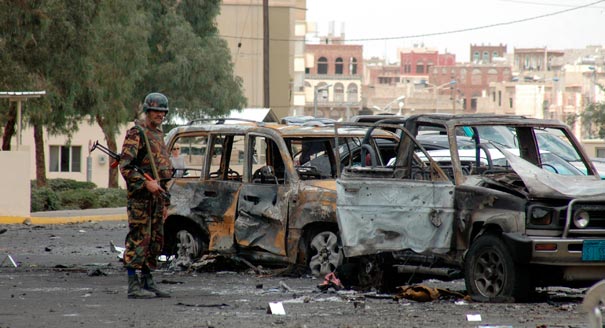
The struggle to root out al-Qaeda in the Arabian Peninsula will require extensive Yemeni and U.S. cooperation, but it is ultimately a problem that the Yemenis must solve.
Source: Fox News
In the continued fight against Al Qaeda in the Arabian Peninsula (AQAP), the Obama administration has relied on a two-track strategy of conducting drone strikes and working to build the capacity of the Yemeni government. Speaking with Fox News, Carnegie's Frederic Wehrey explained that this dual track approach “is the best option given the circumstances and the lessons we’ve learned from Iraq and Afghanistan." Wehrey discussed how AQAP, like other branches of al Qaeda, feeds off the local grievances in a country.
In response to a question regarding whether or not the administration should utilize a larger military campaign, Wehrey noted, “This is ultimately a Yemeni problem that will have to be addressed and solved by the Yemenis.” Indeed, there is mounting evidence that the drone strikes are exacerbating radicalization, he added. Ultimately, the struggle to root out AQAP is destined to be a long battle that will require extensive Yemeni and U.S. cooperation, Wehrey concluded.
Senior Fellow, Middle East Program
Frederic Wehrey is a senior fellow in the Middle East Program at the Carnegie Endowment for International Peace, where his research focuses on governance, conflict, and security in Libya, North Africa, and the Persian Gulf.
Recent Work
Frederic Wehrey, Charles H. Johnson
Frederic Wehrey, Charles H. Johnson
Carnegie does not take institutional positions on public policy issues; the views represented herein are those of the author(s) and do not necessarily reflect the views of Carnegie, its staff, or its trustees.

In an interview, Ian Lustick and Eli Clifton discuss their new book on why a prominent ally has so much influence in America.

Michael Young

As the U.S. stumbles in its war with Iran, we are likely to see an acceleration of its disengagement from the region.
Michael Young

Middle Eastern states should welcome an accelerated U.S. disengagement from their region.
Michael Young

The accord represents a pivotal moment in the region to avert a security vacuum in the Gulf.


Azeema Cheema, Mohanad Hage Ali

In an interview, Jason Burke discusses his sweeping account of the “revolutionists” who so shaped the 1970s and early 1980s.
Michael Young