

Commentary
Marc Pierini
{
  "authors": [
    "Marc Pierini"
  ],
  "type": "legacyinthemedia",
  "centerAffiliationAll": "",
  "centers": [
    "Carnegie Endowment for International Peace",
    "Carnegie Europe",
    "Malcolm H. Kerr Carnegie Middle East Center"
  ],
  "collections": [
    "Turkey’s Transformation"
  ],
  "englishNewsletterAll": "",
  "nonEnglishNewsletterAll": "",
  "primaryCenter": "Carnegie Europe",
  "programAffiliation": "",
  "programs": [],
  "projects": [],
  "regions": [
    "Middle East",
    "Europe",
    "Türkiye",
    "Levant"
  ],
  "topics": [
    "Foreign Policy",
    "Political Reform"
  ]
}
Source: Getty
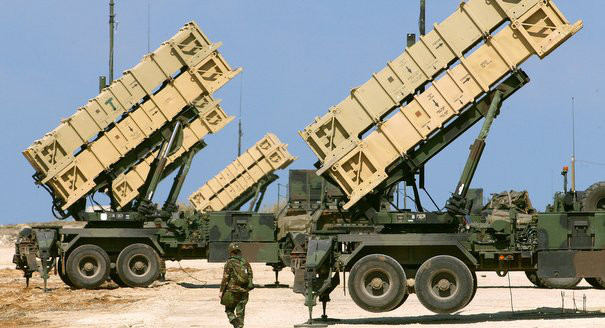
NATO's deployment of Patriot missile batteries in Southern Turkey draws a clear red line for Damascus.
Source: Hurriyet Daily News

The purpose of the Patriot deployment should not be mistaken for what it is not. Missiles such as these are used against incoming ballistic/tactical missiles and against aircrafts. Since the Syrian government alluded on July 24 to the use of chemical or biological weapons if “exposed to external aggression,” the main threat coming from the Bashar al-Assad regime is thought to be Scud missiles with chemical warheads. This is a purely defensive posture.
This is not equivalent to declaring a no-fly zone, not even implementing a safe area for displaced persons within Syria. Such objectives would need many more steps to be taken, both legally and technically. At this stage of the Syrian crisis, it is also out of question to take decisions such as sending troops into Syrian territory or aircrafts in its airspace. The Patriot deployment is typical of the “no-boots-on-the-ground-nor-in-the-air” posture of Western powers.With such relatively limited objectives, what is the meaning of the Patriot deployment?
First and foremost, it draws a clear red line for Damascus: the Turkish territory is off-limit to the Syrian army and air force. Bashar al-Assad is known, like his father Hafez, for his inclination to internationalize a conflict when he feels under strong pressure. The elimination of a Lebanese security chief in Beirut last October was a tragic example, as was a foiled action attempt against Jordan. There was a U.S. red line about chemical weapons, a French one about Lebanon, NATO is now drawing another one concerning Turkey.
Secondly, it sends a signal to the powers supporting the al-Assad regime, in case they would not succeed in deterring it from attacking Turkey. The Western assumption is that both Moscow and Tehran will do their utmost to dissuade Damascus to resort to chemical warfare.
Third, it is a strong and multi-faceted signal to Turkey. When it is engulfed in a crisis, Turkey can rely on the Western alliance. Yet, in both declaratory and military terms, this protection frames Turkey’s freedom of maneuver in the broader NATO context. Turkey is bound to operate under the alliance’s chain of command and rules of engagement.
Fourth, there is a foreign policy lesson to draw: the Patriot deployment illustrates the often-described gap between the Turkish foreign policy rhetoric (claiming not so long ago that Turkey is the “agenda-setter” in the Middle-East) and the hard realities of diplomacy and security. It is one thing to criticize Israel about Gaza, it is altogether another one to stand alone against a brutal Syrian regime armed to the teeth with gear that Turkey does not possess.
Fifth, for the European observer, there is an inevitable parallel to be drawn with the economic scene. As recently as last month, Turkish officials blasted the EU 2012 Progress Report, while at the same time recognizing that its economy is deeply rooted in the EU and making their utmost to attract more European investors, not least in Paris.
In sum, when all is said and done, when the dust and emotions have settled down, what remains is a simple truth: for its security as well as for its economy, Turkey relies on the West. And, in the current Middle-East turmoil, this is good for Turkey and Europe.
Hopefully, with the plummeting morale of their soldiers, the defection of entire brigades, the rapid attrition of usable aircrafts, and growing disarray of their logistics, the Syrian army is quickly losing its edge on the domestic front. Hence, it may have little energy to devote to an eventual external front, and the Patriot missile shield will not have to be used.
The al-Assad regime has maneuvered itself in a corner. With a usable territory soon to shrink to Damascus and/or the Alawite mountain, how soon will the Assad-Makhlouf clan understand the hard fundamentals of their situation? That is the next question. At least, by now, they know that neighboring countries are off-limits.
This article originally appeared in the Hurriyet Daily News.

Senior Fellow, Carnegie Europe
Marc Pierini is a senior fellow at Carnegie Europe, where his research focuses on developments in the Middle East and Turkey from a European perspective.
Recent Work
Marc Pierini
Marc Pierini
Carnegie does not take institutional positions on public policy issues; the views represented herein are those of the author(s) and do not necessarily reflect the views of Carnegie, its staff, or its trustees.
Reconciliation councils are emerging throughout the country to mediate in intracommunal disputes, many from the war years.
Natacha Danon
The civil war in Syria may have ended, but the country continues to serve as a source for the trafficking of illegal substances into and via Jordanian territory.


Armenak Tokmajyan, Laith Qerbaa
As the U.S.-led Coalition withdraws, the Kurds’ reliance on Baghdad, and on themselves, will only increase.
Wladimir van Wilgenburg

In an interview, Ian Lustick and Eli Clifton discuss their new book on why a prominent ally has so much influence in America.
Michael Young
As the U.S. stumbles in its war with Iran, we are likely to see an acceleration of its disengagement from the region.
Michael Young