

Article
Marc Pierini
{
  "authors": [
    "Marc Pierini"
  ],
  "type": "legacyinthemedia",
  "centerAffiliationAll": "",
  "centers": [
    "Carnegie Endowment for International Peace",
    "Carnegie Europe",
    "Malcolm H. Kerr Carnegie Middle East Center"
  ],
  "collections": [
    "Transatlantic Cooperation",
    "Europe’s Southern Neighborhood",
    "Arab Awakening"
  ],
  "englishNewsletterAll": "",
  "nonEnglishNewsletterAll": "",
  "primaryCenter": "Carnegie Europe",
  "programAffiliation": "",
  "programs": [],
  "projects": [],
  "regions": [
    "Middle East",
    "Russia",
    "Europe",
    "North America",
    "Levant",
    "United States",
    "Türkiye",
    "Syria",
    "Western Europe"
  ],
  "topics": [
    "Foreign Policy",
    "Political Reform",
    "Security",
    "Global Governance"
  ]
}
Source: Getty
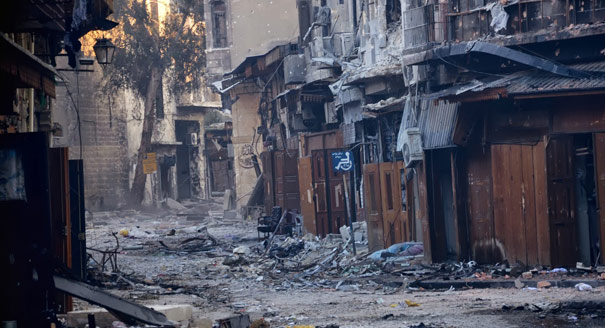
The diplomatic confusion around the Syrian crisis is huge. Analysts and columnists are at a loss to make any sense out of it, and maybe diplomats are too.
Source: Hurriyet Daily News
The diplomatic confusion around the Syrian crisis is huge, analysts and columnists are at a loss to make any sense out of it, and maybe diplomats are, too.
Within Syria, the situation is relatively simple to understand: the country is divided between the regime and various rebel brigades, the Bashar al-Assad regime has no prospect of regaining political legitimacy over the entire country, while the civilian opposition is unable to unify its positions. The only certainty is that the jihadists have the strongest fighters and that they will extract a political price from this situation when the time comes.
The al-Assad regime is alive thanks to the Russian position, which itself has a lot more to do with Russia’s standing in world affairs than the Syrian crisis. One can even claim that Russia’s interests in the region cannot be served by a surviving al-Assad regime anymore. China is aligned with Russia for its own bilateral reasons.The European Union has had the good idea of self-marginalizing itself through the mechanisms emanating from the Lisbon treaty. Even the “big two” (France and the United Kingdom) do not matter much on their own, because the weakness of the EU system as a whole (which they engineered) prevents them from carrying the entire 27 with them.
Qatar’s and Saudi Arabia’s policy of arming some rebel factions does favor the rise of the most radical of Islamists movements in northern Syria, which runs against the future stability of the country and against Western interests. Turkey itself has long had a fluctuating policy; it first embraced Bashar al-Assad, then called for his removal and then began training rebels even as it suffered from the spillover effects on its own territory. Turkey’s position is now firmly under the U.S. umbrella, particularly since the Patriot missiles deployment earlier this year and the Washington meetings last month.
As for Israel, it is prepared for any type of contingency and will defend its vital interests according to its own agenda and strong military capabilities. Iran and its proxy, the Lebanese Hezbollah, are playing with fire since they have a lot to lose in the downfall of al-Assad. In addition, Iran has ulterior motives to oppose Western powers.
Finally, the U.S. has shown an unprecedented risk aversion in the Middle East as a result of its successive engagements in Iraq and Afghanistan. For Washington, the stakes are, however, wider than just Syria; they touch upon the security of Israel, Iran’s nuclear capabilities and the worldwide trade in oil and gas.
Does this leave any prospect for the Geneva II conference supposed to be held in June? Little, it seems. The conference will be awfully difficult to put together for a host of reasons. The first attempt will probably end up in miserable confusion. Subsequently, back-channel meetings will take place until a realization is made that a compromise solution, however shaky, is better than the current descent into inferno.
The main difficulties are well-known. The Syrian civilian opposition is utterly weak and divided, leaving the political and military clout to the Islamists. One underlying assumption is that elections can be held in Syria, but this is a non-starter since the country doesn’t have any credible electoral system, not even voters’ lists.
Yet, with a push from Moscow, a “compromise” could be found between the opposition and “reasonable elements” of the regime. This will resemble Tunisia and Egypt on the day after revolution: interesting on paper but not sustainable. Later on, should elections be held, the outcome is more than predictable: the winners will be the Islamists. Unless Syria is partitioned.
This looks awful indeed. Yet, the only way forward at this stage is more diplomatic footwork between the U.N. Security Council’s “permanent five” and renewed efforts at back-channel (or “track two”) diplomacy. Until all the parties realize where the narrow path serving their combined interests lies.
This article was originally published in Hurriyet Daily News

Senior Fellow, Carnegie Europe
Marc Pierini is a senior fellow at Carnegie Europe, where his research focuses on developments in the Middle East and Turkey from a European perspective.
Recent Work
Marc Pierini
Marc Pierini
Carnegie does not take institutional positions on public policy issues; the views represented herein are those of the author(s) and do not necessarily reflect the views of Carnegie, its staff, or its trustees.

Huawei pushed hard to enter the Egyptian data centers market, until the Americans made a better offer.

Angie Omar

Middle Eastern states should welcome an accelerated U.S. disengagement from their region.

Michael Young

In an interview, former ambassador Charles Freeman assesses the Trump administration’s war against Iran.
Michael Young

The accord represents a pivotal moment in the region to avert a security vacuum in the Gulf.


Azeema Cheema, Mohanad Hage Ali
In an interview, Jason Burke discusses his sweeping account of the “revolutionists” who so shaped the 1970s and early 1980s.
Michael Young