

Commentary
Dmitri Trenin
{
  "authors": [
    "Dmitri Trenin"
  ],
  "type": "commentary",
  "centerAffiliationAll": "",
  "centers": [
    "Carnegie Endowment for International Peace",
    "Carnegie Russia Eurasia Center"
  ],
  "collections": [],
  "englishNewsletterAll": "",
  "nonEnglishNewsletterAll": "",
  "primaryCenter": "Carnegie Russia Eurasia Center",
  "programAffiliation": "",
  "programs": [],
  "projects": [
    "Eurasia in Transition"
  ],
  "regions": [
    "Middle East",
    "Iran",
    "Syria"
  ],
  "topics": [
    "Foreign Policy",
    "Nuclear Policy",
    "Nuclear Energy"
  ]
}
Source: Getty
Obama needs to follow up on the Syrian disarmament plan and be ready to augment it by a serious effort at a political settlement in Syria within the Geneva framework. If there is to be a solution on Syria, Iran should be part of it. Engaging the Iranians on Syria would be a confidence building measure which would also help in the nuclear talks.
The opening week of the UN General Assembly annual meeting in New York was dominated by two issues: the chemical weapons in Syria and Iran’s nuclear program. On both issues, there have been early breakthroughs. The UN Security Council unanimously passed a resolution to guide the process of Syria’s chemical disarmament, while the presidents of the United States and Iran had their first phone conversation since the establishment of the Islamic Republic in 1979. These initial signs of cooperation between rivals and adversaries may constitute a rare positive change in the political dynamic in the Middle East, or they may be a false dawn.
Even if one is an optimist, one has to accept that implementing the chemical weapons agreement under conditions of a raging civil war will be extremely difficult. One would have to make sure that Assad is not cheating; that the rebels do not stage assault on chemical weapons storage facilities; that the international force secures all relevant facilities and makes any further use of chemical weapons physically impossible; that the weapons are then removed for elimination; and that they are finally safely disposed of. It is certainly hard to be an optimist on this score, but all other options are worse.
The U.S.-Iranian rapprochement which had eluded Washington and Tehran for so long is now official. The first baby steps have been made to break the ice. However, even under the best of circumstances, the ice will take a long time to melt, and clearing it altogether is an absolutely daunting task. Yet, both Barack Obama and Hassan Rowhani—with the Supreme Leader Khamenei behind him—appear to realize that now they have the best chance ever to reach accommodation between their countries. Others see this too, and are getting nervous. Skeptics in Israel are concerned that Obama may give Iran too much. On Saturday, a news anchor on the main analytical program of Russian television expressed the Kremlin’s unease at seeing the Five-plus-One talks on Iran overshadowed by the direct negotiating link between Tehran and Washington. These concerns and worries indicate that the shift in the U.S.-Iranian relations is deemed possible.
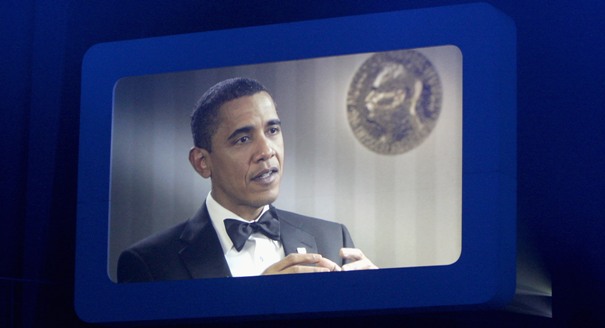
President Obama, who only a few weeks ago looked trapped and cornered in the Middle East, now has a great opportunity to clinch a brilliant diplomatic victory from the teeth of a seemingly certain defeat. It will not happen automatically, though. Obama needs to follow up on the Syrian disarmament plan and be ready to augment it by a serious effort at a political settlement in Syria within the Geneva framework. If there is to be a solution on Syria, Iran should be part of it. Engaging the Iranians on Syria would be a confidence building measure which would also help in the nuclear talks. Obama has his work cut out for him, but he can actually earn his Nobel.
Former Director, Carnegie Moscow Center
Trenin was director of the Carnegie Moscow Center from 2008 to early 2022.
Recent Work
Dmitri Trenin
Dmitri Trenin
Carnegie does not take institutional positions on public policy issues; the views represented herein are those of the author(s) and do not necessarily reflect the views of Carnegie, its staff, or its trustees.

In an interview, Ian Lustick and Eli Clifton discuss their new book on why a prominent ally has so much influence in America.

Michael Young

As the U.S. stumbles in its war with Iran, we are likely to see an acceleration of its disengagement from the region.
Michael Young

Huawei pushed hard to enter the Egyptian data centers market, until the Americans made a better offer.

Angie Omar

Middle Eastern states should welcome an accelerated U.S. disengagement from their region.
Michael Young

In an interview, former ambassador Charles Freeman assesses the Trump administration’s war against Iran.
Michael Young