

Commentary
Dmitri Trenin
{
  "authors": [
    "Dmitri Trenin"
  ],
  "type": "legacyinthemedia",
  "centerAffiliationAll": "dc",
  "centers": [
    "Carnegie Endowment for International Peace",
    "Carnegie Europe",
    "Malcolm H. Kerr Carnegie Middle East Center",
    "Carnegie Russia Eurasia Center"
  ],
  "collections": [
    "Europe’s Eastern Neighborhood",
    "Europe’s Southern Neighborhood"
  ],
  "englishNewsletterAll": "menaTransitions",
  "nonEnglishNewsletterAll": "",
  "primaryCenter": "Carnegie Russia Eurasia Center",
  "programAffiliation": "MEP",
  "programs": [
    "Middle East"
  ],
  "projects": [
    "Eurasia in Transition"
  ],
  "regions": [
    "Levant",
    "Middle East",
    "Syria",
    "Russia"
  ],
  "topics": [
    "Security",
    "Foreign Policy",
    "Global Governance"
  ]
}
Source: Getty
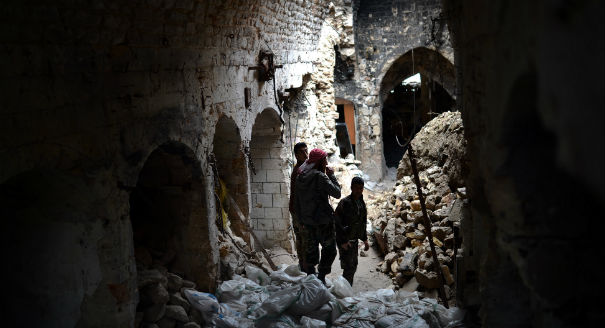
Russia’s position on Syria is not primarily about Syria. It is about the world order: who has the right to decide on a military intervention?
Source: Financial Times
When people in the west seek to explain Moscow’s approach to the crisis in Syria, they often refer to Damascus as Russia’s “last remaining ally in the Middle East”. They also frequently include Russia’s interest in the Syrian arms market and the Tartus naval facility. Finally, a seemingly powerful argument is made about the Syrian people’s fight for democracy – which sends shivers down the spine of authoritarians, including President Vladimir Putin.
These explanations are generally misleading. True, Hafez al-Assad, Bashar’s father, was a Soviet ally, but Moscow de facto withdrew from geopolitical competition in the Middle East in 1990, when it joined Washington and many others to oppose its other nominal ally, Saddam Hussein’s Iraq. Bashar al-Assad, in calmer times, was a more frequent visitor to Paris and London than to Moscow. Mr Putin himself never visited Damascus.
The Syrian arms bazaar has been dominated by Moscow merchants since the 1960s, but the proceeds from it, while substantial, are far less than the Russians earn in Algeria, China, India or Venezuela. Tartus is a modest resupply facility that no self-respecting navy would call a base. And the savage civil war in Syria is a bad advertisement for democratic revolution.Russia’s position on Syria is not primarily about Syria. It is about the world order: who has the right to decide on a military intervention? Since Nato’s 1999 air war against Yugoslavia, the Kremlin has been seeking to defend its own and its allies’ sovereignty against US strikes. Since Ukraine’s 2004 Orange Revolution, it has dreaded “regime change” engineered from abroad. Moscow’s defence is built around its veto power at the UN Security Council. This power cannot prevent US-led intervention but, by making it illegal in terms of international law, can seriously weaken the case for it. Russia’s interests are wrapped around high principles, which is not unique in international politics.
At a slightly lower level, Moscow’s actions on Syria are informed by its reading of the Arab spring. Many Europeans and Americans naively hoped for a new 1848 or 1989. But Russians were rightly sceptical about the near-term impact of the awakening in the Arab world. Egypt has just been able to stop on the brink. The civil war in Syria has pushed the radicals and, particularly, the extremists to the fore and sidelined the moderates.
As to the fighting itself, Moscow’s calculus has so far proved to be more accurate than that of Washington, London or Paris. The Russians never ruled out that Mr Assad might eventually be toppled, but they never declared him to be on his last legs. It is also clear that the removal of the regime in Damascus would not mark the end of the civil war, but only a new phase.
For now, it is truly striking to see the merchant classes of Damascus still sticking with the government there, even as the lesser evil. It is also amazing to watch the Syrian army engaged in a brutal war against part of its own people, and not buckling under the enormous psychological pressure that such conflicts usually bring. There have been some cracks and a few defections, but not many. The centre has held for more than 30 months.
The Russians side with Mr Assad not because he is their man, but because his forces are killing Islamist extremists, whom Moscow now considers to be its most dangerous enemies. But for him, al-Qaeda’s allies would have turned Syria into a base for international terrorism. Russians play down the fact that Mr Assad’s Russian-made weapons are also killing innocent civilians, and thus breed more jihadis.
While the Kremlin has long decided on its goals, the White House has so far demonstrated only two aims: it wants to see Mr Assad go and is reluctant to become involved militarily. Sensing this, Russia has sought to engage the US on Syria’s chemical disarmament and a wider political settlement of the crisis. These are less about Syria than about achieving Mr Putin’s most far-reaching, even improbable goal in foreign affairs: restoring equality to the US-Russia relationship.
The US is unlikely to accept Moscow as a peer, but Russia will not settle for less, making even US-Russia co-operation a hard-fought act. Today, Syria is a mere playground in this bigger game.
This article was originally published on the Financial Times.
Former Director, Carnegie Moscow Center
Trenin was director of the Carnegie Moscow Center from 2008 to early 2022.
Recent Work
Dmitri Trenin
Dmitri Trenin
Carnegie does not take institutional positions on public policy issues; the views represented herein are those of the author(s) and do not necessarily reflect the views of Carnegie, its staff, or its trustees.
As the U.S.-led Coalition withdraws, the Kurds’ reliance on Baghdad, and on themselves, will only increase.
Wladimir van Wilgenburg

In an interview, Ian Lustick and Eli Clifton discuss their new book on why a prominent ally has so much influence in America.

Michael Young

As the U.S. stumbles in its war with Iran, we are likely to see an acceleration of its disengagement from the region.
Michael Young
The Zaidi government’s objective to collect weapons is constrained by regional conflict, but it can take certain measures at home.
Ali Al-Mawlawi

The accord represents a pivotal moment in the region to avert a security vacuum in the Gulf.


Azeema Cheema, Mohanad Hage Ali