

Commentary
Policy discussion is ignoring that the Palestinian national project is hollowed out and apartheid is a present danger.
Nathan J. Brown
{
  "authors": [
    "Vladimir Dvorkin"
  ],
  "type": "commentary",
  "centerAffiliationAll": "",
  "centers": [
    "Carnegie Endowment for International Peace",
    "Carnegie Russia Eurasia Center"
  ],
  "collections": [],
  "englishNewsletterAll": "",
  "nonEnglishNewsletterAll": "",
  "primaryCenter": "Carnegie Endowment for International Peace",
  "programAffiliation": "",
  "programs": [],
  "projects": [],
  "regions": [
    "North America",
    "United States",
    "Russia"
  ],
  "topics": [
    "Security",
    "Military",
    "Foreign Policy",
    "Nuclear Policy",
    "Arms Control"
  ]
}
Source: Getty
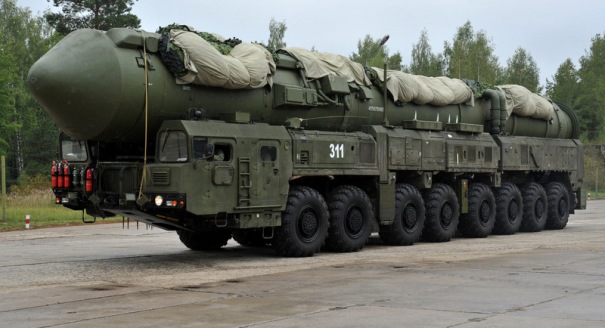
The recent reports in the U.S. media suggest that Russia has violated the INF Treaty seem to echo, at a new stage, previous claims made almost six months ago. At that time, questions arose in connection with the Rubezh missile flight tests and assumptions were made that the Rubezh missiles are actually intermediate-range missiles.
The recent reports in the U.S. media suggest that Russia has violated the INF Treaty seem to echo, at a new stage, previous claims made almost six months ago. At that time, questions arose in connection with the Rubezh missile flight tests and assumptions were made that the Rubezh missiles are actually intermediate-range missiles. The allegations were triggered by a multiple-warhead missile launch from the Kapustin Yar missile base to the Balkhash area at an INF-range distance.
However, a single-warhead missile of this type was launched from Plesetsk to Kura, which is a strategic distance. According to the conclusions in the U.S. Air Force Intelligence Report, as explained by Hans M. Kristensen of the Federation of American Scientists, the missile was tested at intercontinental range. This rebuts the claims that Russia is violating the INF Treaty.
In the same manner, similar allegations can be leveled against any intercontinental ballistic missile (ICBM) the range of which virtually completely overlaps that of the intermediate-range missiles; in fact, ICBM tests to INF range and minimal range have always been conducted.
Vladimir Dvorkin, Major General (Ret.)., is a chief researcher at the Center for International Security at the Russian Academy of Sciences' Institute of World Economy and International Relations.
Vladimir Dvorkin
Major General Dvorkin (retired) is a chief researcher at the Center for International Security at the Institute of World Economy and International Relations.
Carnegie does not take institutional positions on public policy issues; the views represented herein are those of the author(s) and do not necessarily reflect the views of Carnegie, its staff, or its trustees.

Policy discussion is ignoring that the Palestinian national project is hollowed out and apartheid is a present danger.

Nathan J. Brown
As negotiations with Iran and Lebanon continue, chaos is at the heart of the Netanyahu government’s calculations.

Michael Young

The party’s domestic and regional roles have changed, so Lebanon should devise a disarmament strategy that encompasses this.
Michael Young

In an interview, Marc Lynch discusses his new book decrying the post-1990 U.S.-dominated order in the Middle East.
Michael Young

Because perpetual conflict enhances control, offers economic benefits, and allows leaders to ignore popular preferences.

Angie Omar