

Commentary
Dmitri Trenin
{
  "authors": [
    "Dmitri Trenin"
  ],
  "type": "commentary",
  "centerAffiliationAll": "",
  "centers": [
    "Carnegie Endowment for International Peace",
    "Carnegie Russia Eurasia Center"
  ],
  "collections": [],
  "englishNewsletterAll": "",
  "nonEnglishNewsletterAll": "",
  "primaryCenter": "Carnegie Russia Eurasia Center",
  "programAffiliation": "",
  "programs": [],
  "projects": [],
  "regions": [
    "North America",
    "United States",
    "East Asia",
    "China",
    "Japan"
  ],
  "topics": [
    "Security",
    "Foreign Policy"
  ]
}
Source: Getty
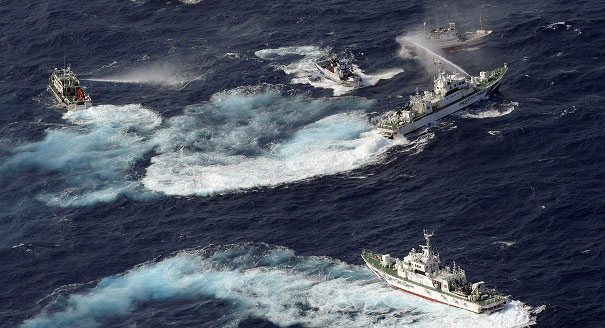
The intensification of the Sino-Japanese standoff in the East China Sea calls for better communication between the Chinese People’s Liberation Army and the Pentagon.
Of the events that happened last week, one of the most important was the Chinese imposition of an air defense notification zone over the Diaoyu islands in the East China Sea, claimed by China but held by the Japanese who call them Senkaku. The obvious change in the status quo in the disputed area provoked an immediate U.S. reaction in the form of two unarmed B-52 bombers flying over the islands, ignoring the Chinese demand for prior notification. The Japanese and the South Koreans followed up by sending their own warplanes. Even though later the Obama administration told U.S. commercial airlines to follow Beijing’s requirements, the situation in the East China Sea has acquired a new, more worrisome quality.
The loose war talk is getting louder in China, and war fears are getting higher in Japan, where for the first time since WWII a National Security Council is being formed and a secrets act has been passed. It is still incredible that the two countries which are linked by a vibrant trade relationship and hundreds of flights per day can actually go to war, but tensions are rising, not subsiding. The United States, by its bold move, has sought to restore the status quo, but it has also raised the stakes for itself and for China as the two countries are making their points regarding their respective strategic positions in the Western Pacific.
At minimum, the intensification of the Sino-Japanese standoff in the East China Sea calls for better communication between the People’s Liberation Army and the Pentagon. While China and the United States are not in the Cold War bind like the United States and the Soviet Union once were, they would benefit from having agreements preventing incidents in the air and at sea. The practice of breaking off contact between the Chinese and U.S. militaries in response to some political moves is fraught with dangers of misperception, miscalculation and, eventually, a collision. The world has had its share of big fear over Cuba and Berlin. It need not revisit it in Asia.
Former Director, Carnegie Moscow Center
Trenin was director of the Carnegie Moscow Center from 2008 to early 2022.
Recent Work
Dmitri Trenin
Dmitri Trenin
Carnegie does not take institutional positions on public policy issues; the views represented herein are those of the author(s) and do not necessarily reflect the views of Carnegie, its staff, or its trustees.

In an interview, Ian Lustick and Eli Clifton discuss their new book on why a prominent ally has so much influence in America.

Michael Young

As the U.S. stumbles in its war with Iran, we are likely to see an acceleration of its disengagement from the region.
Michael Young

Huawei pushed hard to enter the Egyptian data centers market, until the Americans made a better offer.

Angie Omar

Middle Eastern states should welcome an accelerated U.S. disengagement from their region.
Michael Young

In an interview, former ambassador Charles Freeman assesses the Trump administration’s war against Iran.
Michael Young