

Commentary
In an interview, Rozina Ali discusses her new book on the rise and manifestations of Islamophobia in the United States.
Michael Young
{
  "authors": [
    "Akio Kawato"
  ],
  "type": "commentary",
  "centerAffiliationAll": "",
  "centers": [
    "Carnegie Endowment for International Peace",
    "Carnegie Russia Eurasia Center"
  ],
  "collections": [],
  "englishNewsletterAll": "",
  "nonEnglishNewsletterAll": "",
  "primaryCenter": "Carnegie Russia Eurasia Center",
  "programAffiliation": "",
  "programs": [],
  "projects": [],
  "regions": [
    "North America",
    "United States",
    "East Asia",
    "Japan",
    "Russia",
    "Eastern Europe",
    "Ukraine"
  ],
  "topics": [
    "Foreign Policy"
  ]
}
Source: Getty
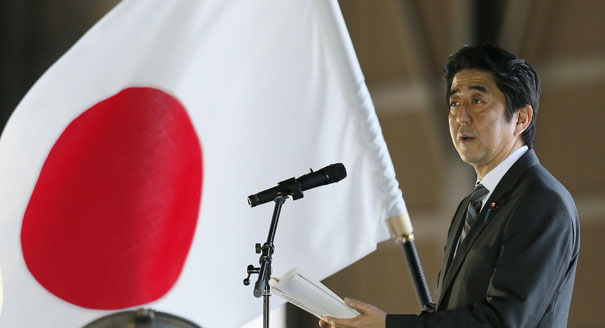
Japan makes judgment about Ukraine in the context of her balancing game among the United States, Russia, and China. However, if Moscow sends troops to Eastern Ukraine, the Japanese political class will unanimously support serious measures to stop Russia.
When Japan and China brawl over tiny Senkaku Islands, people in the regions far from East Asia dismiss it as a needless conflict over small rocks. But in the eyes of the Japanese the current tug of war over Ukraine looks like a self-imposed confrontation between Russia and the United States. Although neither the United States nor Russia is ready to take the full burden of Ukraine, they engage in a tit-for-tat tussle, drawing in their allies and friends.
At first, the situation in Ukraine was a distant issue for the Japanese. However, Russia’s annexation of Crimea became the top news, though the recent tax hike and issues involving the United States, South Korea, North Korea, and China draw more earnest attention. Now the prevailing narrative in Japan about the annexation of Crimea is that it was realized under the coercive effect of the Russian military force. Though newspapers do report about the gruesome anti-Russian activities of the Ukrainian rightists, this is something too complex for foreigners to swallow. Nevertheless, some hesitation about joining “sanctions” against Russia remains, partly because the Japanese are not yet totally convinced that this is the right step to take, and partly because it is “mottai-nai” (it is a pity) to throw away recent achievements in Russo-Japanese relations.
Japan makes judgment about Ukraine in the context of her balancing game among the United States, Russia, and China. The alliance with the United States remains, of course, the mainstay of Tokyo’s foreign policy. Japan does not like that “needless” conflicts are created in remote areas and that the U.S. government’s attention and U.S. forces are distracted elsewhere. Therefore, Japan would be willing to contribute to a quick stabilization of Ukraine.
However, if things take a fatal downward spiral in Ukraine, Japan will play it out. If Russia sends troops to Eastern Ukraine, for example, the Japanese political class will unanimously support serious measures to stop Russia. The situation in Ukraine has started to resemble very much the start of the Cold War, when Czechoslovakia in 1947-1948 was forced by the Soviet Union to reject the Marshall Plan and was drawn into Moscow’s orbit.
Akio Kawato
Writer
Akio Kawato is a former Japanese diplomat and blogger.
Carnegie does not take institutional positions on public policy issues; the views represented herein are those of the author(s) and do not necessarily reflect the views of Carnegie, its staff, or its trustees.

In an interview, Rozina Ali discusses her new book on the rise and manifestations of Islamophobia in the United States.

Michael Young

In an interview, Ian Lustick and Eli Clifton discuss their new book on why a prominent ally has so much influence in America.
Michael Young

As the U.S. stumbles in its war with Iran, we are likely to see an acceleration of its disengagement from the region.
Michael Young

Middle Eastern states should welcome an accelerated U.S. disengagement from their region.
Michael Young

In an interview, former ambassador Charles Freeman assesses the Trump administration’s war against Iran.
Michael Young