

In The Media
Lina Khatib
{
  "authors": [
    "Lina Khatib"
  ],
  "type": "legacyinthemedia",
  "centerAffiliationAll": "dc",
  "centers": [
    "Carnegie Endowment for International Peace",
    "Malcolm H. Kerr Carnegie Middle East Center"
  ],
  "collections": [],
  "englishNewsletterAll": "menaTransitions",
  "nonEnglishNewsletterAll": "",
  "primaryCenter": "Malcolm H. Kerr Carnegie Middle East Center",
  "programAffiliation": "MEP",
  "programs": [
    "Middle East"
  ],
  "projects": [],
  "regions": [
    "Gulf",
    "Levant",
    "Iran",
    "Saudi Arabia",
    "Syria",
    "Middle East"
  ],
  "topics": [
    "Political Reform",
    "Foreign Policy"
  ]
}
Source: Getty
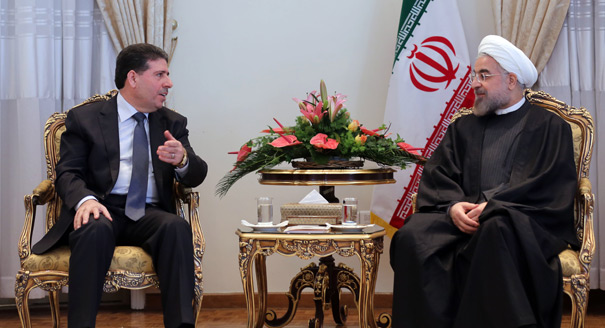
Saudi Arabia and Iran seem to be on their way towards rapprochement. This can only be bad news for Bashar al-Assad.
Source: Al Jazeera
After months of back-channel talks, Saudi Arabia and Iran seem to be on their way towards rapprochement. This can only be bad news for Bashar al-Assad. While Saudi Arabia’s stance towards Assad remains unchanged, aimed as it is at removing him from power, Iran’s stance is likely to migrate closer to Saudi Arabia’s, albeit for different reasons.
The dominant wisdom has been that Iran has thrown its full weight behind Assad and that it would not abandon this ally because Assad guarantees Iran’s strategic interests in the Levant. But Assad himself is less valuable to Iran than the much-coveted nuclear arms deal. Talks between the United States and Iran appear to be heading towards a settlement, while Saudi Arabia’s softened stance towards Iran means that Iran must give Saudi Arabia something in return for cordial relations, because Saudi Arabia remains the stronger regional player in the Gulf. Assad is likely to be the least costly compromise for Iran on both fronts.
Although Assad’s relationship with Iran continues, his value to Tehran is lessening because of some of the strategic decisions he has taken in order to stay in power. Assad’s reliance on Hezbollah to fight the Syrian opposition may have given him military wins on the ground, but it has lessened his regional political clout. Hezbollah has managed to translate its military triumphs in Syria into increased political power within Lebanon. The delay in electing the next Lebanese president is due to no small extent to Hezbollah’s wish to handpick the president at a time of its choosing, namely, after the Syrian presidential election. This is not so that Assad can give his blessing before a Lebanese president can be elected, as was usually the case with all post-civil war presidents, but so that Hezbollah can show Assad that it now has the autonomy to impose its political agenda within Lebanon.Assad has thus empowered Hezbollah at the expense of his own regional influence. This makes him less valuable for Iran than Hezbollah. Instead of taking measures to bolster Assad’s regional position, Iran has begun a bottom-up process of replicating the Lebanese Hezbollah model in Syria. Not only is Iran establishing a Syrian Hezbollah, it is also sponsoring a process of Shiasation among the Syrian population. Those measures are about Iran’s planting the seeds of long-term clientelism within Syria so that its own regional influence can be retained regardless of who rules Syria.
For Iran as well as Israel, Assad remains valuable enough to keep in power as long as he is able to guarantee their strategic interests. But his indirect support of the Islamic State in Iraq and Syria (ISIS) has created a potential serious threat to stability in those countries. ISIS is now reportedly financially independent, which means it is likely to begin operating outside the remit of Assad’s control. Recent assessments of ISIS’s capabilities paint it as the new al-Qaida in terms of potential international threat. Neither Iran nor Israel will accept a volatile Sunni extremist group using a neighbouring country as a hub. Saudi Arabia too sees in ISIS a dangerous challenge to its domestic stability. Assad’s strategic decisions have thus inadvertently given the Middle East’s three staunchest rivals common ground. The blooming Iranian-Saudi rapprochement is partly driven by shared concerns about security in the region.
Domestically, Assad is also on his way to losing his grip. His destruction of state infrastructure even in loyalist areas means that in the future he will not be able to meet the service demands of his supporters, who will be driven to become the clients of the new warlords ruling Syria, such as the chiefs of the National Defence Force. With the rise of ISIS, Assad is also likely to begrudgingly be forced to accept a power sharing compromise with jihadists further down the line. Having less domestic control means a lessened ability to guarantee Iran’s interests.
The anticipated rapprochement between Iran and Saudi might therefore be the shortest straw for Assad. Though this will not mean an end to the Syrian regime, or an end to the conflict, it does mean that Assad’s forthcoming presidential election is likely to be his last.
Former Director, Middle East Center
Khatib was director of the Carnegie Middle East Center in Beirut. Previously, she was the co-founding head of the Program on Arab Reform and Democracy at Stanford University’s Center on Democracy, Development, and the Rule of Law.
Recent Work
Lina Khatib
Lina Khatib
Carnegie does not take institutional positions on public policy issues; the views represented herein are those of the author(s) and do not necessarily reflect the views of Carnegie, its staff, or its trustees.

Middle Eastern states should welcome an accelerated U.S. disengagement from their region.

Michael Young

In an interview, former ambassador Charles Freeman assesses the Trump administration’s war against Iran.
Michael Young

The accord represents a pivotal moment in the region to avert a security vacuum in the Gulf.


Azeema Cheema, Mohanad Hage Ali

In an interview, Jason Burke discusses his sweeping account of the “revolutionists” who so shaped the 1970s and early 1980s.
Michael Young
In an interview, Sohaib Jawhar analyzes the profound changes in the ties between the neighboring countries.
Michael Young