

Commentary
Dmitri Trenin
{
  "authors": [
    "Dmitri Trenin"
  ],
  "type": "legacyinthemedia",
  "centerAffiliationAll": "",
  "centers": [
    "Carnegie Endowment for International Peace",
    "Carnegie Russia Eurasia Center"
  ],
  "collections": [],
  "englishNewsletterAll": "",
  "nonEnglishNewsletterAll": "",
  "primaryCenter": "Carnegie Russia Eurasia Center",
  "programAffiliation": "",
  "programs": [],
  "projects": [],
  "regions": [
    "North America",
    "United States",
    "Russia",
    "Eastern Europe",
    "Ukraine",
    "Western Europe"
  ],
  "topics": [
    "Security",
    "Military",
    "Foreign Policy"
  ]
}
Source: Getty
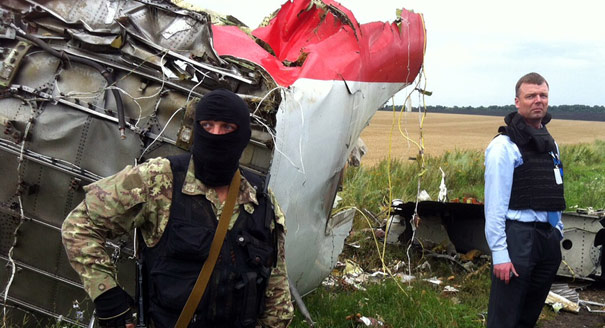
With the international investigation of the Malaysian plane crash yet to begin in earnest, the West will base its understanding on evidence supplied mainly by the United States and Russia will see Western actions as punishment not for shooting down the plane, but rather for Moscow’s position on Ukraine.
Source: WBUR’s Here and Now
The West says pro-Russian separatists in Eastern Ukraine fired a missile that brought down Malaysia Airlines flight MH17. Carnegie Moscow Center’s Dmitri Trenin spoke on WBUR with Here & Now’s Meghna Chakrabarti about the Russian point of view.Trenin noted that that President Putin views the situation with MH17 as extremely serious. “I think Putin is insisting on a very careful international investigation,” Trenin added. However, because “the international investigation has not begun in earnest,” actions of Western governments will be based on evidence supplied essentially by the United States, which Putin and other Russians will see as “sanctions and punishment not so much for the shooting down the plane, but rather for Russia’s position on Ukraine,” Trenin concluded.
Former Director, Carnegie Moscow Center
Trenin was director of the Carnegie Moscow Center from 2008 to early 2022.
Recent Work
Dmitri Trenin
Dmitri Trenin
Carnegie does not take institutional positions on public policy issues; the views represented herein are those of the author(s) and do not necessarily reflect the views of Carnegie, its staff, or its trustees.

In an interview, Rozina Ali discusses her new book on the rise and manifestations of Islamophobia in the United States.

Michael Young

In an interview, Ian Lustick and Eli Clifton discuss their new book on why a prominent ally has so much influence in America.
Michael Young

As the U.S. stumbles in its war with Iran, we are likely to see an acceleration of its disengagement from the region.
Michael Young

Middle Eastern states should welcome an accelerated U.S. disengagement from their region.
Michael Young

In an interview, former ambassador Charles Freeman assesses the Trump administration’s war against Iran.
Michael Young