

Paper
Yezid Sayigh
{
  "authors": [
    "Yezid Sayigh"
  ],
  "type": "legacyinthemedia",
  "centerAffiliationAll": "dc",
  "centers": [
    "Carnegie Endowment for International Peace",
    "Malcolm H. Kerr Carnegie Middle East Center"
  ],
  "collections": [],
  "englishNewsletterAll": "menaTransitions",
  "nonEnglishNewsletterAll": "",
  "primaryCenter": "Malcolm H. Kerr Carnegie Middle East Center",
  "programAffiliation": "MEP",
  "programs": [
    "Middle East"
  ],
  "projects": [],
  "regions": [
    "Gulf",
    "Israel",
    "Iraq",
    "Middle East"
  ],
  "topics": [
    "Political Reform",
    "Foreign Policy"
  ]
}
Source: Getty
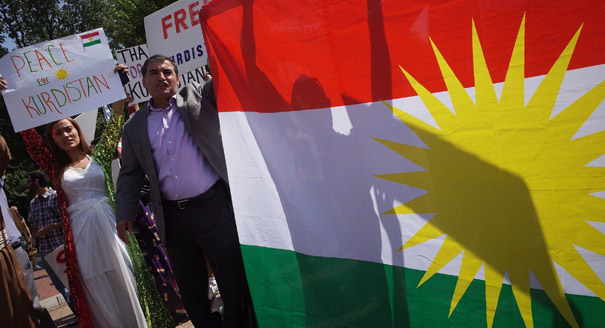
Israeli Prime Minister Benjamin Netanyahu has called for the creation of an independent Kurdish state. But why has Israel expressed support for Kurdish independence?
Source: Press TV
Israeli President Shimon Peres told U.S. President Barack Obama on June 25 that Iraq could not be kept together and asked for support for Kurdish independence. The next day, Israeli Foreign Minister Avigdor Lieberman told U.S. Secretary of State John Kerry in Paris that the establishment of an independent Kurdish state was probably inevitable.
In addition, Prime Minister Benjamin Netanyahu said, “We have to support the independence aspirations of the Kurds.” This was not the first time Israeli leaders have pushed for Kurdish independence. They have repeatedly echoed this line in the decade since the invasion of Iraq.
Historical relationships between some Kurdish factions and Israel go back to the early days of the Zionist project. Dividing the Middle East into countries of warring minorities can be traced back to the days of British colonialism and today Israel is at the forefront of making sure it happens.
To discuss Israel’s support for an independent Kurdistan and the separation of Kurdistan from Iraq, Press TV’s Middle East Files spoke with Carnegie’s Yezid Sayigh.

Senior Fellow, Malcolm H. Kerr Carnegie Middle East Center
Yezid Sayigh is a senior fellow at the Malcolm H. Kerr Carnegie Middle East Center in Beirut, where he leads the program on Civil-Military Relations in Arab States (CMRAS). His work focuses on the comparative political and economic roles of Arab armed forces, the impact of war on states and societies, the politics of postconflict reconstruction and security sector transformation in Arab transitions, and authoritarian resurgence.
Recent Work
Yezid Sayigh
Yezid Sayigh
Carnegie does not take institutional positions on public policy issues; the views represented herein are those of the author(s) and do not necessarily reflect the views of Carnegie, its staff, or its trustees.
As the U.S.-led Coalition withdraws, the Kurds’ reliance on Baghdad, and on themselves, will only increase.
Wladimir van Wilgenburg

In an interview, Ian Lustick and Eli Clifton discuss their new book on why a prominent ally has so much influence in America.

Michael Young

As the U.S. stumbles in its war with Iran, we are likely to see an acceleration of its disengagement from the region.
Michael Young
The Zaidi government’s objective to collect weapons is constrained by regional conflict, but it can take certain measures at home.
Ali Al-Mawlawi

It is improbable that Israel’s forthcoming elections will alter much in terms of how the country thinks about security.

Nathan J. Brown