

Research
- +6
Yasmine Farouk, Nathan J. Brown, Maysaa Shuja Al-Deen, …
{
  "authors": [
    "Michele Dunne"
  ],
  "type": "legacyinthemedia",
  "centerAffiliationAll": "dc",
  "centers": [
    "Carnegie Endowment for International Peace",
    "Malcolm H. Kerr Carnegie Middle East Center"
  ],
  "collections": [
    "Arab Awakening"
  ],
  "englishNewsletterAll": "menaTransitions",
  "nonEnglishNewsletterAll": "",
  "primaryCenter": "Carnegie Endowment for International Peace",
  "programAffiliation": "MEP",
  "programs": [
    "Middle East"
  ],
  "projects": [],
  "regions": [
    "North Africa",
    "Egypt"
  ],
  "topics": [
    "Political Reform",
    "Democracy"
  ]
}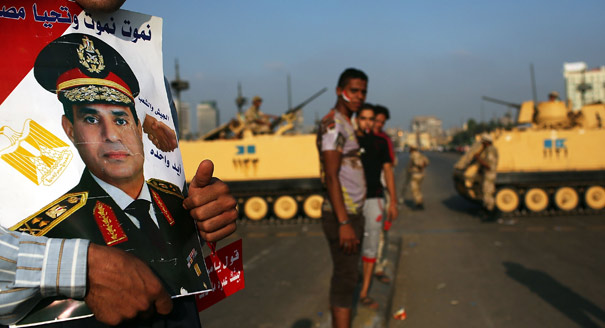
Source: Getty
The question is whether Egypt can stabilize the country and attract foreign investment needed to enliven the economy, while repressing all criticism of government policies from inside or outside and abandoning any semblance of the rule of law.
Source: Washington Post
“No reason, Madame, but you cannot access Egypt anymore,” the security officer at Cairo International Airport replied when I asked why I was being deported this month . As I arranged a return flight to Washington, the young Egyptian airline clerk asked my security escort why this apparently harmless lady was being deported; he told her in Arabic, “Her name is in the computer.” Airport security gave the same explanation to retired ambassador Amin Shalaby, the organizer of the Egyptian Council on Foreign Affairs conference I was invited to attend; he told a television program that “they said her name used to be on the watch list and now is on the no-entry list.”
Why would a think-tank scholar and former U.S. diplomat, who had traveled to Egypt frequently and recently, suddenly be barred? The Egyptian Ministry of Foreign Affairs claimed two days later that it was because I obtained my visa at the airport rather than at the embassy, a claim that was clearly specious. The border guard had stamped me in and let me enter, only to call me back when something apparently popped up on his monitor. American visitors routinely get Cairo airport visas for all sorts of travel (business and study, as well as tourism). I have 15 such visas in my passport, used for trips over the past seven years.
Could it be because my husband was one of 43 Americans and Egyptians involved in a June 2013 judgment against nongovernmental organizations? But I had visited Egypt several times since then, and my writing on the country, and concern about the implications of the lack of meaningful reforms, went back much further.On my many trips in researching Egyptian politics and economics, I met with officials, politicians, activists and business leaders. The country has fascinated me since I studied there in the 1980s and later served at the U.S. Embassy in Cairo. Increasingly troubled by its stagnation under President Hosni Mubarak, in early 2010 I helped form the Working Group on Egypt. This bipartisan group of scholars urged the Obama administration to take Egyptians’ popular demands for political and economic reform into account. The group recommended U.S. political and economic carrots to support the democratic transition that was promised after Mubarak’s 2011 ouster, as well as sticks after President Mohamed Morsi from the Muslim Brotherhood took anti-democratic steps in 2012. After popular disaffection with Morsi paved the way for a military coup in July 2013 that ended the democratic transition, followed by a bloody crackdown, the group called for application of the U.S. law that required suspending military assistance in such cases, a step the administration later took.
In my own research, I looked into the unprecedented human rights abuses, domestic terrorism and startling politicization of the once-respected judiciary that ensued. When Field Marshal Abdel Fatah al-Sissi was elected president, I recommended a new course for U.S. policy: Continue essential security cooperation but rebalance assistance toward the educational needs of Egypt’s restive youth.
My deportation provoked a flurry of debate in the Cairo media. While many Egyptian commentators accepted the foreign ministry’s line that I had tried to force my way into the country without proper documentation, a few prominent voices highlighted what the incident said about Egypt’s political trajectory. Lamees al-Hadidi, Egypt’s most popular (and assertively pro-Sissi) TV talk show host, posed two trenchant questions: Can Egypt be considered a law-respecting state if it varies its visa rules depending on whether the government likes or dislikes the visitor? And what does it mean if Egypt excludes foreign visitors whose views the government dislikes? “This is not North Korea,” she said.
Egypt is not North Korea, but my deportation is just the latest and least important of many steps toward an authoritarianism much nastier than that of the Mubarak era. I am safely at home, but there are an increasing number of Egyptian rights activists, journalists and politicians who have been forced into exile in the past several months and may never be able to return, not to mention thousands of political detainees in Egypt.
On the very day I left for Cairo, I had met with businesspeople from the American Chamber of Commerce in Egypt, several of them old friends, who had come to Washington to proclaim that Egypt was stabilizing and open for business. They were hoping to drum up interest from foreign investors in a high-profile economic conference planned for March.
The question is whether Egypt can do these things simultaneously: stabilize the country and attract foreign investment needed to enliven the economy, while repressing all criticism of government policies from inside or outside and abandoning any semblance of the rule of law. Some Egyptians point to Russia or China as models, but Egypt has neither Russia’s mineral wealth nor China’s more qualified labor force. It must ultimately unshackle the potential of its young and undereducated population, which will require opening the space to allow individual initiatives, ideas, and — yes — criticism that comes from those who wish the nation well, Egyptian and foreign alike.

Former Nonresident Scholar, Middle East Program
Michele Dunne was a nonresident scholar in Carnegie’s Middle East Program, where her research focuses on political and economic change in Arab countries, particularly Egypt, as well as U.S. policy in the Middle East.
Recent Work


Yasmine Farouk, Nathan J. Brown, Maysaa Shuja Al-Deen, …
Robert Springborg, Emile Hokayem, Becca Wasser, …
Carnegie does not take institutional positions on public policy issues; the views represented herein are those of the author(s) and do not necessarily reflect the views of Carnegie, its staff, or its trustees.

The armed forces champion a form of capitalism that is generating revenue, but its reliance on rent faces diminishing returns, leaving the country with massive sunk costs and deferred returns, deepening dependency on external borrowing.

Yezid Sayigh

This will be the region’s most representative tournament, amid broad changes in its footballing landscape.

Issam Kayssi
Understanding how farmers in the Oued Sahel-Soummam Valley grapple with climate change is essential for addressing the paradoxes through which adaptation, operating at both individual and institutional levels, deepens the region’s vulnerability and erodes the social fabric and agrarian identity that once defined life.
Ilyssa Yahmi

The recent African Cup of Nations tournament in Morocco touched on issues that largely transcended the sport.

Issam Kayssi, Yasmine Zarhloule
The UN Support Mission in the country should reassess its approach so that consensus between the warring parties becomes the eventual goal, rather than a procedural matter that dogs the negotiating process at every turn.
Soraya Rahem