

Commentary
As the U.S.-led Coalition withdraws, the Kurds’ reliance on Baghdad, and on themselves, will only increase.
Wladimir van Wilgenburg
{
  "authors": [
    "Mario Abou Zeid",
    "Mamoun Abu-Nowar",
    "Kamel Wazne"
  ],
  "type": "legacyinthemedia",
  "centerAffiliationAll": "dc",
  "centers": [
    "Carnegie Endowment for International Peace",
    "Malcolm H. Kerr Carnegie Middle East Center"
  ],
  "collections": [],
  "englishNewsletterAll": "menaTransitions",
  "nonEnglishNewsletterAll": "",
  "primaryCenter": "Malcolm H. Kerr Carnegie Middle East Center",
  "programAffiliation": "MEP",
  "programs": [
    "Middle East"
  ],
  "projects": [],
  "regions": [
    "Levant",
    "Syria",
    "Middle East"
  ],
  "topics": [
    "Political Reform",
    "Security"
  ]
}
Source: Getty
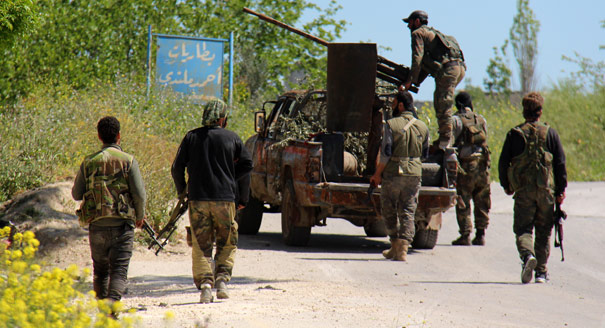
An alliance of opposition forces has seized control of a second strategic city from government troops.
Source: Al Jazeera’s Inside Story
A loose alliance of rebel groups in Syria is claiming a second significant victory against government forces in less than a month. The opposition offensive in northern Idlib province was spearheaded by al-Qaeda’s affiliate in Syria, Nusra Front. Fighting under the banner, “Army of Conquest,” rebel allies seized control of the provincial capital Idlib at the end of March.
A broader union of fighters says it has now overrun nearby Jisr al Shughur. The city was one of the first places to take up arms against president Assad, when security forces cracked down on protests.
The fight for Idlib province comes ahead of UN-backed talks in Geneva on May 4.
So can opposition groups present a united front in the push for peace? Or will the pursuit of different agendas eclipse the fight against a common enemy? Carnegie’s Mario Abou Zeid spoke with Al Jazeera’s Inside Story.
This interview was originally broadcast by Al Jazeera’s Inside Story.

Former Research Analyst, Middle East Center
Abou Zeid was a research analyst at the Carnegie Middle East Center, where his work focuses on political developments in Lebanon, Syria, Iraq, and Iran.
Mamoun Abu-Nowar
Kamel Wazne
Carnegie does not take institutional positions on public policy issues; the views represented herein are those of the author(s) and do not necessarily reflect the views of Carnegie, its staff, or its trustees.
As the U.S.-led Coalition withdraws, the Kurds’ reliance on Baghdad, and on themselves, will only increase.
Wladimir van Wilgenburg

As the U.S. stumbles in its war with Iran, we are likely to see an acceleration of its disengagement from the region.

Michael Young
The Zaidi government’s objective to collect weapons is constrained by regional conflict, but it can take certain measures at home.
Ali Al-Mawlawi

The accord represents a pivotal moment in the region to avert a security vacuum in the Gulf.


Azeema Cheema, Mohanad Hage Ali
In an interview, Jason Burke discusses his sweeping account of the “revolutionists” who so shaped the 1970s and early 1980s.
Michael Young