

In The Media
Lina Khatib
{
  "authors": [
    "Lina Khatib"
  ],
  "type": "legacyinthemedia",
  "centerAffiliationAll": "dc",
  "centers": [
    "Carnegie Endowment for International Peace",
    "Malcolm H. Kerr Carnegie Middle East Center"
  ],
  "collections": [],
  "englishNewsletterAll": "menaTransitions",
  "nonEnglishNewsletterAll": "",
  "primaryCenter": "Malcolm H. Kerr Carnegie Middle East Center",
  "programAffiliation": "MEP",
  "programs": [
    "Middle East"
  ],
  "projects": [],
  "regions": [
    "Levant",
    "Syria",
    "Middle East"
  ],
  "topics": [
    "Political Reform",
    "Security"
  ]
}
Source: Getty
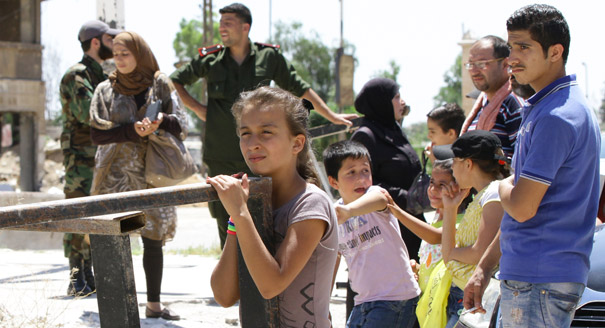
The self-proclaimed Islamic State’s takeover of the Yarmouk refugee camp is good for Bashar al-Assad.
Source: CNN
LINA KHATIB: I know it sounds counterintuitive, but actually, the Assad regime is not really very scared of ISIS. It’s more scared of the Nusra Front, which is an Islamist brigade fighting the regime, and the Free Syrian Army, which is gaining foothold in the south—not far from Yarmouk.ROBYN CURNOW, HOST: So, that’s specifically, I think the town of Daraa. So what you’re saying is that they’re hoping ISIS is going to take on the Free Syrian Army, rather than let the Syrians do it. Am I correct?
KHATIB: Yes, absolutely. So, by allowing ISIS to have access to the Yarmouk camp—because the regime enabled this indirectly by not interfering when ISIS took over the camp—the regime is counting on ISIS to divide the opposition existing within the camp, mainly the Nusra Front. And this has already happened, because some Nusra Front brigades are sympathetic to ISIS, while the majority of the Nusra Front is against ISIS, so it’s damaging the credibility of the Nusra Front. And also, Daraa is only 100 kilometers away from Yarmouk, and Daraa is where the Free Syrian Army is gaining more strength, and so it’s in the regime’s interest for these two entities to be threatened by ISIS.
CURNOW: And also, the sort of wider strategic play going on here. This also coincides with the fall of Idlib. How does that play into it and how the Syrian regime is seeing these two significant advances in the north and in the south by the rebels and by ISIS?
KHATIB: Idlib provides the backstory for why the regime is trying to divide Jabhat al-Nusra and weaken it and hurt its credibility. Because, the Nusra Front, or Jabhat al-Nusra, in Idlib managed to take the town from the regime, making it only the second urban city lost by the Assad regime, after Raqqa, where ISIS is headquarted. So, the regime is seeing that in the north, the Nusra Front is gaining more and more areas, and gaining popularity among Syrians, and in the south, a similar scenario is about to happen in Daraa, but with the Free Syrian Army. And it seems to me that there could be more collaboration between the Free Syrian Army and other rebel groups, such as the Nusra Front. So if that happens, of course the regime is going to have a lot more challenges in its way. So in a way, I think it is getting desperate, the Assad regime is resorting to using ISIS as a tool—not because it likes ISIS, but because it’s convenient, and it can do the dirty work for the regime, unfortunately.
Former Director, Middle East Center
Khatib was director of the Carnegie Middle East Center in Beirut. Previously, she was the co-founding head of the Program on Arab Reform and Democracy at Stanford University’s Center on Democracy, Development, and the Rule of Law.
Recent Work
Lina Khatib
Lina Khatib
Carnegie does not take institutional positions on public policy issues; the views represented herein are those of the author(s) and do not necessarily reflect the views of Carnegie, its staff, or its trustees.

As the U.S. stumbles in its war with Iran, we are likely to see an acceleration of its disengagement from the region.

Michael Young
The Zaidi government’s objective to collect weapons is constrained by regional conflict, but it can take certain measures at home.
Ali Al-Mawlawi

Huawei pushed hard to enter the Egyptian data centers market, until the Americans made a better offer.

Angie Omar

The accord represents a pivotal moment in the region to avert a security vacuum in the Gulf.


Azeema Cheema, Mohanad Hage Ali
In an interview, Jason Burke discusses his sweeping account of the “revolutionists” who so shaped the 1970s and early 1980s.
Michael Young