Source: Global Times
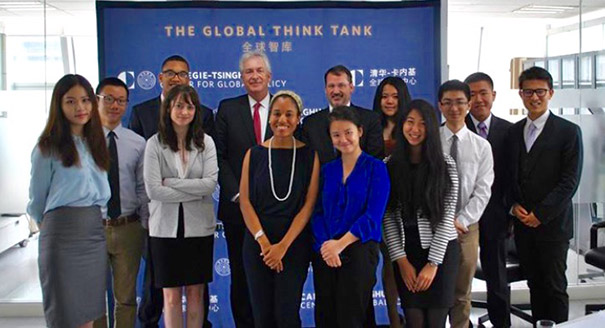
At last month’s 2016 US-China Consultation on People-to-People Exchange (CPE), the Carnegie–Tsinghua Center for Global Policy and other organizations were recognized for their pioneering efforts to cultivate the next generation of global leaders. Officially launched at the CPE, Carnegie-Tsinghua’s Young Ambassadors Program engages young leaders from China, the United States and around the world to develop tomorrow’s innovative leaders in policymaking, international business, academia and diplomacy. The center shares the CPE’s mission of strengthening people-to-people ties, and so we are honored that Carnegie-Tsinghua was chosen to join other like-minded organizations at this important forum for expanding cultural engagement between everyday Chinese and US citizens.
The center itself began in this same spirit of fostering cross-cultural leadership and collaboration. Six years ago, the Carnegie Endowment for International Peace and Tsinghua University identified a shared interest in building a platform in Beijing where experts from China and other countries could jointly research and discuss foreign policy issues. Bringing together the strengths of the oldest US foreign policy think tank and one of China’s most respected universities to advance this mission has proven to be a rewarding and important endeavor. The goal has been to improve understanding and trust across national borders, because the global challenges that we face can only be solved if China and the rest of the international community work together.
In Beijing, the Carnegie–Tsinghua Center and its Young Ambassadors embody the invaluable long-term impact and constructive engagement that people-to-people ties can contribute to overall diplomatic relations. The center’s flagship cultural exchange programs, the Global Intern Program and the US-China Trust Initiative, first began in 2010 and have gradually grown into what the Carnegie–Tsinghua Young Ambassadors Program is today.
Building on this track record of success, the Carnegie–Tsinghua Young Ambassadors Program seeks to further expand their impact going forward in collaboration with supporters who recognize the importance of this work. With the help of the program’s advisor, philanthropist and former basketball star Yao Ming, the Carnegie–Tsinghua Center engages hundreds of promising young people each year from countries including China and the United States, as well as Australia, Canada, France, Russia, Singapore, Spain, South Korea, and the UK.
These young people have firsthand opportunities to learn about and make concrete contributions to pressing foreign policy discussions. Each year, dozens of students and young professionals join the Global Intern Program and work closely with Carnegie–Tsinghua scholars and staff to publish research and host discussions on China’s growing influence in the international community and the evolution of its foreign policy agenda. The US-China Trust Initiative, meanwhile, brings together students from China and the United States to examine the root cause of mistrust between our two countries and identify ways we can build greater trust in the future.
The Carnegie–Tsinghua Center empowers its Young Ambassadors to contribute to the center’s policy work, and they in turn gain a host of skills that will serve them well throughout their professional lives. They acquire a deep and nuanced understanding of complex global challenges, such as nuclear nonproliferation, climate change, and sustainable economic development. They cultivate vital analytical skills such as conducting open-source research, drafting policy memos, and learning how foreign policy is influenced by think tanks in China and the United States. Carnegie–Tsinghua Young Ambassadors hone the language, communication, and leadership skills to leave a lasting, meaningful mark in a wide range of potential cross-cultural work environments. In the process, they exchange views with and form strong bonds with globally-minded peers from around the world, familiarize themselves with other countries’ differing perspectives on international issues, and interact with a world-class network of thought leaders and practitioners focusing on global affairs. In their time at the center, Carnegie–Tsinghua Young Ambassadors further develop the full tool set they need to serve as the next generation of global leaders.
China, the United States, and other countries throughout the world benefit immensely from these kinds of people-to-people exchange programs. Initiatives like the Carnegie–Tsinghua Young Ambassadors Program not only empower promising young leaders to advance professionally, but also prepare them for when they will be called on to help manage the multifaceted challenges that the international community will face in the future.
Carnegie–Tsinghua Young Ambassadors and Alumni are already playing important roles in businesses, government offices, media outlets, and universities around the world, and their Carnegie–Tsinghua experiences and relationships continue to inform their decision-making. The channels of cooperation that these young people are fostering will prove decisive in determining the success with which China, the United States, and the rest of the world can formulate and implement collaborative solutions to today's most pressing, common global challenges.
This is precisely why people-to-people exchanges like those highlighted at the CPE are so important to our present and future. They provide young people with the opportunities and resources necessary to step into their role as the next generation of global leaders. The future belongs to these promising young people—building greater mutual trust and enhancing international cooperation must start here.
This article was originally published by the Global Times.