

Q&A
Alper Coşkun, Amr Hamzawy
{
  "authors": [
    "Amr Hamzawy"
  ],
  "type": "legacyinthemedia",
  "centerAffiliationAll": "dc",
  "centers": [
    "Carnegie Endowment for International Peace"
  ],
  "collections": [],
  "englishNewsletterAll": "menaTransitions",
  "nonEnglishNewsletterAll": "",
  "primaryCenter": "Carnegie Endowment for International Peace",
  "programAffiliation": "MEP",
  "programs": [
    "Middle East"
  ],
  "projects": [],
  "regions": [
    "Middle East",
    "North Africa",
    "Egypt"
  ],
  "topics": [
    "Political Reform",
    "Democracy",
    "Civil Society"
  ]
}
Source: Getty
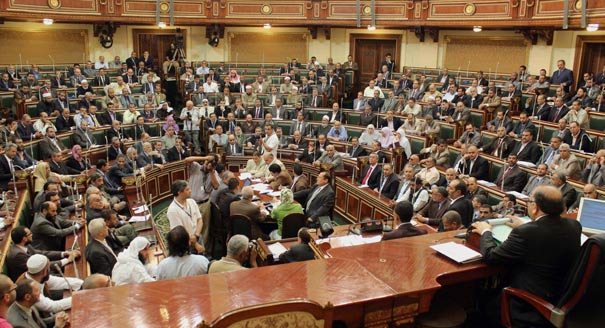
Despite the clear autocratic nature and the violations of basic human rights prevalent in many recently approved laws, the Egyptian parliament passed almost all of them with very little discussion.
Source: Washington Post
Recently, Egypt’s parliament has approved — without revision — almost all of the 342 presidential-decree laws issued by then-Interim President Adly Mansour and by President Abdel Fatah al-Sissi. Despite the clear autocratic nature and the violations of basic human rights prevalent in many of them, the parliament passed almost all of these laws with very little discussion — a testimony to how submissive the legislative branch is to executive power in Egypt and of the growing despotism of Sissi.
The “Organization of Lists of Terrorist Entities and Terrorists” law is particularly troubling. It defines acts of terrorism in an extremely broad manner that can be easily manipulated to pursue peaceful dissidents and to punish independent nongovernmental organizations. The legislation uses elusive phrases such as “preventing and impeding public authorities, disturbing public order, harming social peace, endangering the safety and interests of the community, and harming national unity and security.” It does not even relate acts of terrorism exclusively to the use of violent means or armed force. Rather, it refers to “any means.”The new law practically enables the government to curtail basic rights and freedoms under the banner of counterterrorism efforts. Peaceful assembly, expression of dissenting opinions and the formation of opposition political parties and independent NGOs are constitutionally guaranteed rights and freedoms, that can be undermined once the government classifies practicing them as acts of terrorism.
The law doesn’t necessitate a judicially proven connection with terrorist activities for a charge to be filed, and the procedures for inclusion on the list are done through what seems to be an opaque procedure between the public prosecution and the criminal court. The law doesn’t define the necessary documents to submit a request for placement on the list, and leaves all things “administrative” to the office of the public prosecutor and the Criminal Court of Appeals in Cairo. Affected parties cannot interfere with the question of placement on the list before it is executed, and this strips them of their constitutional legal right to defend themselves from the charges.
Furthermore, the law initiates a wide variety of draconian consequences without waiting for the outcome of an appeal. They include the banning of listed groups, halting of all organizational activities, closing of all locations, criminalization of meetings and freezing of assets and funds. Individuals placed on the terrorist list may be placed under a travel ban and can expect a cancellation of their passports, freezing of their funds and revocation of their constitutional right to run for and occupy public office.
Sissi’s government does not hide its distaste for opposition parties, independent NGOs and voices of dissent. It sees them as hostile entities and individuals conspiring to impose chaos on Egypt. Demands for the protection of human rights and freedoms are, according to Egyptian generals, Trojan horses pushed forward to make the country ungovernable. Since Sissi’s ascendancy to power following the 2013 military coup, his government has outlawed hundreds of NGOs, banned activists from travel and confiscated their assets, and ordered investigations and court proceedings against leading human rights organizations — most notably the Cairo Institute for Human Rights Studies and the Egyptian Initiative for Personal Rights.
Unfortunately, Western silence on Egypt’s authoritarianism continues. Western officials and politicians met with Sissi during the United Nations General Assembly in New York, including U.S. presidential nominees Hillary Clinton and Donald Trump. Sissi unmistakably thinks that his repression of civil society is tolerated — if not outright accepted — by the United States and Europe. They have yet to prove him wrong.
This article was originally published by the Washington Post.

Director, Middle East Program
Amr Hamzawy is a senior fellow and the director of the Carnegie Middle East Program. His research and writings focus on Egypt’s and other middle powers’ involvement in regional security in the Middle East, particularly through collective diplomacy and multilateral conflict resolution
Recent Work

Alper Coşkun, Amr Hamzawy

Sarah Yerkes, Natalie Triche, Amr Hamzawy
Carnegie does not take institutional positions on public policy issues; the views represented herein are those of the author(s) and do not necessarily reflect the views of Carnegie, its staff, or its trustees.

As the U.S. stumbles in its war with Iran, we are likely to see an acceleration of its disengagement from the region.

Michael Young

The accord represents a pivotal moment in the region to avert a security vacuum in the Gulf.


Azeema Cheema, Mohanad Hage Ali

In an interview, Jason Burke discusses his sweeping account of the “revolutionists” who so shaped the 1970s and early 1980s.
Michael Young

The armed forces champion a form of capitalism that is generating revenue, but its reliance on rent faces diminishing returns, leaving the country with massive sunk costs and deferred returns, deepening dependency on external borrowing.

Yezid Sayigh

This will be the region’s most representative tournament, amid broad changes in its footballing landscape.
Issam Kayssi