

Article
C. Raja Mohan, Darshana M. Baruah
{
  "authors": [
    "C. Raja Mohan"
  ],
  "type": "legacyinthemedia",
  "centerAffiliationAll": "dc",
  "centers": [
    "Carnegie Endowment for International Peace",
    "Carnegie India"
  ],
  "collections": [],
  "englishNewsletterAll": "ctw",
  "nonEnglishNewsletterAll": "",
  "primaryCenter": "Carnegie India",
  "programAffiliation": "SAP",
  "programs": [
    "South Asia"
  ],
  "projects": [],
  "regions": [
    "Asia",
    "South Asia",
    "India",
    "North America",
    "United States",
    "East Asia"
  ],
  "topics": [
    "Foreign Policy",
    "Global Governance"
  ]
}
Source: Getty
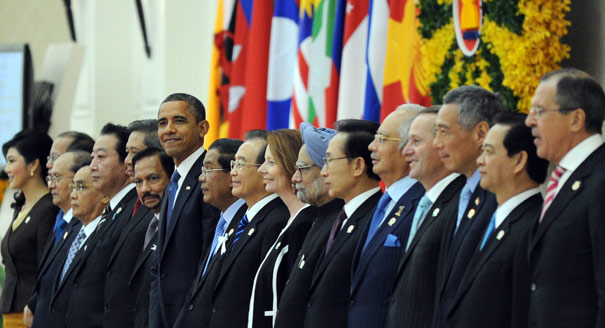
In the past, the contestation in Europe drove world politics. It looks as though it may be Asia that now has agency in shaping the future of the world.
Source: Indian Express
From 1905, when Japan defeated Russia, the prospect of Asia overwhelming the dominant Western powers was a powerful dream for the emerging Asian nationalists. Japan, however, was clearly an exception rather than the rule. Its route to rise through reform, modernization and Westernization seemed quite difficult for its Asian neighbors.
Although the interrelationship between Westernization and modernization was always a contested one, it has been quite central to the evolution of modern Asia. The idea of “Easternisation”, the title of Gideon Rachman's book, is, therefore, quite catchy.
Many would challenge the proposition that there is such a thing. After all, we still don't have the East as an alternative idea to the West. Some would note the fact that Asia is not “emerging”, it is merely “re-emerging”. China and India were the world's largest economies at the turn of the 19th century.
If we put aside the quarrel over Rachman's terminology, it is easy to enjoy his insightful account of Asia's rise as the dominant theater of world politics in the 21st century. In the past, the contestation in Europe drove world politics. Rachman now argues it is Asia that has agency in shaping the future of the world.
This was not the way the world looked at the end of the Second World War. Although the war paved the way for the break-up of colonial empires, the prospects for postcolonial Asia looked dim. The Chinese leader Mao Zedong's claim that the “east wind will prevail over the west” was seen as slogan-mongering rather than realistic.
As China savaged itself during the Cultural Revolution, India teetered on the precipice of famine, and insurgencies gripped most of Southeast Asia, many Western observers wrote off Asia in the 1960s. Yet two decades later, a different picture began to emerge. The Asian economic miracle began with the rise of the Tiger economies in Northeast Asia, followed by Southeast Asia. China's economic reforms from the late 1970s and India's from the early 1990s completed the transformation of Asia and altered the economic balance between the East and the West.
Rachman brings a fresh perspective to this story, which has been told before. To Western audiences unable to accept the rise of the East, Rachman underlines that the old order cannot be sustained. At the same time, he cautions the triumphalists in the East not to get carried away. For a rising Asia, Rachman points out, is also a deeply conflicted Asia.
Rachman reminds those in the West hoping that China and India will trip up on their way up and allow Western primacy to continue that the rise of the West was punctuated by extreme crises, including the civil war in the US and the two World Wars. At the same time, Rachman points to the deep internal fault lines within the two Asian giants — China and India — as well as the inter-state conflicts that have sharpened in recent years with Beijing's rise.
In an important argument, Rachman highlights the enduring institutional advantages of the West. The dollar and international law—commercial and political——remain the greatest strengths of the West and are not going to be replaced any time soon. While there are attempts to create non-Western institutions and systems, Rachman argues that the institutional edge of the US, UK and EU will “help preserve the global reach of the Western nations even as wealth moves east”.
“But retaining the West's institutional integrity will require tremendous self-discipline on the part of American and European leaders… If Western institutions are used too overtly as a source of political power favoring the US and EU, they will risk losing their attractiveness to the rest of the world.” The concluding section of the book looks beyond the East-West divide to assess how the emergence of common problems, like climate change and cyber security, demand cooperative international solutions.
Rachman, chief foreign affairs columnist for the Financial Times, writes with great felicity and walks the reader through the complex arguments about Asia's rise. For the author, the power shift is not an academic question; he relates it to policy debates in different parts of the world, especially in Washington and Beijing. This is but natural, given the centrality of the US-China relationship for the future of Asia and the world. He points to the reluctance of most Asian countries to accept Chinese hegemony and their support for a strong American presence in the region. “A resolute American stance in the Pacific might then buy time for internal changes in China that would make Beijing's power seem less threatening to other Asian nations.” Perhaps.
Rachman, who points to the dangers of American isolationism and obsessive Chinese nationalism, helps think through the potential pathways in which Asia's rise could evolve. That makes Rachman's volume more than a good read.
Former Nonresident Senior Fellow, Carnegie India
A leading analyst of India’s foreign policy, Mohan is also an expert on South Asian security, great-power relations in Asia, and arms control.
Recent Work

C. Raja Mohan, Darshana M. Baruah


Alexander Gabuev, Paul Haenle, C. Raja Mohan, …
Carnegie does not take institutional positions on public policy issues; the views represented herein are those of the author(s) and do not necessarily reflect the views of Carnegie, its staff, or its trustees.

In an interview, Ian Lustick and Eli Clifton discuss their new book on why a prominent ally has so much influence in America.

Michael Young

As the U.S. stumbles in its war with Iran, we are likely to see an acceleration of its disengagement from the region.
Michael Young

Huawei pushed hard to enter the Egyptian data centers market, until the Americans made a better offer.

Angie Omar

Middle Eastern states should welcome an accelerated U.S. disengagement from their region.
Michael Young

In an interview, former ambassador Charles Freeman assesses the Trump administration’s war against Iran.
Michael Young