

Paper
Ashley J. Tellis
{
  "authors": [
    "Ashley J. Tellis"
  ],
  "type": "legacyinthemedia",
  "centerAffiliationAll": "dc",
  "centers": [
    "Carnegie Endowment for International Peace"
  ],
  "collections": [],
  "englishNewsletterAll": "ctw",
  "nonEnglishNewsletterAll": "",
  "primaryCenter": "Carnegie Endowment for International Peace",
  "programAffiliation": "SAP",
  "programs": [
    "South Asia"
  ],
  "projects": [],
  "regions": [
    "North America",
    "United States",
    "South Asia",
    "India",
    "Pakistan",
    "East Asia",
    "China"
  ],
  "topics": [
    "Foreign Policy"
  ]
}
Source: Getty
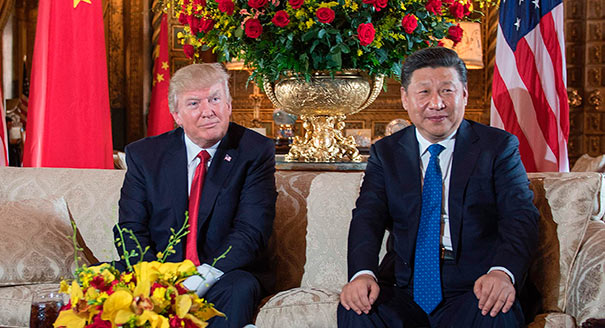
President Trump and Xi Jinping must focus on building personal chemistry and having an honest discussion of their world views.
Source: CGTN
Speaking on CGTN’s The Point, moderated by Liu Xin, Carnegie’s Ashley Tellis argued that during Xi Jinping’s visit with Donald Trump, the two leaders should focus on building personal chemistry and a general understanding of their worldviews.
He went on to discuss how an improving relationship between the United States and China can bring stability to the region, which could benefit countries like India. Right now, countries feel torn between the two nations, but there are opportunities to be gained from maintaining an economic relationship with both.
That being said, Tellis continued, Trump’s “America First,” strategy could cause challenges for many in the region, especially in terms of bilateral economic relations, as the United States may begin requiring more reciprocity. But on average, he said, India will likely gain from “America First,” because there is a general consensus that maintaining a good relationship with India is essential for maintaining balance in Asia.
Tellis concluded by arguing that China is likely perceived as a greater threat in India than it actually is, and that all countries must be open about their plans and actions to build trust in the region.
Former Senior Fellow
Ashley J. Tellis was a senior fellow at the Carnegie Endowment for International Peace.
Recent Work
Ashley J. Tellis
Ashley J. Tellis
Carnegie does not take institutional positions on public policy issues; the views represented herein are those of the author(s) and do not necessarily reflect the views of Carnegie, its staff, or its trustees.

In an interview, Rozina Ali discusses her new book on the rise and manifestations of Islamophobia in the United States.

Michael Young

In an interview, Ian Lustick and Eli Clifton discuss their new book on why a prominent ally has so much influence in America.
Michael Young

As the U.S. stumbles in its war with Iran, we are likely to see an acceleration of its disengagement from the region.
Michael Young

Middle Eastern states should welcome an accelerated U.S. disengagement from their region.
Michael Young

In an interview, former ambassador Charles Freeman assesses the Trump administration’s war against Iran.
Michael Young