

Commentary
Yukon Huang, Isaac B. Kardon, Matt Sheehan
{
  "authors": [
    "Yukon Huang"
  ],
  "type": "legacyinthemedia",
  "centerAffiliationAll": "dc",
  "centers": [
    "Carnegie Endowment for International Peace",
    "Carnegie China"
  ],
  "collections": [
    "U.S.-China Relations"
  ],
  "englishNewsletterAll": "asia",
  "nonEnglishNewsletterAll": "",
  "primaryCenter": "Carnegie China",
  "programAffiliation": "AP",
  "programs": [
    "Asia"
  ],
  "projects": [],
  "regions": [
    "North America",
    "United States",
    "East Asia",
    "China",
    "Western Europe"
  ],
  "topics": [
    "Economy",
    "Trade",
    "Foreign Policy"
  ]
}
Source: Getty
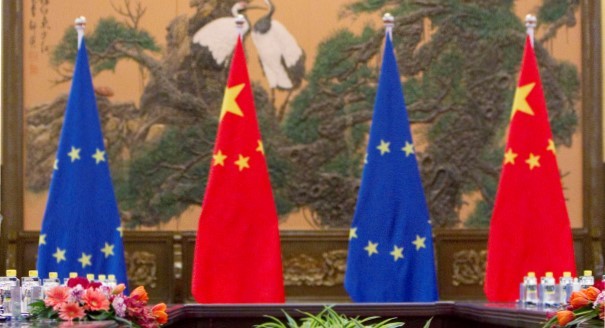
While the EU and the United States have similar barriers to entry, EU investments in China have grown more rapidly.
Source: Financial Times
Trade and currency issues have dominated the Trump administration’s economic agenda with China. The 100-day plan agreed at Mar-a-Lago between Donald Trump and Xi Jinping will focus on moderating the bilateral trade imbalance. But President Trump’s campaign rhetoric on China as a currency manipulator has given way to the evidence that China has actually been propping up the value of the renminbi.
Mr Trump’s moves towards imposing tariffs on steel imports show that potential for conflict over trade remains. However, the more important economic concern has to do with Beijing’s restrictive foreign investment regime, which has a negative impact on both the US and the EU.
Populist sentiment suggests too much American foreign direct investment is going to China, to the detriment of US employment and trade. Yet, surprisingly, despite these being the two largest economies and trading nations, over the past decade only about 1-2 per cent of America’s FDI has been going to China. In contrast, around 20 per cent of South Korean and Japanese FDI is to China. So the real question is: why does America invest so little in China?
Data deficiencies partly explain the low numbers since much of the global flows of foreign investment are channelled through tax havens that blur their origins. But country comparisons help neutralise this distortion. Consider the EU, which in economic size (gross domestic product of $18tn) and bilateral trade with China ($500bn-plus) is comparable to the US. Over the past decade, the EU’s annual flows of FDI to China have been roughly double those of the US, or about 4 per cent of its total, although they began that period at around the same level. A Rhodium comparison using reported transactions covering 2008-2011 shows the EU is also investing much more in China in both manufacturing and services.
Though China presents a large and potentially attractive market, its lack of natural resources relative to its population, security concerns and weak property rights enforcement are seen as reasons for the low FDI from the US. But, given similar barriers to entry, why has EU investment in China grow more rapidly?
The answer is that the EU’s economic strengths in manufacturing have been more complementary to China’s market needs. The EU’s top exports to China are dominated by machinery and transport as well as products targeted at high-end consumers and industrial companies. These sectors lead to FDI flows to support market penetration and servicing, and the establishment of localised production capacity.
In comparison, the top three categories of US exports to China over the past decade and a half have been oilseed and grain, followed by aerospace products and then — surprisingly — recycled waste (scrap metal and discarded paper). None of these categories has led to significant FDI — hardly surprising for food products and recycled waste. For aerospace products, until recently Boeing has refrained from opening operations in China while Europe’s Airbus has had manufacturing centres in China since 2008 and has expanded production as China expands domestic flight services.
In automobile imports, which have only become significant in recent years, much of the recent surge from the US to China is, ironically, accounted for by European luxury branded SUVs such as Audi and Mercedes. These are made in the US but given Beijing’s tax policies can be imported at a lower price than those made in China and the related FDI is counted as European rather than American.
Trade relations with China illustrate how composition matters in shaping FDI flows. Manufacturing imports and investment are largely welcomed in China’s domestic market and cater better to EU strengths, while China’s closed services sector has a more negative effect on the US where higher value services, notably in IT and finance, are more important. Furthermore, many big American companies with a visible presence in China, such as fast food brands — including McDonald’s — and hotel chains, operate as franchises where the US companies do not own the local affiliates but license them, thus they do not necessarily show up in the official FDI figures.
The problem is illustrated by the OECD’s ranking of China as having one of the most restrictive foreign investment regimes for services, especially in communications, telecoms, law, insurance and finance — precisely the areas of greatest interest to American companies.
Bilateral investment treaties have been under negotiation for many years between Beijing and both the US and EU. But discussions with the EU have been disrupted by Brexit and the Trump administration is resistant to an agreement that would encourage American companies to invest more abroad. Yet, for many American and European businesses operating in or hoping to operate in China, liberalising China’s FDI policies would create commercial opportunities that would generate more jobs at home. Thus, moving forward with a bilateral investment treaty should be high on the agenda for both the US and EU.

Senior Fellow, Asia Program
Huang is a senior fellow in the Carnegie Asia Program where his research focuses on China’s economy and its regional and global impact.
Recent Work


Yukon Huang, Isaac B. Kardon, Matt Sheehan
Yukon Huang, Genevieve Slosberg
Carnegie does not take institutional positions on public policy issues; the views represented herein are those of the author(s) and do not necessarily reflect the views of Carnegie, its staff, or its trustees.

As talks begin between Washington and Tehran, Beirut has an opening to advance a regional plan for the party’s disarmament.

Michael Young
What is behind Marco Rubio’s announcement that the body is now an international nongovernmental organization?

Zaha Hassan
Policy discussion is ignoring that the Palestinian national project is hollowed out and apartheid is a present danger.

Nathan J. Brown

As negotiations with Iran and Lebanon continue, chaos is at the heart of the Netanyahu government’s calculations.
Michael Young

The party’s domestic and regional roles have changed, so Lebanon should devise a disarmament strategy that encompasses this.
Michael Young