

Commentary
By failing to address Palestinian representation, the current process is bound to lead to just another temporary arrangement.
Nathan J. Brown
{
  "authors": [
    "Paul Haenle",
    "Qingguo Jia",
    "Yukon Huang",
    "Chen Qi",
    "Claire Reade",
    "Chen Dingding"
  ],
  "type": "other",
  "centerAffiliationAll": "",
  "centers": [
    "Carnegie Endowment for International Peace",
    "Carnegie China"
  ],
  "collections": [
    "U.S.-China Relations",
    "China’s Foreign Relations",
    "Carnegie China Commentaries"
  ],
  "englishNewsletterAll": "",
  "nonEnglishNewsletterAll": "",
  "primaryCenter": "Carnegie China",
  "programAffiliation": "",
  "programs": [],
  "projects": [],
  "regions": [
    "North America",
    "United States",
    "East Asia",
    "China"
  ],
  "topics": [
    "Economy"
  ]
}
Source: Getty
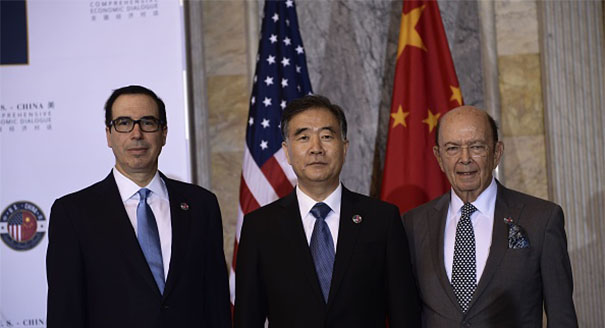
What are the outcomes of the dialogue and what are the implications for economic relations between the two countries? Six Scholars from China and the United States give their insights.
On July 19, the first round of the U.S.-China Comprehensive Economic Dialogue took place in Washington. It was the first meeting covering economic and trade issues under the newly established U.S.-China Comprehensive Dialogue mechanism agreed to at the April summit between President Trump and Xi Jinping. What are the outcomes of the dialogue and what are the implications for economic relations between the two countries? Six Scholars from China and the United States give their insights.
To request an interview, please contact Wanyi Du at wdu@ceip.org.
“At the most recent Comprehensive Economic Dialogue, the United States was disappointed with Chinese cooperation on economic and trade issues, specifically the reduction of steel output, causing the delegation led by Secretaries Ross and Mnuchin to walk away without reaching agreement on deliverables. While U.S. press coverage of the dialogue painted it as failing to achieve progress, U.S. officials also denied the Chinese side a "process" win of holding a joint press conference hailing the dialogue's success. This was a reality check for China, which thought that marginal progress on low hanging fruit would be enough to placate the United States. It has also injected a dose of realism in the Trump administration about the limits of Chinese cooperation, particularly in the lead up to the 19th Party Congress. The stark differences between the glowing Chinese press coverage of the Comprehensive Economic Dialogue and the negative U.S. reporting of it are reflective of the different political environments currently defining Washington and Beijing.”
—Paul Haenle, Director, Carnegie–Tsinghua Center for Global Policy
"The results of the first U.S.-China Comprehensive Economic Dialogue are by no means a surprise. The two sides’ positions are way apart. However, there is no reason to be alarmed. The stakes are too high for the two sides to get into a trade war. That is why the two sides agreed to continue to talk. Ultimately, it is more likely that the two sides will reach a compromise than engage in a trade war. "
—Jia Qingguo, Dean, School of International Studies, Peking University
“The failure to issue a joint statement at the conclusion of the U.S.-China CED reflects the wide divide between how the two parties see bilateral trade and investment issues. The United States sees China’s huge bilateral trade surplus as the major reason for its huge trade deficits while China sees its surpluses as the consequence of transitioning from a middle to high-income economy that will eventually lead to a more balanced outcome. China has recognized the need to liberalize the access of foreign companies to its domestic market as requested by U.S. firms but sees the need for a more gradual process than their U.S. counterparts have been advocating.”
—Yukon Huang, Senior Fellow, Asia Program, Carnegie Endowment for International Peace
“As the first comprehensive economic dialogue between China and the United States came to an end, officials’ and public opinion of the results showed the vast differences in expectations. While this created obstacles for developing a result-oriented U.S.-China trade relationship, it also produced a clear consensus to push for improvements in economic and trade relations. A win-win situation and balanced economic and trade relationship require policy adjustments from both sides and mutual efforts. Avoiding no-win situations such as a confrontation is one of the most pressing challenges in the upcoming months.”
— Chen Qi, Resident Scholar, Carnegie–Tsinghua Center for Global Policy
“Both sides had a stake in demonstrating on July 19 that the CED process works. The lack of any announced progress at the summit raises a number of different questions: Was there a breakdown in process or ineffective selling of the deal to the president on the U.S. side? Did China miscalculate how much it needed to move to make a deal? And most importantly, what will happen next? The circumstances may create U.S. leverage for more progress, given China’s interest in keeping foreign relations stable through the Chinese leadership transition in the fall and President Trump’s planned visit to China. But there are limits. China seems unlikely in the near term to take actions as bold or systemic as those in the 3rd Plenum Decision. And even if U.S. leaders are irritated at the lack of strong enough progress, I am sure the U.S. president knows that China is very efficient at retaliating if it feels wronged, and a major economic rift with China would blow back quickly on the U.S. economy. We may shortly see high profile, industry-specific restrictions coming from the U.S. side, but let us also hope for quiet talks that result in helpful changes to policies that distort the operation of the market.”
—Claire Reade, Senior Associate, Center for Strategic and International Studies
“The dialogue produced effective results while also exposing challenging problems. One of the achieved results includes China agreeing to import rice from the United States. But one of the challenging problems that surfaced is the lack of major adjustments to the current economic imbalance between China and the United States. Of course, it’s important for us to realistically look at things as most of the problems in such a complex and crucial bilateral economic relationship cannot be solved with one dialogue; the correct path is to continue the in-depth conversation. As China and the United States continue to build mutual economic interdependence, there is no other way but to cooperate.”
— Chen Dingding, Professor, Jinan University

Former Maurice R. Greenberg Director’s Chair, Carnegie China
Paul Haenle held the Maurice R. Greenberg Director’s Chair at the Carnegie Endowment for International Peace and is a visiting senior research fellow at the East Asian Institute, National University of Singapore. He served as the White House China director on the National Security Council staffs of former presidents George W. Bush and Barack Obama.
Qingguo Jia

Senior Fellow, Asia Program
Huang is a senior fellow in the Carnegie Asia Program where his research focuses on China’s economy and its regional and global impact.

Chen Qi
Former Resident Scholar , Carnegie-Tsinghua Center for Global Policy
Chen Qi was a resident scholar at the Carnegie-Tsinghua Center until June 2020.
Claire Reade
Claire Reade is a senior associate with the Freeman Chair in China Studies at the Center for Strategic and International Studies and senior counsel at Arnold & Porter in Washington, D.C.
Chen Dingding
Carnegie does not take institutional positions on public policy issues; the views represented herein are those of the author(s) and do not necessarily reflect the views of Carnegie, its staff, or its trustees.

By failing to address Palestinian representation, the current process is bound to lead to just another temporary arrangement.

Nathan J. Brown

The armed forces champion a form of capitalism that is generating revenue, but its reliance on rent faces diminishing returns, leaving the country with massive sunk costs and deferred returns, deepening dependency on external borrowing.

Yezid Sayigh

Morocco and Algeria, each in its own way, are having to navigate the global economic fallout of the U.S.-Israeli military campaign against Iran.

Yasmine Zarhloule
Any move by the United States to make good on Trump’s suggestion that Washington persuade Damascus to confront Hezbollah militarily would have catastrophic consequences.

Kheder Khaddour

As talks begin between Washington and Tehran, Beirut has an opening to advance a regional plan for the party’s disarmament.

Michael Young