

Article
Cara Abercrombie
{
  "authors": [
    "Cara Abercrombie"
  ],
  "type": "legacyinthemedia",
  "centerAffiliationAll": "dc",
  "centers": [
    "Carnegie Endowment for International Peace",
    "Carnegie India"
  ],
  "collections": [],
  "englishNewsletterAll": "ctw",
  "nonEnglishNewsletterAll": "",
  "primaryCenter": "Carnegie Endowment for International Peace",
  "programAffiliation": "SAP",
  "programs": [
    "South Asia"
  ],
  "projects": [],
  "regions": [
    "South Asia",
    "India",
    "Russia",
    "United States"
  ],
  "topics": [
    "Security",
    "Military",
    "Foreign Policy"
  ]
}
Source: Getty
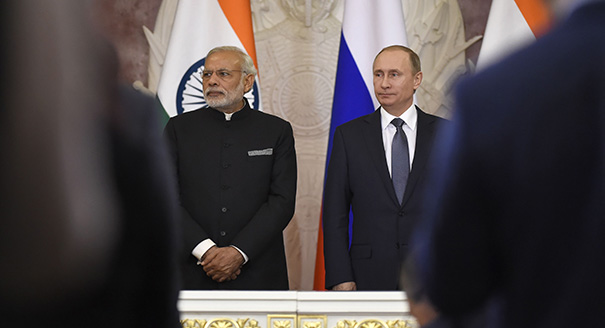
India may soon close a deal with Russia to purchase two S-400 air defense systems, thereby triggering secondary sanctions from the United States. Without Congressional action, the U.S.-India defense relationship will likely suffer.
Source: Axios
India may close a major defense deal with Russia as early as next week, when Indian Defense Minister Nirmala Sitharaman will make her first trip to Moscow. The deal covers two S-400 air defense systems, which include radar, missile launchers and command center technology.
Why it matters: In August 2017, President Trump signed into law the Countering America’s Adversaries through Sanctions Act (CAATSA) against Russia. Because the sanctions target any country trading with Russia's defense and intelligence sectors, India's pending deal may put it on a collision course with the U.S.
The background: Approximately 60% of India’s defense inventory is Russian-made, a legacy of India’s Cold War–era relationship with the Soviet Union. While the U.S. has become its second largest defense supplier — mainly of aircraft and artillery — India still relies heavily on Russian equipment, such as submarines and missiles, that the U.S. has been unwilling to provide.
India has good reason to want high-end weapons systems: It is the only country in the world that has contested borders with two nuclear neighbors — Pakistan and China — and has fought wars with both. Forcing India to abruptly cut off Russian supplies would create unacceptable risk to India's self-defense. If forced to choose between a robust, well-equipped military and U.S. goodwill, India would likely choose the former.
What's next: These sanctions, like penalties the U.S. imposed after India's nuclear tests in the 1990s, would sour relations. At worst, they could stoke domestic backlash and close off U.S. defense sales to India for the foreseeable future. Given bipartisan support for the U.S.–India defense relationship, Congress should grant India waiver authority under CAATSA. Without waivers, other important regional partners, like Vietnam and Indonesia, are also likely to trigger sanctions.
The bottom line: India warrants an exemption from these secondary sanctions, as does any country with which the U.S. is forging new and strategically important defense relations.
Former Visiting Scholar, South Asia Program
Cara Abercrombie was a visiting scholar with Carnegie’s South Asia Program. She focuses on U.S. security interests in Asia, particularly opportunities for greater U.S.-India defense cooperation.
Recent Work
Cara Abercrombie
Carnegie does not take institutional positions on public policy issues; the views represented herein are those of the author(s) and do not necessarily reflect the views of Carnegie, its staff, or its trustees.

In an interview, Rozina Ali discusses her new book on the rise and manifestations of Islamophobia in the United States.

Michael Young

In an interview, Ian Lustick and Eli Clifton discuss their new book on why a prominent ally has so much influence in America.
Michael Young

As the U.S. stumbles in its war with Iran, we are likely to see an acceleration of its disengagement from the region.
Michael Young

Middle Eastern states should welcome an accelerated U.S. disengagement from their region.
Michael Young

In an interview, former ambassador Charles Freeman assesses the Trump administration’s war against Iran.
Michael Young