• Research
  • Diwan
  • About
  • Experts
Carnegie Middle East logoCarnegie lettermark logo
LebanonIran
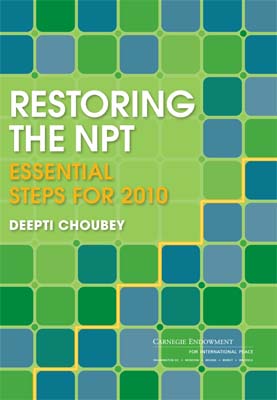
Restoring the NPT: Essential Steps for 2010
Report

Restoring the NPT: Essential Steps for 2010

The upcoming 2010 Non-Proliferation Treaty Review Conference is an opportunity to strengthen the struggling nonproliferation regime, but achieving even modest success will require the political cooperation of nuclear and non-nuclear-weapon states.

Link Copied
By Deepti Choubey
Published on Nov 16, 2009

Additional Links

Full TextSummary

With growing fears about Iran and North Korea’s nuclear programs, conventional wisdom holds that the nonproliferation regime is on the verge of collapse. The upcoming 2010 Non-Proliferation Treaty (NPT) Review Conference is an opportunity to strengthen the regime, but it is in danger of being overloaded by expectations.

Deepti Choubey identifies achievable goals for the Review Conference and outlines steps that nuclear-weapon states—including recommendations tailored for the United States—and non–nuclear-weapon states should take to avert failure.

Recommendations:

  • All states should recognize that restoring the NPT is a joint endeavor—each state’s security is affected by the outcome of nonproliferation efforts, so all states have a stake in fixing problems. States must raise the political profile of the Review Conference and engage NGOs that can provide expertise and create accountability.
     
  • The United States should secure domestic and international support for its agenda to reduce and eliminate nuclear dangers by demonstrating how all of the elements of that agenda are mutually reinforcing and imperative. The United States must reconcile its Nuclear Posture Review with its NPT commitments.
     
  • Non–nuclear-weapon states should seize the window of opportunity opened by President Obama’s forward-leaning leadership. These states must reconcile policy inconsistencies, choose friends wisely, and plan for the future by anticipating what progress on disarmament will mean for them. 


“Averting failure and achieving some modest success at the 2010 NPT Review Conference will require action by all states—nuclear-weapon states and non-nuclear-weapon states alike,” says Choubey. “Although ambitious steps are welcome, small steps will do.”

About the Author

Deepti Choubey

Former Deputy Director, Nuclear Policy Program

Choubey was previously the director of the Peace and Security Initiative for the Ploughshares Fund. She also worked for Ambassador Nancy Soderberg in the New York office of the International Crisis Group.

    Recent Work

  • Q&A
    Understanding the 2010 NPT Review Conference

      Deepti Choubey

  • Article
    Defining Success for the NPT Review Conference

      Deepti Choubey

Deepti Choubey
Former Deputy Director, Nuclear Policy Program
Deepti Choubey
North AmericaUnited StatesMiddle EastEast AsiaChinaCaucasusRussiaWestern EuropeNuclear PolicyNuclear Energy

Carnegie does not take institutional positions on public policy issues; the views represented herein are those of the author(s) and do not necessarily reflect the views of Carnegie, its staff, or its trustees.

More Work from Malcolm H. Kerr Carnegie Middle East Center

  • Commentary
    Diwan
    The United States and Iran Have Agreed to a Two-Week Ceasefire

    Spot analysis from Carnegie scholars on events relating to the Middle East and North Africa.

      Michael Young

  • Commentary
    Diwan
    Iran Rewrites Its War Strategy

    In an interview, Hamidreza Azizi discusses how Tehran has adapted in real time to the conflict with the United States and Israel.

      Michael Young

  • Commentary
    Diwan
    Trump’s Plan for Gaza Is Not Irrelevant. It’s Worse.

    The simple conclusion is that the scheme will bring neither peace nor prosperity, but will institutionalize devastation.

      Nathan J. Brown

  • Commentary
    Diwan
    What Does the Strait of Hormuz’s Closure Mean?

    In an interview, Roger Diwan discusses where the global economy may be going in the third week of the U.S.-Israeli war with Iran.

      Nur Arafeh

  • Commentary
    Diwan
    Tehran’s Easy Targets

    In an interview, Andrew Leber discusses the impact the U.S. and Israeli war against Iran is having on Arab Gulf states.

      Michael Young

Get more news and analysis from
Malcolm H. Kerr Carnegie Middle East Center
Carnegie Middle East logo, white
  • Research
  • Diwan
  • About
  • Experts
  • Projects
  • Events
  • Contact
  • Careers
  • Privacy
  • For Media
Get more news and analysis from
Malcolm H. Kerr Carnegie Middle East Center
© 2026 Carnegie Endowment for International Peace. All rights reserved.




